8:00AM - 6:00PM
Monday to Saturday
Monday to Saturday
+971 52 856 0299
Hor Al Anz


By Emarati Consultancy | ISO Certification Consultant Experts in UAE | Updated 2026
If you supply goods or services to ADNOC, any Abu Dhabi government entity, Mubadala, Aldar Properties or any of the 31-plus organisations participating in the UAE National ICV Programme — you need an ICV certificate. Without one your tender submission receives a score of zero in the ICV evaluation. And in competitive ADNOC tender evaluations where technical proposals are comparable, a zero ICV score is the difference between winning and losing a contract worth millions of dirhams.
This guide explains exactly what ICV certification is, why Abu Dhabi contractors need it in 2026, how the scoring system works, what Gold and Silver and Bronze tiers mean for your tender outcomes and the seven strategies that legitimately improve your score before your next certification cycle.
ICV stands for In-Country Value. It is the measure of how much economic value a company creates within the UAE — through local employment, spending with UAE-registered suppliers, investing in UAE-based assets, hiring and developing Emirati talent and reinvesting profits within the country.
The National ICV Programme was launched by ADNOC in 2018 and expanded nationwide by the Ministry of Industry and Advanced Technology — MoIAT — in 2021. It now operates as a unified national framework that applies across all UAE emirates and all sectors — not just oil and gas. More than 31 government and semi-government entities participate, including ADNOC and all its subsidiaries, the Abu Dhabi Department of Economic Development, Aldar Properties, Mubadala and the Emirates Nuclear Energy Corporation.
An ICV certificate is the official document issued by a MoIAT-approved certifying body confirming your company’s ICV score for a specific financial year. This score is calculated from your audited financial statements using the official MoIAT scoring formula — not self-declared and not estimated. It is independently verified, third-party audited and publicly reflected in your procurement standing with every participating entity simultaneously.
ADNOC has approved AED 551 billion in capital expenditure for the 2026 to 2030 period. Of that, AED 220 billion is explicitly committed to channelling value into the UAE economy through the ICV programme over the next five years. This is not a corporate sustainability commitment or a government aspiration. It is a procurement framework that determines which suppliers win contracts from that AED 220 billion and which do not.
Every contract within that procurement pipeline requires a valid ICV certificate from qualifying suppliers. Companies with no ICV certificate are excluded before technical evaluation begins. Companies with low ICV scores are systematically disadvantaged in commercial evaluation. Companies with high ICV scores receive meaningful tender preference.
If your business operates in Abu Dhabi’s construction, oil and gas, engineering, maintenance, logistics, technology, healthcare, catering or any other sector that supplies to ADNOC or Abu Dhabi government entities — the ICV programme determines your access to the largest sustained infrastructure spending programme in the UAE.
Most discussions of ICV certification focus on the score number. What they miss is how ADNOC categorises and uses those scores in tender evaluation through a tiered system that directly affects commercial outcomes.
ADNOC categorises ICV certificates into performance tiers based on the certified score. During the commercial review of tender submissions bidders with higher ICV certification levels — Gold tier — receive stronger preference than those with Silver or Bronze tier scores. Companies with no certificate receive zero preference and effectively no ICV score at all.
Understanding which tier your current or projected score places you in is commercially important — because moving from Bronze to Silver, or from Silver to Gold, has measurable impact on your tender competitiveness across every ADNOC submission simultaneously.
Under ADNOC’s 2026 Industrial Resilience Program, contractors and suppliers with strong local sourcing can earn additional ICV credit through a new ICV+ initiative. This makes a well-prepared ICV certificate even more commercially valuable when competing for ADNOC’s significant project award pipeline for 2026 to 2028. Companies that invest in optimising their ICV submissions — not just obtaining a certificate — gain access to this additional credit that competitors relying on basic certification miss entirely.
Your ICV score is calculated from six categories of economic contribution using the official MoIAT formula applied to your IFRS-audited financial statements.
Total employee cost — salaries, benefits and allowances — for all employees based in UAE is included in the ICV formula. UAE national employees generate significantly higher ICV contribution per dirham of salary than expatriate employees — reflecting the national priority of Emiratisation. MoIAT is targeting 10 percent Emirati representation in skilled roles at certified companies by the end of 2026, and the scoring formula heavily rewards genuine Emirati roles with real salaries, training records and career progression rather than token headcount on payroll.
Spending on goods and services sourced from UAE-registered suppliers generates direct ICV contribution. Critically the ICV contribution of your supplier spending is weighted by your suppliers’ own ICV certificate scores. Spending with an ICV-certified UAE supplier is credited at that supplier’s certified percentage — meaning a supplier with a 70 percent ICV score contributes more to your ICV calculation per dirham of spending than an uncertified supplier with a zero default score. This creates a powerful commercial incentive to buy from ICV-certified suppliers and is one of the most overlooked score improvement strategies available.
Investment in technology transfer to UAE entities, funding of local research and development activities and the training of UAE national employees in technical skills and professional competencies generates ICV contribution in this component. Companies with formal Emiratisation development programmes — rotations, mentoring, professional qualifications funding — consistently generate higher scores in this component than those with informal development activities.
The net book value of assets your company owns and operates within UAE — machinery, equipment, vehicles, IT infrastructure and property — generates ICV contribution through depreciation calculated within the ICV formula. Companies with significant UAE-based asset bases consistently generate stronger scores in this component — creating an additional commercial argument for capital investment in UAE operations rather than relying on imported or rented equipment.
Spending on UAE-registered third parties — subcontractors, specialist service providers, maintenance companies, logistics operators and professional services firms — generates ICV contribution, again weighted by those third parties’ own ICV certificate scores. This component rewards companies that build genuinely UAE-based supply chains rather than routing work through international entities with UAE offices.
Profits retained within the UAE economy — through reinvestment in UAE operations, assets or employment rather than repatriation overseas — generate ICV contribution in this final component. For UAE-registered subsidiaries of international groups the profit allocation and reinvestment accounting must correctly reflect actual UAE economic contribution to claim this component accurately.
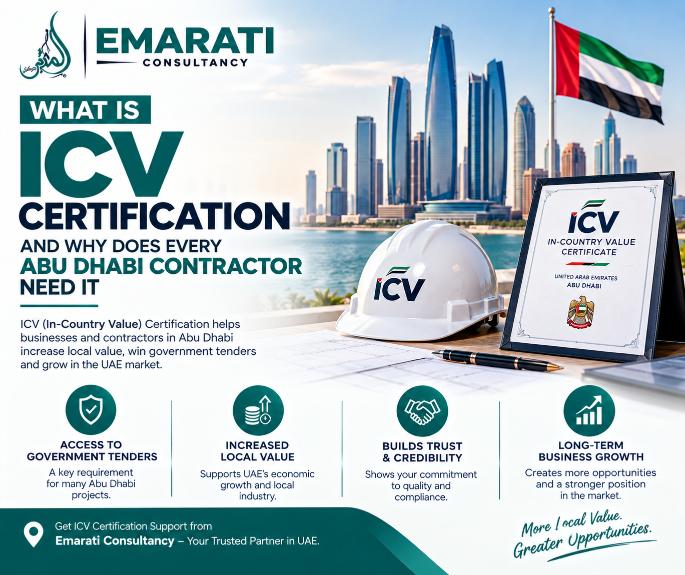
This is the commercial reality that most Abu Dhabi contractors understand intuitively but few have seen quantified clearly.
Without a valid ICV certificate your company receives a score of zero in the ICV evaluation component of every ADNOC and Abu Dhabi government tender you submit. A zero ICV score does not prevent submission — but it places you at a systematic and measurable commercial disadvantage compared to every certified competitor in the same evaluation.
Consider two construction contractors bidding on an Abu Dhabi infrastructure contract. Their technical proposals are equivalent. Their commercial prices are comparable. Contractor A has an ICV score of 65 percent — Silver tier. Contractor B has no ICV certificate — zero score. The ICV evaluation preference that Contractor A receives from its Silver tier certification directly influences the commercial evaluation outcome. Contractor B is competing with one hand tied behind its back.
Now extend this across every tender submission over a year — and across every participating entity beyond ADNOC. The cumulative commercial cost of not having an ICV certificate, across an active Abu Dhabi contractor submitting 10 to 20 tenders per year, is not a minor commercial inconvenience. It is a systematic exclusion from the competitive tier that wins contracts.
The most common misconception about ICV certification in UAE is that it is an oil and gas contractor requirement. It is not. Here is the complete picture of who needs ICV certification.
Main contractors bidding directly on ADNOC and Abu Dhabi government contracts need ICV certification for direct tender participation. Subcontractors to main contractors increasingly need it because main contractors — whose own ICV scores are partly determined by their subcontractors’ ICV scores — prefer or require ICV-certified subcontractors in their supply chain. The ICV programme is cascading down through supply chains across all sectors as main contractors optimise their own scores by sourcing from certified suppliers.
Technology companies, IT service providers, software developers, cybersecurity firms and digital services businesses supplying to ADNOC, Abu Dhabi government entities or any other participating organisation need ICV certification. The Abu Dhabi Department of Economic Development’s participation in the programme means that virtually any technology contract with an Abu Dhabi government entity carries an ICV evaluation component.
Medical device companies, pharmaceutical suppliers, hospital facility management companies and healthcare technology providers supplying to SEHA, Department of Health Abu Dhabi facilities or ADNOC’s medical services function need ICV certification for their procurement qualification.
Catering contractors, housekeeping companies, security services providers and integrated facility management businesses supplying to ADNOC facilities, Abu Dhabi government buildings or entities participating in the national programme need ICV certification as part of their supplier qualification.
Training companies, professional certification bodies and management development providers supplying to ADNOC’s learning and development function or Abu Dhabi government training procurement need ICV certification — with particular ICV score benefit from programmes that develop UAE national employees.
Free zone companies can obtain ICV certification and participate in ADNOC and Abu Dhabi government tenders using their ICV certificates. Free zone companies eligible for ICV certification must correctly allocate local value within UAE jurisdiction — including staff based in UAE, assets located in UAE and procurement from UAE-registered suppliers — to maximise their score within the free zone operational framework.
Your ICV score is recalculated every certification cycle from your audited financial statements. The decisions you make during this financial year directly determine the score on your next certificate. Here are seven legitimate strategies that genuinely improve scores.
UAE national employees generate the highest per-employee ICV contribution in the formula. Genuine Emirati recruitment — with real salaries, real responsibilities and real career development — is the highest-impact single action available for most companies seeking score improvement. Token Emiratisation — UAE nationals on payroll without genuine roles — is visible to MoIAT reviewers and carries integrity risk alongside minimal score benefit.
Since spending with ICV-certified suppliers is credited at their certified score percentage, replacing uncertified UAE suppliers with ICV-certified equivalents generates immediate ICV score improvement without changing your total spending levels. Conduct a procurement audit identifying which of your current UAE suppliers hold ICV certificates — and for suppliers that do not, consider whether comparable certified alternatives exist.
Review your import spend by category and identify where UAE-registered suppliers offer commercially viable alternatives. Every dirham shifted from international procurement to UAE-registered suppliers generates ICV contribution — with additional benefit if those UAE suppliers themselves hold high ICV scores.
Review your asset register for completeness of UAE-located assets. Equipment, machinery, vehicles and IT infrastructure located and used in UAE generate ICV contribution through depreciation. Companies that have assets in UAE that are not properly documented in their asset register leave ICV score points unclaimed in every certification cycle.
Spending on training, professional development, professional qualifications and skills certification for UAE national employees generates ICV contribution in the technology transfer component. Many companies invest in Emirati development but fail to maintain the training records, cost documentation and competency evidence needed to claim full credit in their ICV template. Systematic training record-keeping is low-cost score improvement.
One of the most common causes of ICV score undercount is incorrect cost categorisation in the MoIAT template. UAE-registered supplier spending incorrectly categorised as international, third-party services incorrectly excluded from the local spend calculation, asset costs misclassified or depreciation incorrectly calculated — all reduce your verified score below what your actual economic contributions justify. Professional template completion by an experienced ICV consultant consistently recovers score points that self-prepared templates miss.
For main contractors with significant subcontractor spend, transitioning subcontractor relationships to ICV-certified entities directly improves your ICV score. The ICV credit from subcontractor spending is weighted by the subcontractor’s own ICV score — making ICV-certified subcontractors more commercially valuable to your ICV calculation than uncertified ones at equivalent pricing.
ICV certification and ISO certification are separate but commercially inseparable requirements for ADNOC vendor registration and Abu Dhabi government procurement qualification. Understanding how they interact is essential for any Abu Dhabi contractor planning their full procurement qualification portfolio.
ISO certification — particularly QHSE IMS combining ISO 9001, ISO 14001 and ISO 45001 — demonstrates that your company manages quality, environment and safety to internationally recognised standards. ADNOC requires it for vendor registration as a mandatory management system compliance document.
ICV certification demonstrates that your company creates measurable economic value within the UAE. ADNOC incorporates it into commercial tender evaluation as a scored preference factor.
A company with excellent ISO certification but no ICV certificate fails in commercial evaluation through zero ICV score. A company with excellent ICV score but no ISO certification fails at vendor registration through missing management system compliance. Both are required for ADNOC supply chain participation. Both should be managed as part of a single integrated ADNOC qualification programme.
Emarati Consultancy now provides both ISO certification and ICV certification under one roof — the only UAE consultancy offering the complete ADNOC procurement qualification package.
QHSE IMS certification UAE ,
ISO certification in Abu Dhabi
| Company Size | Total All-Inclusive Cost | Timeline |
|---|---|---|
| Small — up to 30 employees | AED 4,500 — 7,500 | 2 to 4 weeks |
| Medium — 30 to 150 employees | AED 7,500 — 12,500 | 3 to 6 weeks |
| Large — 150+ employees | AED 12,500+ | 4 to 8 weeks |
All-inclusive figures cover MoIAT platform fee, MoIAT-approved certifying body verification fee and Emarati Consultancy preparation support. Annual renewal costs approximately 70 to 80 percent of initial certification cost. ICV certificates are valid for 14 months from the date of the audited financial statements.
ICV — In-Country Value — certification is the official measure of how much economic value a company creates within UAE through local employment, procurement, investment and Emiratisation. The National ICV Programme is governed by the Ministry of Industry and Advanced Technology — MoIAT — and applies across all UAE emirates and sectors. ICV certificates are issued by MoIAT-approved certifying bodies based on independently verified audited financial statements. ADNOC originated the programme in 2018 and it expanded to a national framework in 2021.
ICV certification is not legally mandatory for all UAE businesses. However companies bidding on contracts with ADNOC, Abu Dhabi government entities or any of the 31-plus participating organisations receive a score of zero in the ICV evaluation without a valid certificate — which in competitive tender evaluations is effectively disqualification. For any company actively participating in ADNOC or Abu Dhabi government procurement ICV certification is commercially mandatory even if not legally required.
ICV scores above 40 percent are considered competitive for ADNOC tender evaluations. Scores above 70 percent are strong and place your company in the upper tier of ICV performance. Top performing UAE companies consistently achieve scores of 80 to 90 percent. ADNOC categorises certificates into Gold, Silver and Bronze tiers — with Gold tier certificates receiving the strongest tender evaluation preference. Understanding which tier your score places you in — and what changes would move you to the next tier — is the most commercially actionable insight from any ICV assessment.
Your ICV score is calculated from six components using the official MoIAT formula applied to your IFRS-audited financial statements — local manpower and Emiratisation costs, local procurement and supplier spending weighted by suppliers’ own ICV scores, technology transfer and local development investment, capital investment and UAE-based asset depreciation, third-party and subcontractor spending in UAE weighted by their ICV scores, and reinvested profits within UAE. The formula is applied by a MoIAT-approved certifying body that independently verifies your claimed contributions against supporting documentation.
ICV certification from engagement start to certificate issued typically takes 2 to 6 weeks depending on the completeness of your financial documentation. Companies with well-organised audited financial statements and complete procurement and payroll records typically complete the process in 2 to 3 weeks. Companies with documentation gaps that require resolution before submission take longer. Emarati Consultancy assesses your documentation readiness in the free initial consultation and provides a realistic timeline estimate before you commit to anything.
Yes — your ICV score is recalculated every certification cycle from your audited financial statements. Actions taken during this financial year directly affect your score on your next certificate. The seven strategies with the most consistent impact are increasing UAE national hiring in genuine skilled roles, switching to ICV-certified UAE suppliers, sourcing locally where international alternatives exist, documenting UAE-based assets correctly, recording all UAE national training investment, correcting procurement cost categorisation in the MoIAT template and engaging ICV-certified subcontractors. Emarati Consultancy provides ICV score improvement assessments that quantify the impact of each strategy for your specific situation.
Subcontractors do not always directly require ICV certification to participate in their subcontract work. However main contractors whose own ICV scores are partly determined by their subcontractors’ ICV scores increasingly prefer or require ICV-certified subcontractors — because spending with ICV-certified suppliers is credited at the supplier’s certified percentage rather than at zero. A subcontractor with a 65 percent ICV score generates significantly more ICV contribution to the main contractor’s calculation than an uncertified subcontractor. This makes ICV-certified subcontractors commercially preferable and increasingly competitive in main contractor supply chain selection.
Yes. The National ICV Programme applies across all UAE emirates — not just Abu Dhabi. Companies registered in Dubai, Sharjah, RAK, Ajman, Fujairah and Umm Al Quwain can obtain ICV certification and use their certificate to bid on qualifying contracts with all participating entities across UAE. One ICV certificate per legal entity is valid across all participating entities simultaneously — regardless of which emirate the company is registered in or which emirate the participating entity is located in.
ADNOC’s AED 220 billion ICV commitment over the next five years represents one of the largest sustained procurement opportunities in the world for UAE-registered businesses. The contractors and suppliers competing most effectively for that opportunity are those that hold high-scoring ICV certificates — verified by MoIAT-approved certifying bodies, optimised through professional template preparation and renewed annually to maintain uninterrupted tender eligibility.
Emarati Consultancy provides ICV certification consultancy across all seven UAE emirates — combining our deep knowledge of ISO certification and ADNOC procurement qualification with specialist ICV assessment, MoIAT template preparation and annual renewal management. Whether you are obtaining your first ICV certificate, renewing an existing one or looking to improve your score for an upcoming major ADNOC tender submission — we provide the expertise, documentation support and strategic guidance to maximise your commercial outcome.
Phone: +971 52 856 0299
Email: info@emaraticonsultancy.ae
Office: City Bay Business Centre, Office 303, Near Abu Bakr Metro Station, Dubai, UAE
Looking for reliable ISO renewal services in the UAE? Our specialists in Dubai, Abu Dhabi, and Sharjah help you align your OHSMS with updated ISO 45001 requirements, ensuring continuous compliance and smooth recertification.
The great explorer of the truth, the master-builder of human happiness no one rejects dislikes avoids pleasure itself because it is pleasure but because know who do not those how to pursue pleasures rationally encounter consequences that are extremely painful desires to obtain.
Read More