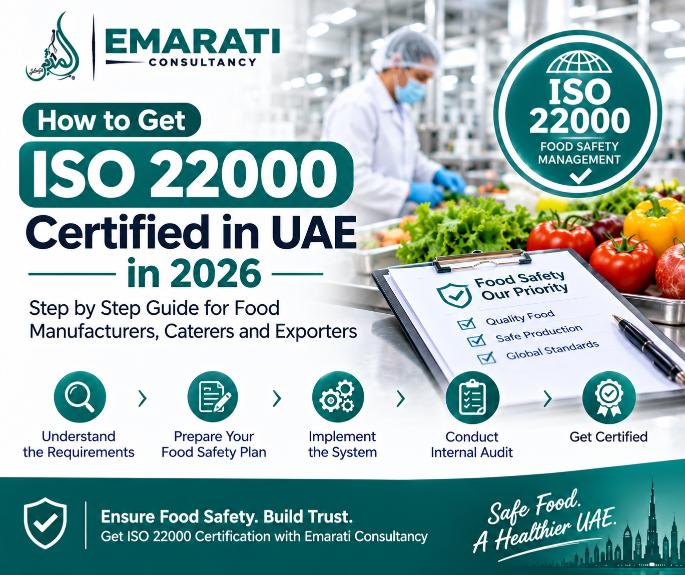
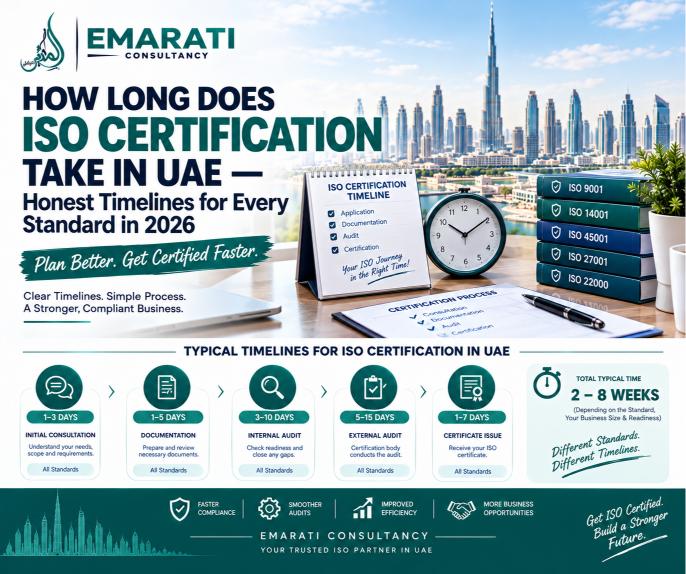
How to Get ISO 22000 Certified in UAE in 2026: Step by Step Guide for Food Manufacturers, Caterers and Exporters
By Emarati Consultancy | ISO Certification Consultant Experts in UAE | Updated 2026
Most UAE food businesses do not need ISO 22000, and the ones that do usually find out when a client asks for it. A hotel group asks its catering supplier for a certified food safety management system. An importer in Europe asks a manufacturer for proof beyond a HACCP plan. A procurement team qualifying a packaging supplier asks for an audited certificate. At that point the question becomes: how do we get ISO 22000 certified, how long will it take and what will it cost?
This guide answers all three. It starts with an honest check on whether you need ISO 22000 or whether HACCP is enough. It then walks through the 12 steps to certification, with 2026 AED costs and realistic timelines. It also covers three things competitor guides skip: the climate change requirement already in force, how to choose the right prerequisite programme standard, and what the upcoming revision means for your certificate.
ISO CERTIFICATION IN UAE
Do You Actually Need ISO 22000? An Honest Answer First
ISO 22000 is not a legal requirement for UAE food businesses. UAE food safety regulation expects a HACCP-based system, and Dubai Municipality and ADAFSA inspect against that expectation. ISO 22000 is a commercial requirement. You need it because a client, market or supply chain asks for it, not because an inspector does.
You probably need ISO 22000 if you are:
- A food manufacturer or processor supplying hotel groups, airlines, institutional buyers or large retailers that audit their suppliers
- A catering company or central kitchen supplying multiple sites, events or international hotel brands
- A food packaging manufacturer supplying food producers
- A cold chain, storage or food logistics operator whose clients require a certified system
- A food exporter whose importers ask for a full food safety management system rather than HACCP alone
- An ingredient or additive supplier to other food manufacturers
You probably do not need ISO 22000 if you are:
- A single-site restaurant, cafe or food truck serving walk-in customers (HACCP is usually the right level)
- A small food business with no client or export requirement asking for more
If you are in the second group, read our guide to getting HACCP certified in UAE instead. We would rather tell you that now than sell you a certificate you do not need.
What ISO 22000 Is and How It Differs From HACCP
ISO 22000 is the international standard for food safety management systems. It combines the key elements of food safety along the food chain, including interactive communication, system management and prerequisite programmes. The current edition is ISO 22000:2018, and it applies to any organisation in the food chain, from farms and manufacturers to packaging, transport, catering and retail. iso
HACCP is one component inside it. ISO 22000 adds the management system around HACCP:
| Element | HACCP | ISO 22000 |
|---|
| Hazard analysis and CCPs | Yes | Yes |
| Prerequisite programmes | Yes, as supporting controls | Yes, formally required and selected |
| Operational PRPs (OPRPs) | Not used | Yes, a distinct control category |
| Leadership, policy, objectives | Not required | Required |
| Internal communication with suppliers and customers | Limited | Required, formally managed |
| Emergency preparedness and response | Limited | Required |
| Traceability, withdrawal and recall | Basic | Formally required |
| Internal audit and management review | Not required | Required |
| Fits with ISO 9001, ISO 14001, ISO 45001 | No | Yes, shared structure |
The point most competitor guides miss is the OPRP. ISO 22000 splits hazard controls into Critical Control Points and Operational Prerequisite Programmes. A control that cannot sensibly have a measurable critical limit, such as certain cleaning or allergen segregation controls, becomes an OPRP. Getting this classification right is one of the most technical parts of implementation.
ISO 22000 certification UAE
Three Things Most ISO 22000 Guides in UAE Do Not Tell You
1. The climate change requirement is already in force
In February 2024 ISO published Amendment 1 to ISO 22000:2018. It adds a sentence to Clause 4.1: the organisation shall determine whether climate change is a relevant issue. It also adds a note to Clause 4.2 that relevant interested parties can have requirements related to climate change. ascfoodsafetyascfoodsafety
In practice you must document your assessment of whether climate change is relevant to your food safety management system. For food businesses the realistic issues are temperature-driven pathogen risk, supply disruption, water availability for cleaning and cold chain reliability during extreme heat. Even if you conclude it is not significant, the assessment must be recorded. A blank context analysis is an easy finding for an auditor. This applies to every ISO 22000 certificate, whether you are certifying for the first time or already certified.
2. You must choose a prerequisite programme standard, and the series was updated in 2025
Prerequisite programmes (PRPs) are the hygiene and operational foundation under your hazard controls: premises, cleaning, pest control, supplier control, personnel hygiene, transport, storage and so on. ISO 22000 expects you to base them on an appropriate sector standard. The ISO 22002 series has parts for different parts of the food chain, so a bakery, a central kitchen, a packaging plant and a cold store each use a different part.
The ISO 22002 series was released in updated form in July 2025, with new requirements including food safety culture, food defence, food fraud, biosecurity and strengthened supplier approval. Choosing the right part for your food chain category, and the right edition for your certification route, is a step we make with every client at the start. The wrong choice means rework mid-project. Substack
3. ISO 22000 is being revised, so what happens to your certificate?
The draft of the third edition, ISO/DIS 22000, will replace ISO 22000:2018. Early commentary on the draft points to food safety culture, food defence and food fraud prevention becoming explicit requirements, alongside alignment with the common management system structure. isoglobalstd
What this means for you:
- Certify to ISO 22000:2018 now. It remains the current valid standard, and your certificate is fully accepted by clients and buyers.
- Expect a transition period once the new edition is published, as with every ISO revision. Certification bodies will announce the deadlines. Draft details may change before publication.
- Do not delay certification to wait for the new edition. Waiting costs you the contracts you need the certificate for today, and a system built well on the 2018 edition transitions far more easily than starting from nothing later.
How to Get ISO 22000 Certified in UAE: The 12 Steps
Step 1: Confirm the right standard for your commercial objective
Ask which client, market or contract requires this certificate and what exactly they accept. Hotel and airline buyers may accept ISO 22000. Many large international retail buyers require a GFSI-recognised scheme, and ISO 22000 on its own is not one. FSSC 22000 is the GFSI-endorsed standard built on ISO 22000 with additional requirements. Choosing wrongly here means paying twice. Substack
FSSC 22000 certification UAE
Step 2: Define your scope and food chain category
Define which sites, products, processes and activities the certificate will cover, and which food chain category you fall into: manufacturing, catering, packaging, transport and storage, retail and so on. Scope determines your PRP standard, your audit duration and what appears on the certificate. A scope that is too narrow may not satisfy your client. Check the buyer’s requirement before you finalise it.
Step 3: Select your PRP standard
Choose the ISO 22002 part that matches your food chain category, and confirm the edition with your certification body. See the section above for why this matters.
Step 4: Run a gap analysis
Compare your current practices against ISO 22000:2018 and your chosen PRP standard. If you already hold HACCP, much of your hazard analysis carries over, and the gaps are usually the management system elements: policy, objectives, communication, emergency response, traceability and recall, internal audit and management review.
Step 5: Form your food safety team and set policy and objectives
Appoint a food safety team leader with real authority and a multidisciplinary team covering production, quality, procurement, maintenance and logistics. Top management must issue a food safety policy and set measurable objectives. Auditors check that leadership is involved, not just that a policy exists.
Step 6: Complete the hazard analysis and classify controls
For every product and process, identify biological, chemical, physical and allergen hazards, assess significance and decide the control for each: PRP, OPRP or CCP. Define action criteria for OPRPs and critical limits for CCPs, and validate that your control measures actually work. This is the most technical step. A generic template cannot do it, because it must reflect your recipes, equipment and layout.
Step 7: Develop the documented information
This covers the food safety policy, scope, process flows, hazard analysis, HACCP or control plan, PRP procedures, traceability and recall procedure, emergency response procedure, supplier control, internal audit procedure and the records the standard requires. Document how you really operate, in language your staff use.
Step 8: Implement and generate records
Deploy the system on the production floor and keep running it. Auditors want evidence that the system has operated, which means monitoring logs, verification records, supplier approvals, cleaning records and training records spanning a period, not a single week. One certification body advises you to operate the system for some time and document the process before inviting a certification body. This operating period is the main reason ISO 22000 takes longer than HACCP. SIS Certifications
Step 9: Train your people
Everyone in scope needs food safety awareness training for their role. Staff with CCP or OPRP duties need specific training. Auditors interview operators and ask what they do when a limit is exceeded. Build training into onboarding, because staff turnover in UAE food operations is high and untrained new starters are a common finding.
Step 10: Conduct an internal audit and a management review
Audit the whole system against the standard, close every non-conformity, then hold a documented management review. Both must be completed before the external audit. A superficial internal audit leaves the findings for the external auditor.
Step 11: Choose an accredited certification body and complete Stage 1 and Stage 2
Choose a certification body whose accreditation is verifiable on the EIAC register for food safety management systems, and confirm that your client accepts its certificates. Food safety certification bodies work to the ISO 22003 series, which sets requirements for bodies providing food safety conformity assessment. Stage 1 reviews your documentation and readiness. Stage 2 is the on-site audit of implementation, including a walk through production, staff interviews and record sampling. iso
Step 12: Receive your certificate and maintain it
The certificate is valid for three years with annual surveillance audits. Keep your climate change assessment, PRPs, supplier approvals and training current throughout, and watch for the revision transition announcements.
ISO certification process UAE
ISO 22000 Certification Cost in UAE: 2026 Figures
| Business Size | Typical Profile | All-Inclusive Cost (AED) |
|---|
| Small | Up to 30 employees, single site | 6,000 to 10,000 |
| Medium | 30 to 150 employees | 10,000 to 18,000 |
| Large | 150+ employees or multi-site | 18,000 and above |
All-inclusive means Emarati Consultancy fees and certification body audit fees together. Your cost moves with the number of sites, process complexity, number of product lines, existing HACCP maturity and the PRP standard that applies. Businesses already holding HACCP pay less because the hazard analysis foundation is in place. Annual surveillance audits cost less than initial certification.
ISO certification cost UAE
How Long Does ISO 22000 Take in UAE?
| Business Size | Implementation Timeline |
|---|
| Small | 4 to 8 weeks |
| Medium | 8 to 14 weeks |
| Large or multi-site | 14 to 20 weeks |
You will see other sources quoting 3 to 6 months. The difference is mostly the operating period. Our ranges assume a business with some existing food safety practice, a committed team and an experienced consultant, and they measure from engagement start. A business starting from nothing, or one that needs a long records period before audit, will sit toward the top of these ranges or beyond them. Certification body scheduling also adds time that you cannot compress, so book your audit slot early. almaerifah
ISO 22000 vs HACCP vs FSSC 22000: Choosing the Level
| Your Situation | Recommended Standard |
|---|
| Restaurant, cafe, food truck, UAE compliance | HACCP |
| Caterer supplying hotels or airlines | HACCP at minimum, ISO 22000 where the buyer asks |
| Manufacturer, domestic and GCC institutional buyers | ISO 22000 |
| Manufacturer whose buyer requires a GFSI-recognised scheme | FSSC 22000 |
Identify your most demanding buyer first and implement to that level. For the full comparison read our guide to HACCP vs ISO 22000 vs FSSC 22000 in UAE
If you may move up to FSSC 22000 later, note that FSSC 22000 Version 7 was published in May 2026 and incorporates the new ISO 22002-x series on prerequisite programmes. Building your ISO 22000 system with that direction in mind reduces the later upgrade effort. fssc
ISO 22000 Certification Across the UAE
Dubai
Dubai food manufacturers, caterers and logistics operators work under Dubai Municipality oversight and FoodWatch, and serve a hotel and hospitality market that audits suppliers heavily. ISO 22000 strengthens your supplier qualification and your inspection evidence.
ISO certification in Dubai
Abu Dhabi and Al Ain
Abu Dhabi businesses are regulated by ADAFSA and serve government, healthcare, airline and energy-sector catering buyers that require documented systems.
ISO certification in Abu Dhabi
Sharjah and the northern emirates
The industrial zones of Sharjah, Ajman, RAK and Fujairah host many food manufacturers that supply the wider UAE and export. ISO 22000 is a common requirement for those supplying large buyers.
ISO certification in Sharjah
Five Mistakes UAE Food Businesses Make With ISO 22000
Mistake 1: Choosing ISO 22000 when the buyer needs FSSC 22000 or the reverse. Confirm in writing what the buyer accepts before you start.
Mistake 2: Copying a template hazard analysis. Auditors walk your production line and compare it with your flow diagram. Generic documents fail on the floor.
Mistake 3: Skipping the climate change assessment. It is a recent requirement, easy to miss and easy for auditors to check.
Mistake 4: Wrong PRP standard. Discovering mid-project that your PRPs follow the wrong part or edition costs weeks of rework.
Mistake 5: Too few records before the audit. A system that has only just started operating cannot demonstrate effectiveness. Build the operating period into your plan.