8:00AM - 6:00PM
Monday to Saturday

Monday to Saturday
+971 52 856 0299
Hor Al Anz

HACCP certification in UAE food businesses need to satisfy Dubai Municipality food safety requirements, pass Food Watch inspections, win catering and hospitality contracts and demonstrate systematic food safety management to regulators and clients starts here. Emarati Consultancy guides food businesses across all seven UAE emirates through HACCP implementation from hazard analysis to certificate issued — practically, transparently and without the confusion that leads to failed inspections and regulatory penalties.
HACCP stands for Hazard Analysis and Critical Control Points. It is a systematic, science-based approach to food safety management that identifies potential food safety hazards throughout every stage of food production, processing, storage and service — and implements preventive controls at the critical points where those hazards must be managed to protect consumers.
HACCP is built on seven internationally recognised principles developed by the Codex Alimentarius Commission — the joint food standards body of the United Nations Food and Agriculture Organisation and the World Health Organisation. These seven principles form the backbone of every HACCP system and must be applied based on your specific food operation, menu, processes and risk profile.
Unlike traditional reactive approaches that test finished food products for contamination after the fact, HACCP takes a preventive approach — identifying where biological, chemical, physical and allergen hazards can enter the food chain and implementing controls that prevent those hazards from reaching the consumer. Dubai Municipality, the Abu Dhabi Agriculture and Food Safety Authority and all UAE regulatory bodies do not just want to see a HACCP manual on a shelf. They want documented evidence that your food safety system is genuinely operational — that your staff follow it, your monitoring records are current and your corrective actions are documented when deviations occur.
Learn about HACCP from Codex Alimentarius
Every HACCP system must be built on and demonstrate compliance with all seven principles: Principle 1 — Conduct a hazard analysis identifying all biological, chemical, physical and allergen hazards. Principle 2 — Identify Critical Control Points where hazards must be controlled. Principle 3 — Establish critical limits for each CCP. Principle 4 — Establish monitoring procedures at each CCP. Principle 5 — Establish corrective actions when monitoring reveals a deviation. Principle 6 — Establish verification procedures to confirm the HACCP system is working. Principle 7 — Establish documentation and record-keeping systems covering all HACCP activities. Emarati Consultancy develops and implements all seven principles for every HACCP client — producing a HACCP system that satisfies both certification body auditors and UAE regulatory inspectors.
Dubai Municipality’s Food Safety Department requires all food establishments operating in Dubai to implement food safety management systems based on HACCP principles. Restaurants, cafes, catering companies, food manufacturers, hotel kitchens, supermarkets and food distributors are all subject to Dubai Municipality food safety inspections that assess HACCP system implementation. Establishments that cannot demonstrate systematic food safety management during inspections face corrective action orders, operational restrictions, fines and in serious cases licence revocation. HACCP certification is the most credible evidence a Dubai food business can provide during a Dubai Municipality inspection.
It is mandatory for food businesses in Dubai to be registered on Food Watch — Dubai Municipality’s digital food safety monitoring programme — and to comply with food safety guidelines published on the platform. Food Watch inspections assess HACCP implementation, temperature monitoring records, staff training documentation, cleaning schedules and corrective action logs. HACCP certification demonstrates to Food Watch inspectors that your food safety system is systematically managed and independently verified — not just managed reactively when problems arise.
ISO certification in UAE
ADAFSA — the Abu Dhabi Agriculture and Food Safety Authority — enforces food safety standards for all food businesses operating across Abu Dhabi, Al Ain and the Western Region. ADAFSA requires food establishments to implement HACCP-based food safety management systems and maintains an active inspection programme that assesses compliance. HACCP certification demonstrates ADAFSA compliance through independently audited evidence rather than self-declaration.
ISO certification in Abu Dhabi
Catering companies supplying airlines, hospitals, schools and government institutions across the UAE face the most demanding food safety qualification requirements of any food service category. Emirates, Etihad, flydubai and all major UAE airlines require HACCP certification from catering suppliers as a non-negotiable contract qualification criterion. Hospital and healthcare facility food service contracts across Dubai and Abu Dhabi require HACCP as a standard supplier prerequisite. Without current HACCP certification catering companies cannot qualify for these high-value institutional contracts.
International hotel brands operating in the UAE — including all major five-star hotel groups — require HACCP certification from their food suppliers, catering contractors and kitchen operators. International supermarket chains and retail food buyers consistently require HACCP as a baseline food safety qualification from UAE food manufacturers and distributors. HACCP certification removes a critical supplier qualification barrier for UAE food businesses pursuing hospitality sector and retail supply chain opportunities.
HACCP certification provides independently verified evidence that your food safety management system meets Dubai Municipality, ADAFSA and emirate-level food safety regulatory requirements — protecting your business from inspection failures, corrective action orders, fines and operational restrictions.
HACCP certification qualifies your food business for airline catering contracts, hospital food service agreements, school meal programme contracts and government institution catering tenders — high-value, recurring revenue opportunities completely unavailable to uncertified food businesses.
Implementing HACCP gives your business a systematic, documented approach to preventing food safety hazards from reaching consumers — reducing the risk of foodborne illness incidents, product recalls and the significant legal, financial and reputational consequences they create.
HACCP certification satisfies the food safety supplier qualification requirements of international hotel brands operating in the UAE — opening access to the hospitality sector’s extensive food procurement market that requires certified suppliers as a standard qualification condition.
HACCP certification demonstrates to consumers, clients and partners that food safety in your operation is managed systematically and independently verified — not just managed based on good intentions and kitchen experience. In the UAE’s competitive food market this is increasingly a differentiator that influences consumer and procurement decisions.
For UAE food businesses with export ambitions or international retail supply chain objectives, HACCP certification provides the food safety management foundation that can be efficiently extended to ISO 22000 or FSSC 22000 — the higher-level internationally recognised food safety management standards required by global food buyers and export market regulators.
Dubai Municipality and ADAFSA inspectors assess HACCP compliance through documentation review as well as operational observation. The core documentation your food business must maintain includes:
A documented hazard analysis covering all food processes, ingredients and menu items — identifying every biological, chemical, physical and allergen hazard, assessing the risk each creates and confirming the critical control points and critical limits established to control them.
Continuous, dated records of temperature monitoring at all critical control points — cooking temperatures, chilling temperatures, refrigeration and freezer storage temperatures and hot-holding temperatures — demonstrating that critical limits are consistently met during every operational period.
Documentation of food safety and HACCP training for all food handling staff — including training dates, topics covered, trainer qualifications and individual competency assessments. Dubai Municipality requires at least one Person in Charge to hold recognised food safety certification.
Documentation of supplier approval, ingredient specifications, delivery inspection records and supplier audit evidence — demonstrating that raw material food safety risks are controlled from the point of receipt into your operation.
Documented cleaning and sanitation schedules covering all food contact surfaces, equipment, storage areas and food preparation environments — with completion records demonstrating consistent implementation.
Documented records of all deviations from critical limits, the corrective actions taken, the root causes identified and the verification that corrective actions were effective. Internal audit reports demonstrating systematic review of the entire HACCP system at planned intervals.

We begin with a free consultation to understand your food business — your menu, your processes, your premises, your staff and your regulatory obligations under Dubai Municipality, ADAFSA or other relevant emirate food safety authorities. We confirm the right scope for your HACCP implementation and provide a transparent fixed-scope proposal before you commit to anything.
Before the HACCP plan itself can be effective, prerequisite programmes covering personal hygiene, cleaning and sanitation, pest control, temperature management, supplier control and staff training must be established. We assess your current prerequisite programmes and develop any that are missing or inadequate.
We conduct a systematic hazard analysis of every stage of your food operation — from raw material receipt through storage, preparation, cooking, holding, service and delivery — identifying all biological, chemical, physical and allergen hazards that could enter the food chain at each stage.
Based on the hazard analysis we identify all Critical Control Points in your food operation — the specific process steps where control is essential to prevent, eliminate or reduce a food safety hazard to an acceptable level. We apply the internationally recognised decision tree methodology to ensure CCPs are correctly and defensibly identified.
We establish scientifically justified critical limits for each CCP, design practical monitoring procedures appropriate for your operation and develop clear corrective action protocols that your staff can implement immediately when a critical limit deviation is detected.
We develop your complete HACCP documentation system — HACCP plan, hazard analysis records, CCP monitoring forms, corrective action logs, supplier verification records, cleaning schedules and staff training records — designed to be simple, practical and employee-friendly while satisfying both certification body and Dubai Municipality inspection requirements.
We train all food handling staff on the HACCP system — covering their specific responsibilities, the critical control points relevant to their role, monitoring procedures and corrective action protocols. Training is delivered in plain language appropriate to your workforce and can be conducted in multiple languages where required.
Before the external certification audit we conduct a full internal audit of your HACCP system — reviewing documentation completeness, observing operational implementation, checking monitoring records and verifying corrective action logs. All gaps are addressed before the external assessor arrives.
All non-conformities from the internal audit are fully resolved before the external certification audit. We prepare your team for the certification body audit process — covering what to expect, how to present records and how to respond to auditor questions confidently and accurately.
The accredited certification body conducts an on-site HACCP audit — reviewing your documentation, observing food handling operations, interviewing staff and checking monitoring records. We support your team throughout the audit. Following a successful assessment your HACCP certificate is issued, valid for one to three years depending on the certification body and scope.
HACCP certification cost depends on the size and complexity of your food operation, the number of menu items and processes within scope, the number of sites and your current food safety documentation maturity. Realistic 2026 figures covering both Emarati Consultancy fees and certification body audit fees combined:
| Organisation | Operation Type | Total Cost AED |
|---|---|---|
| Small business | Restaurant, cafe, small catering | AED 4,000 — 7,000 |
| Medium business | Large catering, food manufacturer | AED 7,000 — 12,000 |
| Large business | Multi-site, complex operations | AED 12,000 upward |
HACCP is consistently the most affordable food safety certification available to UAE food businesses — reflecting the focused scope of the standard relative to the comprehensive management system requirements of ISO 22000 or FSSC 22000. Contact Emarati Consultancy for a transparent fixed-scope quote.
Get a transparent fixed-scope quote
| Organisation | Operation Type | Timeline |
|---|---|---|
| Small business | Restaurant, cafe | 2 to 4 weeks |
| Medium business | Catering, food manufacturer | 3 to 6 weeks |
| Large business | Multi-site, complex operations | 6 to 10 weeks |
The speed of HACCP certification depends primarily on the complexity of your menu and food processes and how quickly your team can implement monitoring procedures and begin generating records. Businesses with already-established basic food hygiene practices move through implementation significantly faster than those starting from scratch.
All restaurants and cafes operating in Dubai are subject to Dubai Municipality food safety requirements that reference HACCP implementation. HACCP certification demonstrates systematic food safety management during routine Dubai Municipality inspections — reducing the risk of corrective action orders, fines and the reputational damage of food safety failures in a market where online reviews amplify food safety incidents rapidly.
ISO certification in Dubai
Catering companies in the UAE face the most demanding food safety qualification requirements of any food service category. Airline catering, hospital catering, school meal delivery and event catering all require current HACCP certification. Catering operations produce high-volume food at a central location for service at multiple remote sites — a risk profile that makes HACCP implementation both legally required and operationally essential.
International hotel brands operating in the UAE require HACCP certification from their kitchen operations as a brand standard requirement — independent of whatever Dubai Municipality or ADAFSA minimum requirements specify. Hotels supply food to thousands of guests across restaurants, room service, banqueting and pool service simultaneously — a scale of food safety risk that HACCP is specifically designed to manage.
Food manufacturers, food processors and packaged food producers across UAE industrial zones implement HACCP to satisfy UAE food product registration requirements, export market food safety standards and the supplier qualification requirements of UAE retail chains, supermarkets and international food buyers.
Food distribution companies, cold chain operators and food wholesalers implement HACCP to manage food safety risks in temperature-controlled storage and transport — satisfying the supply chain food safety requirements of their retail, hospitality and institutional clients and demonstrating compliance with UAE food import and distribution regulations.
Supermarkets, hypermarkets and food retail businesses implementing fresh food preparation, bakery production, deli counters and hot food service implement HACCP to manage the food safety risks of in-store food production and demonstrate compliance with Dubai Municipality and ADAFSA retail food safety standards.
Emarati Consultancy serves restaurants, cafes, catering companies, hotel kitchens, food manufacturers and food retailers across mainland Dubai and all Dubai districts. Dubai’s Food Watch programme, Dubai Municipality Food Safety Department inspection framework and the food safety requirements of international hotel brands operating in Dubai make HACCP certification operationally essential for every food business in the emirate.
We support food businesses across Abu Dhabi, Al Ain and the Western Region in achieving and maintaining HACCP certification that satisfies ADAFSA food safety inspection and licensing requirements. Abu Dhabi’s institutional food service sector — including hospital catering, government institution food service and airline catering — makes HACCP certification a commercial necessity for Abu Dhabi food businesses targeting these high-value contract opportunities.
Emarati Consultancy provides HACCP certification consultancy across all remaining UAE emirates — Sharjah, Ras Al Khaimah, Ajman, Fujairah and Al Ain with both in-person and remote consultation available.
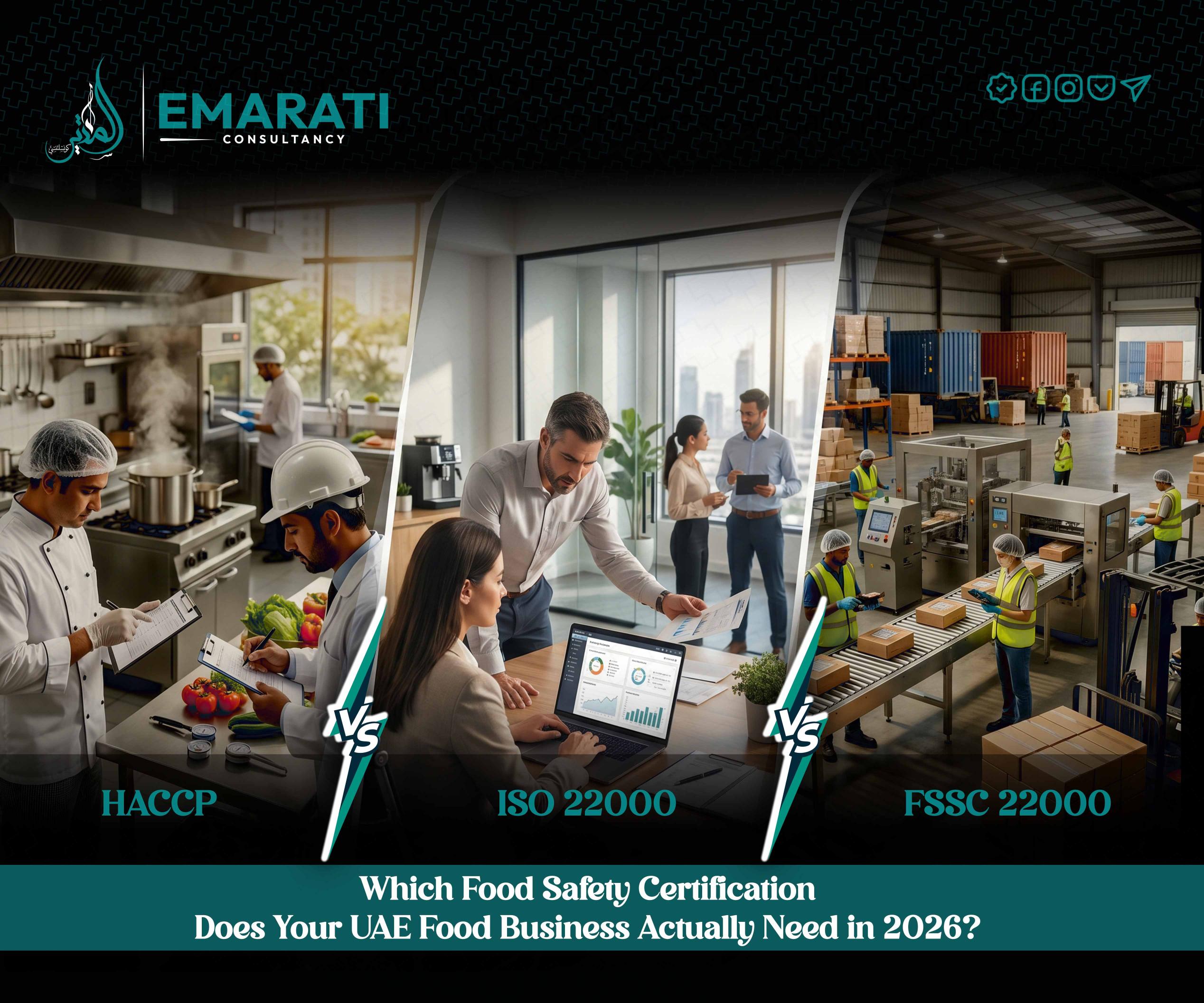
HACCP focuses specifically on hazard analysis and critical control point management — a food safety methodology rather than a full management system standard. ISO 22000 incorporates HACCP principles within a comprehensive food safety management system framework that adds management system requirements covering leadership commitment, communication, emergency preparedness and continual improvement. ISO 22000 carries internationally accredited certification recognition that HACCP alone does not — making it the preferred standard for UAE food businesses with export ambitions or international retail supply chain requirements.
FSSC 22000 is the Global Food Safety Initiative-recognised food safety certification scheme that builds on ISO 22000 with additional sector-specific requirements. FSSC 22000 is required by major international retailers and global food manufacturers as a supply chain qualification standard. HACCP is appropriate for food businesses focused on UAE regulatory compliance and domestic market requirements. FSSC 22000 is appropriate for food manufacturers and exporters targeting international markets and global retail supply chains.
ISO 9001 addresses quality management across all business processes — how your organisation consistently delivers products and services that meet customer requirements. HACCP addresses food safety specifically — preventing biological, chemical, physical and allergen hazards from causing consumer harm. Food businesses typically implement HACCP for regulatory compliance and food safety management, and ISO 9001 for broader quality management and commercial contract qualification where required.
Emarati Consultancy has direct knowledge of Dubai Municipality Food Safety Department inspection requirements, Food Watch registration obligations, ADAFSA food safety standards and the specific documentation and operational evidence that UAE food safety inspectors assess. We implement HACCP systems that satisfy both certification body audit requirements and UAE regulatory inspection expectations simultaneously.
A HACCP system that exists only on paper fails both certification audits and Dubai Municipality inspections. Emarati Consultancy implements HACCP as a working food safety management system — with monitoring procedures that your staff actually follow, records that are genuinely maintained and corrective action protocols that are used when deviations occur. The evidence of operational implementation is what satisfies inspectors.
Every hazard analysis, CCP identification, critical limit, monitoring procedure and corrective action protocol we develop is built specifically for your food operation — your menu, your processes, your premises and your staff. Generic HACCP templates consistently fail certification audits because they do not reflect real operational workflows, actual equipment use or genuine food handling risks.
Dubai’s food service workforce is multilingual — and food safety training in a language your staff do not fully understand is ineffective food safety training. Emarati Consultancy delivers HACCP awareness training in the languages your operational staff work in — ensuring genuine understanding of food safety responsibilities, not just certificate attendance.
If your food business grows to need ISO 22000 for comprehensive food safety management or FSSC 22000 for international retail supply chain qualification — Emarati Consultancy handles the full progression from HACCP through to the highest international food safety certification standards. One team, one relationship, every food safety certification your UAE business needs.
HACCP certification is effectively mandatory for food businesses operating in Dubai. Dubai Municipality's Food Safety Department requires all food establishments to implement food safety management systems based on HACCP principles, and Food Watch inspections assess HACCP system implementation as a standard component of food business licensing compliance. Restaurants, catering companies, hotel kitchens, food manufacturers and food distributors all face Dubai Municipality food safety inspection requirements that HACCP certification satisfies most credibly.
A food hygiene certificate is a training qualification for individual food handlers — it confirms that a person has received food safety awareness training. HACCP certification applies to your entire food business — it is a systematic, independently audited food safety management system that demonstrates your operation identifies and controls food safety hazards throughout all food handling processes. A food hygiene certificate for individual staff is a component within a HACCP system — not a substitute for it.
Small food businesses — restaurants and cafes — typically achieve HACCP certification in 2 to 4 weeks. Medium food operations — catering companies and small food manufacturers — require 3 to 6 weeks. Large or complex food operations with multiple sites or extensive product ranges need 6 to 10 weeks. The speed of implementation depends on the complexity of your menu and food processes and how quickly your team can implement monitoring procedures and begin generating records.
HACCP certification for small food businesses in the UAE costs from AED 4,000 including both Emarati Consultancy fees and certification body audit fees. Medium food operations typically pay AED 7,000 to AED 12,000. Large or multi-site operations from AED 12,000 upward. HACCP is the most affordable food safety certification available to UAE food businesses. Contact Emarati Consultancy for a transparent fixed-scope quote based on your specific operation.
Dubai Municipality food safety inspectors require HACCP plans and hazard analysis records, temperature monitoring records for all critical control points, staff training certificates including Person in Charge qualification, supplier verification records and delivery inspection logs, cleaning and sanitation schedules with completion records, corrective action logs documenting all CCP deviations and their resolution, and internal audit reports demonstrating systematic HACCP system review. Emarati Consultancy develops all of this documentation as standard within every HACCP engagement.
Food Watch is Dubai Municipality's digital food safety monitoring programme that tracks food establishment compliance, inspection results and food safety performance across Dubai. Registration on Food Watch is mandatory for food businesses operating in Dubai. The programme enables Dubai Municipality to monitor food safety standards, conduct risk-based inspections and publish food establishment ratings that are visible to consumers. HACCP certification and documented food safety management significantly improve Food Watch inspection outcomes.
The right choice depends on your food business objectives. If your primary goal is Dubai Municipality and ADAFSA regulatory compliance for domestic market operations, HACCP certification is the appropriate starting point — it is faster, more affordable and directly addresses UAE regulatory requirements. If your business has export ambitions, supplies international retail chains or wants internationally accredited food safety certification recognised by global buyers, ISO 22000 or FSSC 22000 is the right standard. Emarati Consultancy provides free guidance on which standard is right for your specific business situation.
Yes. Emarati Consultancy provides HACCP certification consultancy across all seven UAE emirates — Dubai, Abu Dhabi, Sharjah, Ajman, Ras Al Khaimah, Fujairah and Al Ain — with both in-person and remote consultation available. Our consultants have direct experience with Dubai Municipality Food Watch requirements, ADAFSA food safety inspection standards and the food safety procurement requirements of major UAE hotel groups, airlines and institutional catering clients.
HACCP certification protects your customers from food safety hazards, satisfies Dubai Municipality and ADAFSA regulatory requirements, qualifies your business for airline catering, hospital food service and hotel supply contracts and demonstrates to every client and regulator that food safety in your operation is managed to internationally recognised standards.
Whether you are a restaurant in Dubai pursuing Dubai Municipality compliance, a catering company qualifying for institutional contracts or a food manufacturer preparing for export market requirements — Emarati Consultancy has the food safety expertise, UAE regulatory knowledge and practical HACCP implementation experience to guide you through efficiently across all seven UAE emirates.
Phone: +971 52 856 0299 Email: info@emaraticonsultancy.ae Office: City Bay Business Centre, Office 303, Near Abu Bakr Metro Station, Dubai, UAE
Looking for reliable ISO renewal services in the UAE? Our specialists in Dubai, Abu Dhabi, and Sharjah help you align your OHSMS with updated ISO 45001 requirements, ensuring continuous compliance and smooth recertification.

The great explorer of the truth, the master-builder of human happiness no one rejects dislikes avoids pleasure itself because it is pleasure but because know who do not those how to pursue pleasures rationally encounter consequences that are extremely painful desires to obtain.
Read More