8:00AM - 6:00PM
Monday to Saturday

Monday to Saturday
+971 52 856 0299
Hor Al Anz


By Emarati Consultancy | ISO Certification Consultant Experts in UAE | Updated 2026
If you operate a food business in UAE — a restaurant in Dubai, a catering company in Abu Dhabi, a food manufacturing facility in Sharjah, a cloud kitchen in a free zone or a food truck anywhere in the country — HACCP certification is not optional. Dubai Municipality requires it for every licensed food establishment. ADAFSA enforces it across Abu Dhabi. And for any UAE food business targeting export markets the EU, UK, USA, Australia and Canada all make HACCP certification a mandatory import requirement.
This guide tells you exactly how to get HACCP certified in UAE in 2026 — with the complete step by step process, realistic timelines, transparent AED costs for different food business types and the specific Dubai Municipality FoodWatch requirements that determine whether your restaurant receives an A, B or C grade in public inspections — or faces closure.
HACCP — Hazard Analysis and Critical Control Points — is the internationally recognised food safety management system that identifies biological, chemical, physical and allergen hazards in food production and processing, establishes Critical Control Points where those hazards must be controlled, sets critical limits that must be met at each CCP and requires systematic monitoring and corrective action when limits are breached.
HACCP was developed by NASA and Pillsbury in the 1960s to ensure food safety for space missions — and has since become the globally accepted foundation for food safety management in every professional food environment. It is recognised by Codex Alimentarius — the international food standards authority — and mandated by food safety regulatory frameworks in UAE, Europe, the USA and most major food-importing nations worldwide.
In UAE, HACCP is mandatory under the UAE Cabinet Decision No. 21 of 2020 on Food Safety — the federal food safety law governing all food businesses across all seven emirates. Dubai Municipality enforces it through Dubai Food Safety Law and the FoodWatch digital inspection platform. Abu Dhabi Agriculture and Food Safety Authority — ADAFSA — enforces it across Abu Dhabi emirate. The Emirates Authority for Standardisation and Metrology — ESMA — applies it to food product standards and import requirements.
This is the distinction most UAE food businesses do not understand — and it matters commercially.
Dubai Municipality requires all food establishments to implement a HACCP-based food safety management system — meaning your operations must follow HACCP principles with documented hazard analysis, Critical Control Points, monitoring records and corrective actions. This is a regulatory compliance requirement for operating a licensed food establishment.
Third-party HACCP certification — where an accredited certification body independently audits your HACCP system and issues a certificate — is additionally required by hotel groups and hospitality brands qualifying food suppliers, airline catering and flight kitchen clients, international food manufacturers and retailers qualifying UAE suppliers, export markets requiring independent food safety certification and major UAE supermarket chains and food retail brands qualifying supplier facilities.
For restaurants serving only domestic retail customers, Dubai Municipality compliance with HACCP-based food safety management satisfies the legal requirement. For food businesses supplying hotels, airlines, supermarkets, export markets or institutional clients — third-party HACCP certification is the commercial requirement that opens those supply relationships.
This is the section most UAE restaurant owners need to read most urgently — and the information most HACCP guides completely ignore.
Dubai Municipality grades every food establishment on the FoodWatch platform following inspections. Restaurants receive a letter grade — A requiring a score of 90 or above, B requiring 75 to 89, C for scores of 60 to 74 — with scores below 60 resulting in closure until re-inspection. The grade is visible publicly via the FoodWatch app and must be displayed at the restaurant entrance. kokoroai
HACCP documentation quality directly determines your FoodWatch grade. Dubai Municipality requires restaurants to maintain and produce a current HACCP plan during inspection — including a hazard analysis for each food process in the kitchen covering receiving, storage, preparation, cooking, cooling, reheating and service. kokoroai
A restaurant with weak or missing HACCP documentation receives lower inspection scores across multiple evaluation criteria simultaneously — because Dubai Municipality inspectors assess HACCP plan completeness, CCP monitoring record currency, corrective action documentation and food safety management system evidence as primary inspection components. If a food business has incomplete, inaccurate, or false FoodWatch logs, it can now be fined between AED 50,000 and AED 100,000 for serious violations from 2026. structuralsolutions
The commercial consequence of a C grade — visible on the FoodWatch app to every potential customer before they visit your restaurant — is measurable customer loss and reputational damage that far exceeds the cost of professional HACCP certification. An A grade, by contrast, is a marketing asset that demonstrates food safety excellence to every customer who checks before visiting.
Different food business types face different HACCP requirements. Here is the specific guidance for each major food business category.
Restaurants and cafes in Dubai operating under Dubai Municipality licensing must implement a HACCP-based food safety management system as a condition of their food establishment permit. HACCP documentation must be current, complete and available for inspection during both scheduled and unannounced Dubai Municipality visits. The Person in Charge — PIC — at every restaurant must hold a Dubai Municipality approved food safety qualification — typically Level 3 Advanced Food Safety including HACCP application — and must be present during operational hours.
Third-party HACCP certification from an accredited certification body is required for restaurants supplying hotel groups, airline catering, corporate catering contracts, hospital food service or any institutional client that qualifies food suppliers through supply chain audit processes.
Catering companies and central kitchens supplying food to multiple delivery points — corporate clients, events, schools, hospitals or residential communities — face HACCP requirements at both the production facility level and the delivery and service point level. The HACCP plan must address the entire food chain from raw material receiving through production, packaging, temperature-controlled transport and service at the delivery point. Central kitchens are among the highest-risk food safety environments because food is produced in large volumes, held for extended periods and transported before service — making systematic CCP management and temperature monitoring critically important.
Food trucks in Dubai require HACCP certification both for the truck’s kitchen and for the central kitchen where food is prepared off-site. This dual-scope HACCP requirement surprises many food truck operators who assume their mobile operation has simpler food safety requirements than a fixed restaurant. The central kitchen where bulk preparation occurs must have a documented HACCP plan covering production processes. The food truck must have a separate HACCP plan covering the mobile service environment — temperature control during transport, hot holding, service point hygiene and waste management. diac
Cloud kitchens — delivery-only food production facilities operating without a dine-in customer area — require full HACCP certification under Dubai Municipality food establishment permit requirements. The absence of a physical dining area does not reduce HACCP requirements. Cloud kitchens typically operate multiple food brands simultaneously from a single facility — creating additional HACCP complexity around allergen management, cross-contamination prevention between different brand menus and temperature management for multiple simultaneous food production processes.
Food manufacturing facilities across UAE industrial zones — Sharjah, Ajman, RAK, Fujairah and Abu Dhabi — need HACCP certification for regulatory compliance with Dubai Municipality and ADAFSA, retail supply chain qualification from major UAE supermarket chains and export market access — with HACCP certification mandatory for UAE food exports to the EU, UK, USA, Australia and Canada. uaefreezonefinder
For food manufacturers HACCP scope covers raw material receiving and supplier qualification, production process control, in-process monitoring at all identified Critical Control Points, finished product testing, packaging integrity, labelling accuracy, storage and distribution temperature management and traceability throughout the supply chain.
Hotel food and beverage operations — restaurants, banquet kitchens, room service, employee canteens and any other food production unit within a hotel property — require HACCP certification as part of international hotel brand standards and Dubai Tourism regulatory requirements. International hotel brand standards consistently specify third-party HACCP certification from accredited certification bodies for all food production units rather than internal compliance documentation alone.
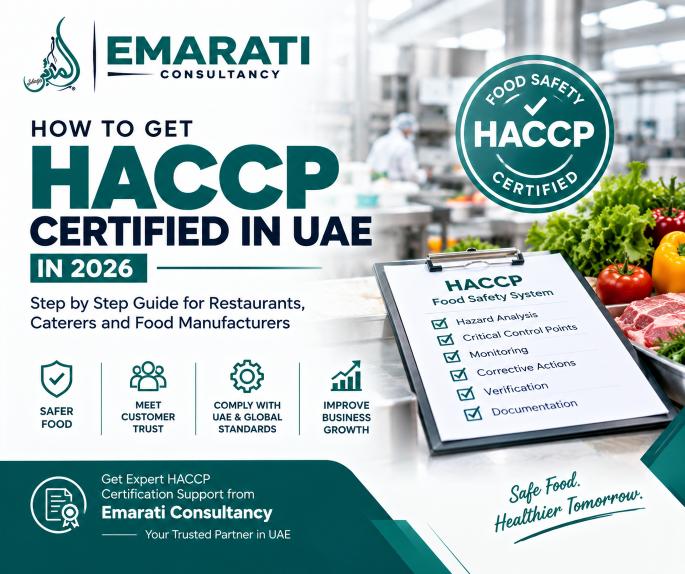
Before beginning implementation determine whether your business needs Dubai Municipality regulatory HACCP compliance, third-party HACCP certification from an accredited body, HACCP for export market qualification or all three simultaneously. The scope and depth of your HACCP system is determined by your most demanding requirement — and building to that level from the start avoids the cost of upgrading a regulatory-only system when a commercial certification requirement arrives.
HACCP requires a cross-functional food safety team — not just the head chef or quality manager working alone. Your HACCP team must include personnel with knowledge of your ingredients and raw materials, your production and preparation processes, your equipment and facility, your packaging and labelling and your distribution and service environment. For small restaurants the HACCP team may be two or three people. For food manufacturers it will include quality management, production, procurement and logistics representation.
Every product or menu item within your HACCP scope must be described in detail — ingredients, processing steps, physical and chemical characteristics, packaging, storage conditions, shelf life and intended consumer group including any vulnerable consumers such as children, elderly or immunocompromised individuals who require additional food safety protection.
Flow diagrams must map every step in the food preparation or production process — from raw material receiving through all processing, cooking, cooling, storage, packaging and service steps. Flow diagrams must be verified against actual operations in the facility — not theoretical descriptions of how processes should work. Discrepancies between documented flow diagrams and actual practice are a primary source of HACCP audit non-conformities.
For every step in every flow diagram all potential biological, chemical, physical and allergen hazards must be identified and assessed. Biological hazards include pathogens such as Salmonella, E. coli, Listeria and Norovirus that can contaminate food during preparation or storage. Chemical hazards include cleaning chemical contamination, pesticide residues and allergen cross-contact. Physical hazards include glass, metal, bone fragments and foreign material. Allergen hazards — increasingly regulated — include the 14 major allergens that must be systematically managed to protect allergic consumers.
For each identified hazard the significance must be assessed — considering the likelihood of occurrence and the severity of consequence if the hazard reaches the consumer. Significant hazards that cannot be controlled by prerequisite programmes such as cleaning and hygiene procedures require Critical Control Points.
This is the most technically demanding step of HACCP implementation and the step where most self-implemented HACCP systems have the most gaps. Inadequate hazard analysis — missing hazards, incorrect significance assessment or poorly justified CCP determinations — is the primary cause of HACCP certification audit failures in UAE.
Critical Control Points are the specific processing steps where control measures can be applied to prevent, eliminate or reduce identified food safety hazards to acceptable levels. Common CCPs in UAE food businesses include cooking temperature — ensuring pathogen destruction — cold holding temperature — preventing pathogen growth — hot holding temperature — maintaining safe serving temperature — and metal detection for manufactured products.
For each CCP a critical limit must be established — the measurable boundary that must not be exceeded for the CCP to be under control. Critical limits must be scientifically validated — based on established food science, regulatory guidance or peer-reviewed research rather than operational preference. For cooking CCPs the critical limit is typically a specific internal temperature for a specific minimum time. For cold storage CCPs the critical limit is a maximum storage temperature.
Every CCP must have documented monitoring procedures — specifying what is measured, how it is measured, how frequently measurements are taken, who is responsible and how measurements are recorded. Monitoring must be continuous or at sufficient frequency to detect loss of control before unsafe food reaches the consumer.
Corrective action procedures must be documented for every CCP — specifying what action is taken when monitoring shows a critical limit has been exceeded. Corrective actions must address both the immediate food safety risk — by safely disposing of or re-processing affected product — and the root cause of the deviation to prevent recurrence.
CCP monitoring records — temperature logs, pH records, metal detection logs — are the most heavily assessed documents during both Dubai Municipality food inspections and third-party HACCP certification audits. Records must be current, complete and maintained consistently — not compiled immediately before inspection.
Prerequisite programmes are the foundational food safety control measures that underpin the HACCP system — covering facility hygiene and cleaning, pest control, personal hygiene, supplier qualification, equipment maintenance and calibration, allergen management and employee food safety training. Prerequisite programmes do not replace CCPs but they control hazards that would otherwise create an unmanageable number of critical control points within the HACCP plan.
Dubai Municipality requires documented prerequisite programmes with completion records — cleaning schedules with sign-off records, pest control service reports, supplier approval documentation and employee health card records. These records are assessed during inspections alongside the HACCP plan itself.
All food handlers within the HACCP scope must receive food safety awareness training covering the food safety hazards relevant to their role, the hygiene and safety procedures they must follow and how to identify and report food safety concerns. For Dubai Municipality compliance the Person in Charge must hold a Dubai Municipality approved Level 3 Advanced Food Safety qualification including HACCP application — and must be present during operational hours.
Before applying for third-party HACCP certification an internal audit must verify that the HACCP plan is complete and correctly documented, CCPs are correctly identified and critical limits are scientifically supported, monitoring is being conducted as documented and records are complete and current, corrective actions are documented and effective and prerequisite programmes are operational with complete records.
The third-party certification body conducts a two-stage audit — Stage 1 reviewing documentation completeness and Stage 2 assessing on-site implementation. Following successful audit completion the HACCP certificate is issued — valid for three years with annual surveillance audits.
| Food Business Type | Emarati Consultancy Fee | Certification Body Fee | Total All-Inclusive |
|---|---|---|---|
| Small restaurant or cafe | AED 2,500 — 4,000 | AED 1,500 — 3,000 | AED 4,000 — 7,000 |
| Medium catering company | AED 4,000 — 6,000 | AED 3,000 — 5,000 | AED 7,000 — 11,000 |
| Cloud kitchen single brand | AED 2,500 — 4,000 | AED 1,500 — 3,000 | AED 4,000 — 7,000 |
| Cloud kitchen multi-brand | AED 4,000 — 7,000 | AED 3,000 — 5,000 | AED 7,000 — 12,000 |
| Food truck — dual scope | AED 3,500 — 5,000 | AED 2,000 — 4,000 | AED 5,500 — 9,000 |
| Small food manufacturer | AED 4,000 — 7,000 | AED 3,000 — 6,000 | AED 7,000 — 13,000 |
| Large food manufacturer | AED 7,000 — 12,000 | AED 5,000 — 10,000 | AED 12,000+ |
All figures are all-inclusive — no hidden costs. Annual surveillance audits cost approximately 50 to 60 percent of initial certification cost.
Get a transparent fixed-scope HACCP quote
| Food Business Type | Timeline |
|---|---|
| Small restaurant or cafe | 2 to 4 weeks |
| Medium catering company | 3 to 6 weeks |
| Cloud kitchen | 2 to 4 weeks |
| Food manufacturer — moderate complexity | 4 to 8 weeks |
| Food manufacturer — high complexity | 6 to 12 weeks |
The most time-consuming element for all food business types is the hazard analysis — which must be specific to your actual menu items, ingredients, recipes and production processes. A HACCP plan copied from a generic template fails certification audits immediately because auditors verify that the hazard analysis reflects your actual operations. Emarati Consultancy develops HACCP plans specifically for each client’s menu, ingredients and food preparation processes — never from generic templates.
This is one of the most searched questions by UAE food businesses planning their food safety certification — and the one most competitor guides answer inadequately.
HACCP is the foundational food safety standard — focused specifically on hazard analysis and Critical Control Point management. It is the minimum third-party certification for hotel supply, airline catering, institutional client qualification and export market access for many food products. Best suited for restaurants, small catering companies, standalone food outlets and food businesses with straightforward production processes.
ISO 22000 extends HACCP by adding a comprehensive management system framework — covering supplier management, traceability, emergency preparedness, communication and management review alongside HACCP requirements. Required by international food manufacturers, companies in complex food supply chains and food businesses where clients or export markets require a full food safety management system rather than HACCP alone. Most efficiently implemented by businesses already holding HACCP — with the HACCP plan forming the core of the ISO 22000 Food Safety Management System.
FSSC 22000 — Food Safety System Certification 22000 — extends ISO 22000 further with sector-specific additional requirements endorsed by the Global Food Safety Initiative — GFSI. Required by major international food retailers including Carrefour, Lulu, ALDI, Lidl and most large European and North American supermarket chains qualifying suppliers. The highest food safety certification tier for UAE food manufacturers and suppliers targeting premium international retail markets.
| Your Situation | Recommended Standard |
|---|---|
| Restaurant, cafe, food truck — UAE compliance | HACCP |
| Catering — hotel or airline supply | HACCP minimum, ISO 22000 preferred |
| Food manufacturer — domestic market | HACCP |
| Food manufacturer — GCC export | ISO 22000 |
| Food manufacturer — EU, UK, USA export | FSSC 22000 |
| Supplier to international supermarket chains | FSSC 22000 |
ISO 22000 certification UAE ,
FSSC 22000 certification UAE
Dubai Municipality’s Food Safety Department enforces HACCP requirements for all food establishments operating under Dubai food establishment permits. FoodWatch registration is mandatory for all food businesses in Dubai and is free of charge. Inspection outcomes — including HACCP documentation assessment — determine your FoodWatch grade which is publicly visible and must be displayed at your establishment entrance. Professional HACCP certification directly improves inspection scores and protects your public grade. diac
Abu Dhabi Agriculture and Food Safety Authority — ADAFSA — regulates food safety across Abu Dhabi emirate. ADAFSA enforces HACCP-based food safety management across all food categories — from restaurants and catering to food manufacturing and imports. ADAFSA inspection teams assess HACCP documentation as part of routine and targeted food business inspections. Food businesses in Abu Dhabi implementing professional HACCP systems consistently achieve stronger ADAFSA inspection outcomes than those relying on informal food safety practices.
ISO certification in Abu Dhabi
Food businesses in the northern emirates face HACCP requirements from both local municipality authorities and from the federal food safety framework under UAE Cabinet Decision No. 21 of 2020. Food manufacturers in Sharjah, Ajman and RAK industrial zones increasingly need third-party HACCP certification for domestic retail supply chain qualification as major UAE food retailers tighten supplier qualification standards. Export-oriented manufacturers in these zones need HACCP for international market access regardless of their emirate of registration.
Mistake 1 — Using a generic template HACCP plan
A HACCP plan copied from a template that describes generic food processes rather than your specific menu, recipes and kitchen layout will fail a certification audit immediately. Auditors verify that the hazard analysis reflects your actual operations. Generic templates produce non-conformities regardless of how professionally formatted they appear. Emarati Consultancy develops HACCP plans specifically for each client’s actual menu, ingredients and preparation processes.
Mistake 2 — Failing to maintain CCP monitoring records consistently
Dubai Municipality inspectors and certification body auditors both request monitoring records from specific historical dates — not just the most recent week. Temperature logs with gaps, missing corrective action records or records that show implausibly consistent readings consistently generate inspection findings. CCP monitoring records must be maintained every operational day from the start of implementation — not compiled before audit visits.
Mistake 3 — Training staff once and never updating
Staff turnover in UAE food businesses is among the highest of any sector. New kitchen staff who have not been trained on HACCP procedures and CCP responsibilities are a consistent food safety risk and a consistent audit vulnerability. HACCP awareness training must be embedded in every new employee onboarding rather than treated as a one-time implementation activity.
Mistake 4 — Choosing HACCP when the client actually needs ISO 22000
Food businesses that implement HACCP for a hotel supply contract and then discover the hotel brand actually requires ISO 22000 pay twice — for HACCP and then for the upgrade to ISO 22000. Always identify your most demanding client requirement before choosing your food safety certification level and implement to that standard from the start.
Mistake 5 — Not registering on FoodWatch before a Dubai Municipality inspection
FoodWatch registration is mandatory for all Dubai food businesses and is free of charge. Businesses discovered operating without FoodWatch registration during an inspection face immediate compliance action. Ensure FoodWatch registration is completed before the first operational day — and ensure HACCP documentation is uploaded and current on the platform at all times.
HACCP is mandatory under UAE federal food safety law and enforced by Dubai Municipality, ADAFSA and all other UAE municipal food authorities. Every commercial food establishment — restaurants, catering companies, food manufacturers, central kitchens, cloud kitchens and food trucks — must implement a HACCP-based food safety management system as a condition of their food establishment operating permit. Third-party HACCP certification from an accredited certification body is additionally required for hotel supply, airline catering, institutional client qualification, major retail supply and export market access.
HACCP certification all-inclusive — covering Emarati Consultancy fees and certification body audit fees — costs from AED 4,000 for small restaurants and cafes. Medium catering companies typically pay AED 7,000 to AED 11,000. Food manufacturers pay AED 7,000 to AED 13,000 for small operations and from AED 12,000 for large or complex facilities. Contact Emarati Consultancy for a transparent fixed-scope quote specific to your food business type and size.
Small UAE restaurants and cafes typically achieve HACCP certification in 2 to 4 weeks. Medium catering companies require 3 to 6 weeks. Food manufacturers with moderate complexity need 4 to 8 weeks. The most time-consuming element is the hazard analysis — which must be specific to your actual menu, ingredients and production processes. A properly conducted hazard analysis that takes its full required time consistently produces better audit outcomes than a rushed one that leaves gaps for auditors to find.
FoodWatch is Dubai Municipality’s mandatory digital food safety monitoring platform. All food businesses in Dubai must register on FoodWatch and maintain current food safety records on the platform. Dubai Municipality inspectors access FoodWatch records during both scheduled and unannounced visits — and incomplete, inaccurate or false records can result in fines of AED 50,000 to AED 100,000 from 2026. HACCP documentation forms a core component of FoodWatch compliance — including current HACCP plan, CCP monitoring logs, corrective action records and supplier documentation.
HACCP addresses food safety hazard identification and Critical Control Point management specifically. ISO 22000 extends HACCP with a comprehensive food safety management system framework — adding supplier management, traceability, emergency preparedness, communication and management review requirements. ISO 22000 is required by international food manufacturers and food businesses in complex supply chains where clients require a full management system rather than HACCP alone. HACCP is the recommended starting point for UAE restaurants, caterers and straightforward food operations.
Yes. HACCP certification is mandatory for UAE food exports to the EU, UK, USA, Australia and Canada. International food importers in these markets require independently verified food safety management as a condition of import. The specific certification level required varies by destination and product category — EU imports typically require HACCP minimum with many categories requiring ISO 22000 or FSSC 22000. Emarati Consultancy advises UAE food exporters on the specific certification required for their target export markets.
Yes. HACCP certification is available to food businesses of any size. Small restaurants — single location, up to 20 employees — can achieve HACCP certification in 2 to 4 weeks at a cost from AED 4,000 all-inclusive. Food trucks need HACCP certification for both the truck kitchen and any central kitchen where food is prepared off-site — a dual-scope requirement that adds modest additional implementation work but is fully achievable. Emarati Consultancy has certified food businesses across every size category from single-location cafes to multi-site food manufacturing operations.
Yes. Emarati Consultancy provides HACCP certification consultancy across all seven UAE emirates — Dubai, Abu Dhabi, Sharjah, Ajman, Ras Al Khaimah, Fujairah, Al Ain and Umm Al Quwain — with direct knowledge of Dubai Municipality FoodWatch requirements, ADAFSA food safety inspection standards and the export market certification requirements of EU, UK, USA, Australia and Canada. Both in-person and remote consultation are available.
HACCP certification protects your food business from regulatory fines, inspection failures and supply chain disqualification simultaneously. In Dubai it directly affects your publicly visible FoodWatch grade — the A, B or C rating that every potential customer can check before deciding to visit your establishment. For food manufacturers it determines your access to hotel supply contracts, airline catering, UAE supermarket qualification and international export markets.
Whether you are a restaurant owner preparing for your first Dubai Municipality food establishment permit, a catering company qualifying for a hotel supply contract, a food manufacturer targeting EU or UK export markets or a cloud kitchen operator building a food safety system for a growing delivery brand — Emarati Consultancy provides the HACCP expertise, UAE regulatory knowledge and food business-specific implementation experience to guide you through certification efficiently and successfully.
Phone: +971 52 856 0299
Email: info@emaraticonsultancy.ae
Office: City Bay Business Centre, Office 303, Near Abu Bakr Metro Station, Dubai, UAE
Looking for reliable ISO renewal services in the UAE? Our specialists in Dubai, Abu Dhabi, and Sharjah help you align your OHSMS with updated ISO 45001 requirements, ensuring continuous compliance and smooth recertification.

The great explorer of the truth, the master-builder of human happiness no one rejects dislikes avoids pleasure itself because it is pleasure but because know who do not those how to pursue pleasures rationally encounter consequences that are extremely painful desires to obtain.
Read More