8:00AM - 6:00PM
Monday to Saturday
Monday to Saturday
+971 52 856 0299
Hor Al Anz


By Emarati Consultancy | ISO Certification Consultant Experts in UAE | Updated 2026
If you are a UAE business owner asking how to get ISO certified you are asking the right question at the right time. ISO certification in the UAE in 2026 is not just a quality management credential — it is the commercial entry requirement for Dubai Municipality government tenders, ADNOC vendor registration, Abu Dhabi government procurement and international supply chain qualification. Without it you are excluded from these markets before evaluation begins. With it you compete on equal terms with any certified company in any UAE emirate.
This guide covers the complete ISO certification process for UAE businesses in 2026 — from choosing the right standard through gap analysis, documentation, implementation, internal audit and both stages of the external certification audit. With realistic timelines, transparent AED costs and the UAE-specific guidance that most certification guides miss.
Before covering the step-by-step process there are four UAE-specific factors that determine everything from which standard you need to how long the process takes. Understanding these first prevents the most common and most costly mistakes.
Every certification body that conducts legitimate ISO audits in UAE requires the organisation being certified to hold a valid UAE trade licence. Your trade licence must be current and your licence activities must be consistent with the scope of your ISO certification. This is particularly critical for businesses pursuing ADNOC vendor registration — where your trade licence activities must align with your intended ADNOC supply categories and hold Supreme Petroleum Council approval for oil and gas supply activities. Businesses that pursue ISO certification before ensuring their trade licence activities are correctly aligned with their certification scope consistently face scope rejection during certification body Stage 1 review.
UAE government tender portals, ADNOC vendor prequalification and Dubai Municipality supplier databases all filter specifically for certificates issued by EIAC-accredited certification bodies. EIAC — the Emirates International Accreditation Centre — operates under the Emirates Authority for Standardisation and Metrology. DAC — the Dubai Accreditation Centre — is a separate UAE accreditation body that is also recognised for many UAE procurement purposes. Both are IAF member bodies. When choosing your certification body confirm specifically which accreditation your target procurement authority requires — not all procurement systems accept all IAF member accreditations equally.
UAE workforces are among the most linguistically diverse in the world — with workers from South Asia, Southeast Asia, Africa, the Arab world and Western countries all working within the same organisations. ISO management systems that are documented and communicated only in English consistently underperform in certification audits — because auditors interview front-line staff and assess whether the management system is genuinely understood across the whole workforce. Providing key procedures and awareness content in both English and Arabic — and in Urdu, Hindi, Tagalog or Malayalam where relevant — directly improves audit outcomes and genuine management system effectiveness.
The most common and most expensive mistake UAE businesses make when pursuing ISO certification is choosing the wrong standard for their commercial objectives. ISO 9001 alone qualifies you for most UAE government tenders but not ADNOC vendor registration where all three — ISO 9001, ISO 14001 and ISO 45001 — are mandatory. HACCP qualifies you for Dubai Municipality food safety compliance but not for airline catering or hotel brand supply chain qualification where ISO 22000 is the minimum. Choosing the right standard from the start avoids the cost of returning for additional certifications later.
The right ISO standard for your business is determined by one question above all others. What commercial outcome do you need this certification to achieve?
Use this decision framework before making any other decision.
| Your Commercial Objective | The Standard You Need |
|---|---|
| UAE government tenders — general | ISO 9001 |
| Dubai Municipality construction tenders | ISO 9001 + ISO 14001 + ISO 45001 — QHSE IMS |
| ADNOC vendor registration | ISO 9001 + ISO 14001 + ISO 45001 — QHSE IMS |
| Dubai Municipality food safety compliance | HACCP |
| Export market food qualification | ISO 22000 |
| International retail food supply | FSSC 22000 |
| Technology company — client data security | ISO 27001 |
| Medical device registration — MOHAP | ISO 13485 |
| School — KHDA or ADEK quality management | ISO 21001 |
| UAE Federal Climate Law GHG reporting | ISO 14064 |
| Energy cost reduction and ESG reporting | ISO 50001 |
| AI governance for technology companies | ISO 42001 |
For businesses that need ISO 9001, ISO 14001 and ISO 45001 simultaneously — which includes the majority of UAE construction, oil and gas, manufacturing and industrial businesses — QHSE IMS implementing all three as a single integrated system saves 25 to 40 percent compared to three separate certifications.
The right starting point for any UAE ISO certification project is a free initial consultation with a qualified ISO consultancy — not documentation purchase or certification body application. The initial consultation establishes your commercial objective and the standard that achieves it, your organisation’s current management system maturity and the realistic gap between where you are and where certification requires you to be, your timeline requirements and whether specific tender deadlines or ADNOC registration windows are driving your schedule, and your total all-inclusive cost covering both consultancy fees and certification body audit fees before you commit to anything.
A quality UAE ISO consultancy provides this consultation at no charge and without pressure to commit. If a consultancy cannot answer your commercial objective questions — which procurement systems, which standards, which certification body for your specific situation — they are not the right partner for your certification.
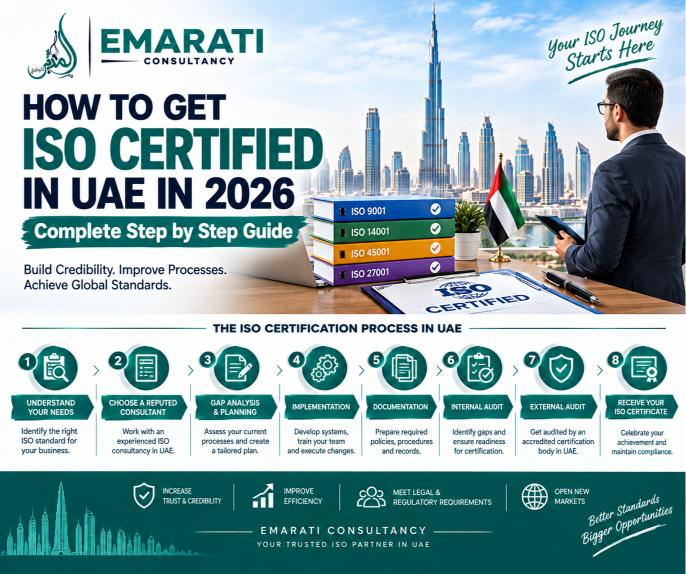
The gap analysis is the diagnostic foundation of your entire ISO certification project. It assesses your current business practices against the specific requirements of your chosen ISO standard — identifying what already exists in your organisation, what needs to be built and what the realistic implementation timeline looks like for your specific situation.
A thorough gap analysis for a UAE business covers documentation review — what policies, procedures and records already exist and which meet ISO requirements. Process observation — how operations actually function on the ground versus what the standard requires. Key personnel interviews — understanding how processes are managed in practice rather than on paper. Regulatory mapping — identifying all applicable UAE regulatory requirements — Dubai Municipality, ADAFSA, MOHAP, UAE Federal Climate Law — that must be addressed within your management system.
The gap analysis output must give you a specific compliance percentage against the standard’s requirements, a prioritised list of gaps with implementation complexity assessment, a realistic project timeline with milestones and a fixed-scope cost proposal for the complete implementation.
Duration: 1 to 3 days on-site depending on organisation size.
The most common gap analysis mistake: Conducting a superficial gap analysis that identifies obvious documentation gaps but misses operational non-conformities — leaving them for the external auditor to find at significantly higher cost and with significantly greater disruption.
Choosing the right certification body must happen before implementation begins — not after. Your certification body choice determines whether your certificate is accepted by your target procurement authority, what audit fees you will pay and when audit slots are available relative to your timeline.
How to choose your certification body:
Verify EIAC accreditation first. Navigate independently to the EIAC website and confirm the certification body appears in the accredited bodies register for your specific standard. Confirm specifically that their certificates are accepted by Dubai Municipality, ADNOC or whichever UAE procurement authority you are targeting. Check their audit fee schedule for your organisation size — certification body fees vary between bodies for equivalent scopes. Confirm their audit scheduling availability relative to your certification timeline requirements. Check their sector expertise — a certification body with strong oil and gas auditor capabilities is different from one with strong food safety or healthcare expertise.
What to avoid: Certification bodies not found on the EIAC register. Certification bodies offering unrealistically low audit fees that do not reflect the mandatory audit duration requirements under IAF MD 5. Certification bodies recommended by consultancies without any independent verification of their accreditation status.
Documentation is the foundation your management system is built on. Every ISO standard requires a set of documented policies, procedures and records. The specific documents vary by standard but the documentation hierarchy is consistent.
Level 1 — Policy: Your top-level management commitment statement. Quality policy, environmental policy, health and safety policy, food safety policy, information security policy — depending on your standard. Typically one page. Must be approved by senior management. Must be communicated to all staff.
Level 2 — Procedures: Descriptions of how key processes are managed — who does what, in what sequence, to what standard. Document control procedure, corrective action procedure, internal audit procedure, supplier evaluation procedure and all process-specific operational procedures relevant to your certification scope.
Level 3 — Records: Evidence that your procedures are being followed. Temperature logs, training records, internal audit reports, corrective action registers, management review minutes, supplier evaluation records. Records are what auditors check most carefully — and the gap that causes the most non-conformity findings across UAE ISO certifications.
The critical rule for UAE management system documentation: Document how your business actually operates — not how an ideal business would theoretically operate. Auditors observe operations, interview staff and check records. If what they observe does not match what your procedures describe you receive non-conformities regardless of how professionally formatted your documentation is.
Duration for documentation development: 1 to 8 weeks depending on organisation size, standard complexity and existing documentation maturity.
Documentation development is followed by implementation — the phase where documented processes are deployed into actual operations. This phase is consistently underestimated by UAE businesses pursuing ISO certification and is the most common reason certifications fail.
Implementation covers deploying new or updated processes across all departments within the certification scope. Training staff on their specific roles within the management system. Establishing record-keeping systems and confirming that records are being generated consistently. Conducting walkthrough reviews to verify that operational reality matches documented procedures.
The implementation reality for UAE businesses: UAE workforces turn over at higher rates than most international markets. New employees in key roles who have not been trained on management system responsibilities are a consistent audit vulnerability — particularly for businesses in construction, hospitality, logistics and manufacturing where workforce turnover is high. Building management system training into every employee onboarding process, rather than treating it as a one-time implementation activity, produces consistently better audit outcomes.
Duration: 2 to 6 weeks depending on operational change required.
Every employee within the certification scope must understand the management system — their role within it, how their work contributes to the system’s objectives and what records they are responsible for maintaining. This is not optional — it is directly assessed during Stage 2 certification audits.
Auditors interview staff at all levels during Stage 2. Front-line employees who cannot explain what the management system is, what their specific role involves or where to find the procedures relevant to their work signal to auditors that awareness training was either not conducted or not effective. This finding is common, entirely preventable and consistently produces non-conformities that delay certificate issuance.
Training covers general management system awareness for all staff within scope. Role-specific training for personnel with specific management system responsibilities — the Management Representative, internal auditors, department heads. Internal auditor training for whoever will conduct your internal audits. Management briefing for senior leadership covering their specific ISO obligations around policy, objectives and management review.
Duration: 1 to 3 days depending on organisation size and number of standards.
Before your external certification body audit your organisation must conduct a comprehensive internal audit of the management system. The internal audit is your opportunity to find and fix non-conformities before an external auditor finds them — at significantly lower cost and without the commercial consequences of a delayed certificate.
A properly conducted internal audit covers every clause of the relevant ISO standard against every process, department, site and location within the certification scope. Internal auditors must be competent in both the standard requirements and auditing techniques — which is why internal auditor training is part of the implementation process.
Internal audit findings must be documented — recording each non-conformity against the relevant clause, assigning corrective action responsibility and tracking closure with effectiveness verification. All non-conformities identified during the internal audit must be resolved before the external Stage 2 audit.
The most common internal audit failure in UAE: Conducting superficial internal audits that identify only obvious non-conformities and miss the operational gaps — particularly in records management, staff awareness and management review quality — that external auditors consistently find. A rigorous internal audit that finds real problems and resolves them before Stage 2 is the single most effective investment in first-time audit success.
Duration: 1 to 3 days depending on organisation size.
Your first formal management review must be completed before the external certification audit. This is one of the most consistently underprepared elements of UAE ISO certifications — and one of the most carefully assessed by certification body auditors.
Management review is a structured meeting where senior leadership evaluates the management system’s performance. It is not a briefing where the Management Representative presents a report and leadership signs attendance records. It is a formal assessment where leadership reviews specific inputs — quality or safety or environmental performance data, customer feedback, internal audit results, corrective action status, objective achievement, resource adequacy — and documents specific outputs — decisions made, actions assigned with responsibilities and deadlines.
Management review minutes are among the first documents an auditor requests during Stage 1 review. Inadequate management review minutes — showing only attendance records without evidence of substantive performance discussion — consistently generate Stage 1 findings that must be resolved before Stage 2 proceeds.
Stage 1 is the first of two external certification body audit stages. It is a documentation and readiness review — typically conducted at your premises or remotely — where the certification body auditor reviews your management system documentation to confirm it meets the standard’s requirements.
What Stage 1 auditors examine:
Your scope statement — is it clearly defined and appropriate for your business activities. Your risk assessments and planning documentation — are identified risks genuine and proportionate to your actual operations. Your objectives — are they specific, measurable and genuinely connected to your management priorities. Your management review records — was the review conducted properly with appropriate inputs and outputs. Your internal audit records — was the internal audit comprehensive and did findings get properly addressed.
Stage 1 outcomes: The auditor produces a report confirming readiness for Stage 2 or identifying issues requiring resolution first. Stage 1 findings are categorised as major — requiring resolution before Stage 2 proceeds — or minor — observations to address but not preventing Stage 2.
Duration: 1 to 2 days depending on organisation size.
Stage 2 is the full on-site assessment of your implemented management system. This is the audit that determines whether your certificate is issued. Stage 2 auditors observe operations, interview staff at all levels, check records from across the implementation period and verify that what is documented reflects what actually happens.
What Stage 2 auditors examine most carefully in UAE:
Records — specifically records from throughout the implementation period, not just recent weeks. Auditors request records from random historical dates to verify consistent implementation rather than audit-week compliance. Staff awareness — front-line employees are interviewed about their understanding of the management system, their specific responsibilities and how to report non-conformities or raise safety concerns. Operational controls — verifying that procedures are being followed in actual operations through direct observation, not just documentation review. Subcontractor management — particularly for construction, oil and gas and logistics companies where subcontractor qualification and monitoring is a consistently identified gap.
Non-conformity types:
A major non-conformity is a fundamental failure — a required element is absent, a critical process is uncontrolled or systematic non-compliance exists. Major non-conformities prevent certificate issuance until resolved and re-verified by the certification body. Additional audit fees apply for re-verification.
A minor non-conformity is an isolated instance — a single record gap, a procedure not followed once or a minor documentation deficiency. Minor non-conformities must be addressed within 30 to 90 days but do not prevent certificate issuance.
Duration: 1 to 4 days depending on organisation size, scope and number of standards.
Following successful Stage 2 completion your ISO certificate is issued — typically within 2 to 4 weeks of the audit. Your certificate is valid for three years subject to annual surveillance audits in years one and two and a full recertification audit in year three.
The certificate issuance is the beginning of your certification cycle — not the end of your ISO journey. Organisations that treat their certificate as a destination rather than a foundation consistently struggle at their first surveillance audit — finding that records have lapsed, procedures have been abandoned and staff who were trained during initial implementation have been replaced by untrained successors.
| ISO Standard | Small Business | Medium Business | Large Business |
|---|---|---|---|
| ISO 9001 | 2 to 4 weeks | 3 to 6 weeks | 4 to 8 weeks |
| ISO 14001 | 2 to 4 weeks | 3 to 6 weeks | 4 to 8 weeks |
| ISO 45001 | 2 to 4 weeks | 3 to 6 weeks | 4 to 8 weeks |
| QHSE IMS | 4 to 6 weeks | 6 to 10 weeks | 8 to 14 weeks |
| ISO 27001 | 6 to 10 weeks | 10 to 16 weeks | 16 to 24 weeks |
| HACCP | 2 to 4 weeks | 3 to 6 weeks | 6 to 10 weeks |
| ISO 22000 | 4 to 8 weeks | 8 to 14 weeks | 14 to 20 weeks |
| ISO 13485 | 8 to 14 weeks | 14 to 20 weeks | 20 to 28 weeks |
| ISO 42001 | 6 to 10 weeks | 10 to 16 weeks | 16 to 24 weeks |
| ISO 14064 | 4 to 8 weeks | 8 to 14 weeks | 12 to 20 weeks |
Small business = up to 30 employees. Medium = 30 to 150. Large = 150+.
| ISO Standard | Small Business | Medium Business | Large Business |
|---|---|---|---|
| ISO 9001 | AED 5,000 — 8,000 | AED 8,000 — 15,000 | AED 15,000+ |
| ISO 14001 | AED 5,000 — 8,000 | AED 8,000 — 15,000 | AED 15,000+ |
| ISO 45001 | AED 5,000 — 8,000 | AED 8,000 — 15,000 | AED 15,000+ |
| QHSE IMS | AED 10,000 — 15,000 | AED 15,000 — 25,000 | AED 25,000+ |
| ISO 27001 | AED 10,000 — 15,000 | AED 15,000 — 25,000 | AED 25,000+ |
| HACCP | AED 4,000 — 7,000 | AED 7,000 — 12,000 | AED 12,000+ |
| ISO 22000 | AED 6,000 — 10,000 | AED 10,000 — 18,000 | AED 18,000+ |
| ISO 13485 | AED 8,000 — 14,000 | AED 14,000 — 22,000 | AED 22,000+ |
| ISO 42001 | AED 8,000 — 14,000 | AED 14,000 — 25,000 | AED 25,000+ |
| ISO 14064 | AED 6,000 — 10,000 | AED 10,000 — 18,000 | AED 18,000+ |
All figures are all-inclusive covering both Emarati Consultancy fees and certification body audit fees. No hidden costs.
Note on competitor pricing — some UAE ISO consultancies quote AED 40,000 to AED 200,000 for ISO 27001. These figures reflect large international consulting firm rates or significant scope complexity rather than standard market pricing for UAE businesses. Always request an all-inclusive fixed-scope quote and confirm it covers both consultancy and certification body fees before comparing prices.
This is one of the most searched questions by UAE businesses starting their ISO certification journey. Here is the honest answer.
Self-implementation: Technically possible for any ISO standard. No regulatory requirement for an external consultant. Some UAE businesses with strong internal quality management expertise and dedicated internal resources successfully self-implement. The realistic requirement is a Management Representative who can dedicate 50 to 70 percent of their time to the project throughout implementation, deep knowledge of the specific standard’s requirements, previous experience with management system documentation and the ability to conduct a rigorous internal audit objectively.
Why most UAE businesses use consultants: The first-time audit failure rate for ISO 27001 among self-implementing organisations globally exceeds 70 percent. For other standards failure rates are lower but meaningful. The commercial cost of a failed first audit — re-audit fees, delayed certification and missed tender opportunities during the delay — consistently exceeds the consultancy fee savings. For UAE businesses facing specific tender deadlines or ADNOC registration windows the risk of self-implementation failure is rarely worth the cost saving.
The honest recommendation: If you have a dedicated Management Representative with management system experience, no imminent tender deadline and adequate internal time resources — self-implementation is viable for ISO 9001, ISO 14001 or ISO 45001. If you need QHSE IMS, ISO 27001, ISO 13485 or ISO 42001 — or if you have a specific commercial deadline — experienced consultancy support is the commercially intelligent choice.
Understanding why ISO audits fail is more commercially valuable than any other knowledge before starting the process.
Reason 1 — Documentation that describes ideal processes rather than actual ones. Procedures that do not reflect how your business actually operates produce non-conformities when auditors observe operational reality that contradicts documented procedures. Document how you actually work first — then identify improvements.
Reason 2 — Records not maintained consistently throughout implementation. Auditors request records from specific historical dates — not just recent weeks. Gaps in monitoring records, training records or corrective action logs from earlier in the implementation period are visible regardless of how comprehensive recent records appear.
Reason 3 — Superficial internal audit that misses real non-conformities. An internal audit that only confirms documentation exists rather than genuinely assessing implementation effectiveness leaves real gaps for the external auditor to find.
Reason 4 — Management review not conducted properly. A meeting where leadership signs attendance without genuine performance discussion does not satisfy management review requirements. Auditors assess management review records in detail.
Reason 5 — Staff unable to explain the management system during interviews. Front-line employee awareness is directly assessed during Stage 2 audits. Comprehensive training is not optional — it is a certification requirement.
ISO 9001, ISO 14001 and ISO 45001 for small UAE businesses take 2 to 4 weeks each from implementation start to certificate issue. QHSE IMS combining all three takes 4 to 6 weeks for small businesses. ISO 27001 takes 6 to 10 weeks for small businesses due to the depth of information security risk assessment required. The single most important timeline factor is management commitment — businesses where leadership actively champions implementation consistently certify faster than those treating it as a background compliance project.
ISO 9001 all-inclusive for small UAE businesses starts from AED 5,000. HACCP from AED 4,000. QHSE IMS from AED 10,000. ISO 27001 from AED 10,000. All figures cover both consultancy and certification body audit fees. Always request an all-inclusive written quote covering both components before committing. Some UAE consultancies quote consultancy fees only — with certification body audit fees of AED 3,000 to AED 12,000 payable separately.
No — a consultant is not legally required. However the first-time audit failure rate for self-implementing organisations is significantly higher than for those working with experienced consultants. The commercial cost of a failed first audit — re-audit fees, delayed certification and missed tender opportunities — consistently exceeds consultancy fee savings for businesses with specific commercial deadlines. Emarati Consultancy provides a free consultation that honestly assesses whether your organisation has the internal capability for self-implementation before you make this decision.
ISO 9001 is the baseline requirement for most UAE government tenders. Construction, oil and gas and industrial companies typically need ISO 9001, ISO 14001 and ISO 45001 simultaneously for Dubai Municipality, RTA, DEWA and ADNOC qualification. QHSE IMS implementing all three together is the most cost-efficient approach — saving 25 to 40 percent compared to three separate certifications.
Every ISO standard requires a quality or management policy, scope statement, core operational procedures, records of management review, internal audit records, corrective action register and competence and training records. Standard-specific documents include environmental aspects register for ISO 14001, hazard identification and risk assessment for ISO 45001, information security risk assessment and Statement of Applicability for ISO 27001 and HACCP plan and CCP monitoring records for HACCP.
Yes. ISO certification is available to organisations of any size. Small UAE businesses — up to 30 employees — typically achieve ISO 9001, ISO 14001 or ISO 45001 certification in 2 to 4 weeks at a cost from AED 5,000 all-inclusive. The implementation scope is smaller, the documentation requirements are simpler and the audit duration is shorter for small businesses. HACCP for small food businesses starts from AED 4,000. The commercial return from ISO certification — qualifying for government tenders, ADNOC supply chains and international client relationships — is available to small businesses exactly as it is for large ones.
Stage 1 is a documentation and readiness review — the certification body auditor reviews your management system documentation to confirm it meets the standard's requirements. Stage 2 is the full on-site assessment where the auditor verifies that your documented management system is genuinely implemented in operations through staff interviews, records review and process observation. Stage 1 must be completed before Stage 2 proceeds. Both stages together constitute your initial certification audit and lead to certificate issuance following successful completion.
Yes. Emarati Consultancy provides ISO certification consultancy for businesses across all seven UAE emirates — Dubai, Abu Dhabi, Sharjah, Ajman, Ras Al Khaimah, Fujairah, Al Ain and Umm Al Quwain — with both in-person and remote consultation available. We cover all 17 ISO standards plus ISO 14064 and provide a free initial consultation covering which standard is right for your specific commercial objectives before you commit to anything.
ISO certification in UAE is a structured process with a clear pathway — from choosing the right standard through gap analysis, documentation, implementation, internal audit, Stage 1, Stage 2 and certificate issuance. Every step is manageable with the right guidance. Every timeline is achievable with genuine management commitment. And every commercial outcome — government tender qualification, ADNOC vendor registration, international supply chain participation — is available to any UAE business that completes the process correctly.
Emarati Consultancy guides UAE businesses through every stage of ISO certification across 17 specialist standards and all seven UAE emirates — with transparent fixed-scope pricing, genuine UAE regulatory knowledge and a structured implementation approach that consistently achieves first-time audit success.
Phone: +971 52 856 0299
Email: info@emaraticonsultancy.ae
Office: City Bay Business Centre, Office 303, Near Abu Bakr Metro Station, Dubai, UAE
Looking for reliable ISO renewal services in the UAE? Our specialists in Dubai, Abu Dhabi, and Sharjah help you align your OHSMS with updated ISO 45001 requirements, ensuring continuous compliance and smooth recertification.
The great explorer of the truth, the master-builder of human happiness no one rejects dislikes avoids pleasure itself because it is pleasure but because know who do not those how to pursue pleasures rationally encounter consequences that are extremely painful desires to obtain.
Read More