8:00AM - 6:00PM
Monday to Saturday
Monday to Saturday
+971 52 856 0299
Hor Al Anz


By Emarati Consultancy | ISO Certification Consultant Experts in UAE | Updated 2026
If you run a construction company, oil and gas service business or manufacturing operation in the UAE in 2026 you already know that ISO certification is not a differentiator. It is a threshold requirement. Dubai Municipality will not shortlist your tender submission without it. ADNOC will not process your vendor registration application without it. RTA, DEWA, Abu Dhabi government procurement and virtually every semi-government entity in the UAE will not evaluate your bid without it.
The question UAE construction, oil and gas and manufacturing companies are increasingly asking is not whether they need ISO certification. It is which standards they need, in what combination, at what cost and how quickly they can achieve it before the next tender deadline or ADNOC registration window. This guide answers all of those questions with the specificity and UAE regulatory accuracy that most ISO certification guides avoid providing.
ISO Certification Construction Oil Gas that Understanding exactly what each UAE procurement authority requires — not generic statements about ISO being important but the specific standards mandated by specific authorities — is the most commercially useful starting point for any UAE construction, oil and gas or manufacturing company planning its ISO certification investment.
Dubai Municipality contractor prequalification requires ISO 9001, ISO 14001 and ISO 45001 — all three standards — as mandatory qualification criteria for virtually all significant construction contract categories. A missing certificate from any one of the three disqualifies your submission before technical evaluation begins. Dubai Municipality’s contractor classification system grades contractors from Category A through Category E — and ISO certification requirements apply consistently across all categories for construction, fit-out, civil engineering, MEP and specialist contracting work. Without all three certificates your company simply does not exist in the Dubai Municipality tender evaluation process.
The Roads and Transport Authority and Dubai Electricity and Water Authority apply equivalent ISO certification requirements to their contractor and supplier qualification frameworks. RTA infrastructure contracts, road construction and maintenance tenders and DEWA utility infrastructure projects all require QHSE IMS equivalent certification from qualifying bidders. For Dubai-based construction and engineering companies these three procurement authorities — Dubai Municipality, RTA and DEWA — collectively represent the largest accessible government contract market in the UAE. A single QHSE IMS certificate simultaneously qualifies your company for all three.
ADNOC operates a rigorous vendor qualification system. All contractors must register through ADNOC’s Supplier Portal and obtain ICV certification. The qualification process typically takes 3 to 6 months and includes site audits. Key documents required include ISO 9001 and ISO 14001 certifications alongside HSE management system certification. tenderscanai
In practice ADNOC’s mandatory ISO certification requirements cover three standards across all operational and construction supply categories. ISO 9001 quality management is the baseline requirement for every supply category without exception. ISO 14001 environmental management is mandatory for all contractors involved in operational, construction and maintenance activities. ISO 45001 occupational health and safety is mandatory for all site-based contractors across all ADNOC facilities.
ADNOC contractor registration requirements have expanded in 2026 to include ISO 27001 information security certification for contractors handling sensitive operational data — adding a fourth certification requirement for many oil and gas service companies that previously only needed QHSE. RMC Consultancy
This ISO 27001 addition is significant for UAE oil and gas service companies with digital operational technology, SCADA systems, asset management platforms or integrated project management systems that interface with ADNOC operational data.
Companies intending to work directly with ADNOC or any oil and gas related entity in Abu Dhabi must obtain Supreme Petroleum Council approval on their trade licence. SPC approval is a non-negotiable prerequisite for ADNOC vendor registration and prequalification in oil and gas supply categories — and must be in place before submitting your Ariba registration application. ISO certification alone is insufficient without SPC-approved trade licence activities correctly aligned to your intended ADNOC supply categories. Many UAE oil and gas companies discover this requirement after beginning their ISO certification process — adding months of delay to their ADNOC registration timeline.
Any company bidding on contracts with ADNOC, Abu Dhabi government entities or the growing number of federal and semi-government organisations participating in the National ICV Programme must hold a valid ICV certificate or accept a score of zero in the tender evaluation. In practice a missing certificate is as disqualifying as a failed technical submission. kayrouzandassociates
ICV scores above 40 percent are considered competitive in ADNOC tender evaluations. Top performing UAE companies achieve ICV scores of 80 to 90 percent. ISO certification supports your ICV score by demonstrating local management system investment — but ICV and ISO certification are separate requirements that must both be addressed for ADNOC tender success.
Abu Dhabi government infrastructure procurement across all departments — Department of Municipalities and Transport, Department of Energy, Abu Dhabi Public Works and all other government entities — requires ISO 9001, ISO 14001 and ISO 45001 from construction and engineering contractors. The Abu Dhabi Government Procurement Portal — the central tendering system for all Abu Dhabi government procurement — incorporates ISO certification verification as a standard prequalification step.
This is the most important commercial decision UAE construction, oil and gas and manufacturing companies make when planning their ISO certification investment — and the decision that consistently determines whether they overspend by AED 9,000 to AED 20,000 or invest efficiently.
Most UAE companies in these sectors need ISO 9001, ISO 14001 and ISO 45001 simultaneously. Every major UAE procurement authority requires all three. Implementing them as three separate certifications means paying three times — three separate gap analysis engagements, three separate documentation sets, three separate training programmes, three separate internal audit cycles and three separate certification body audit engagements. For a medium UAE construction company this approach typically costs AED 24,000 to AED 45,000.
Implementing the same three standards as a QHSE Integrated Management System — one unified documentation framework, one training programme, one internal audit and one combined certification body audit — delivers the same three certificates for AED 15,000 to AED 25,000 for a medium company. The saving of AED 9,000 to AED 20,000 on initial certification applies to the same three certificates that every Dubai Municipality, RTA, DEWA and ADNOC tender requires. And the ongoing annual surveillance audit saving — one combined audit instead of three separate ones — compounds this advantage throughout the three-year certification cycle.
| Approach | Cost Medium Company | Certificates Issued |
|---|---|---|
| ISO 9001 separate | AED 8,000 — 15,000 | 1 |
| ISO 14001 separate | AED 8,000 — 15,000 | 1 |
| ISO 45001 separate | AED 8,000 — 15,000 | 1 |
| Three separate total | AED 24,000 — 45,000 | 3 |
| QHSE IMS combined | AED 15,000 — 25,000 | 3 |
| Saving | AED 9,000 — 20,000 | Same 3 certificates |
The baseline certification package for every UAE construction company competing for significant government and private developer contracts is QHSE IMS — combining ISO 9001, ISO 14001 and ISO 45001 in a single integrated management system.
Beyond QHSE IMS the specific additional standards depend on the nature of your construction operations and target contract portfolio. Construction companies working with digital project management systems, BIM platforms or integrated client data environments are increasingly required to demonstrate ISO 27001 information security management. Construction companies bidding for ADNOC or Abu Dhabi government infrastructure contracts where ICV scoring applies should ensure their management system documentation supports ICV score optimisation alongside certification body audit requirements.
Construction QHSE IMS implementation faces specific challenges that distinguish it from quality management in office or service environments. Construction sites are temporary and constantly changing — documentation must address dynamic site conditions rather than fixed facility operations. Subcontractor management is a critical ISO 9001 and ISO 45001 requirement that many UAE construction companies under-document — auditors consistently assess subcontractor qualification, monitoring and control procedures as a primary audit focus for construction scope certifications. Environmental aspects across active construction sites — dust management, water runoff, fuel storage, waste management and noise control — must be identified and controlled for ISO 14001 compliance in the context of Abu Dhabi and Dubai construction environmental regulations. Worker safety in UAE construction involves managing a multilingual, multicultural workforce across hazardous environments — ISO 45001 implementation must address multilingual safety communication, worker consultation mechanisms and the specific hazard profile of each project type.
Dubai Municipality Category A and B contractors — the highest classification tiers handling the largest and most complex construction projects — face the most rigorous ISO certification requirements of any contractor classification level. Category A contractors must demonstrate management system maturity that goes beyond basic ISO 9001, ISO 14001 and ISO 45001 compliance — auditors assess the depth of integration between quality, environmental and safety management systems, the sophistication of subcontractor management and the evidence of continual improvement across the certification cycle.
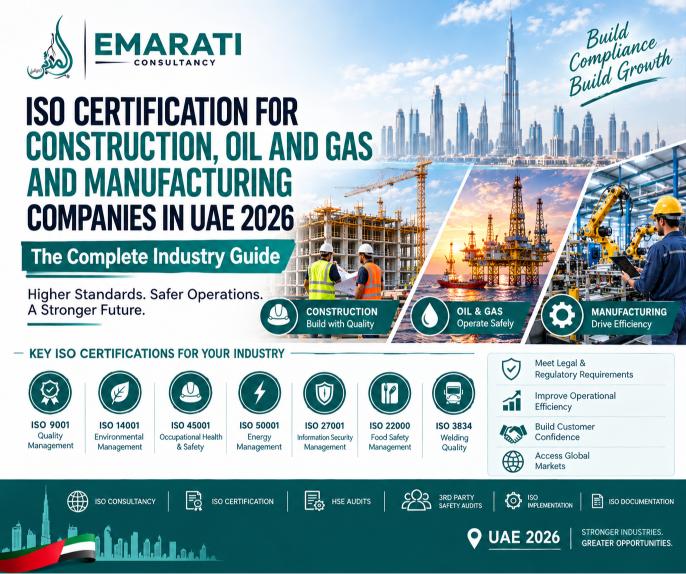
The oil and gas sector has the most demanding ISO certification requirements of any UAE industry — reflecting the operational criticality, environmental sensitivity and safety risk profile of energy sector activities. The minimum ADNOC contractor certification package is QHSE IMS. Additional standards increasingly required by ADNOC and GCC national oil companies include ISO 27001 for contractors handling operational technology data and ISO 29001 for petroleum industry specific quality management.
ISO 29001 is the quality management standard specifically developed for the petroleum, petrochemical and natural gas industry — based on ISO 9001 but with sector-specific requirements covering product and service quality in upstream, midstream and downstream oil and gas operations. GCC national oil companies including ADNOC are requiring ISO 29001 from product and service suppliers in a bid to ensure consistency of quality across contracts for drilling, maintenance and supply of equipment. If your company is bidding on oilfield service contracts in the UAE this certification is becoming a front-line requirement. ascentworld
ISO 29001 is currently held by very few UAE oil and gas service companies — making it a genuine competitive differentiator for companies that pursue it ahead of the market. Emarati Consultancy implements ISO 29001 for UAE oil and gas service companies building on existing ISO 9001 or QHSE IMS foundations — the implementation efficiency from this integration significantly reduces the cost and timeline compared to implementing ISO 29001 from scratch.
ADNOC’s 2026 contractor qualification framework has expanded to require ISO 27001 information security management from contractors handling sensitive operational data. This applies to engineering companies with digital project delivery systems, inspection and integrity management companies with integrated asset management platforms, operations and maintenance contractors with SCADA access, and technology and digital solutions providers interfacing with ADNOC operational systems.
For UAE oil and gas service companies that have historically needed only QHSE IMS this ISO 27001 requirement is new and creates an additional certification obligation that must be addressed before ADNOC vendor registration or contract award. Emarati Consultancy advises oil and gas clients on ISO 27001 scoping for operational technology environments — which differ significantly from standard IT-focused ISO 27001 implementations.
Federal Decree-Law No. 11 of 2024 requires mandatory Scope 1 and Scope 2 greenhouse gas reporting from every UAE business by 30 May 2026. Oil and gas operations are among the highest Scope 1 emitters of any industry — combustion emissions from gas flaring, fugitive methane emissions, process emissions from separation and compression and fuel combustion across production facilities all create significant GHG reporting obligations. Non-compliance carries fines of up to AED 2,000,000 doubling to AED 4,000,000 for repeat violations. ISO 14064 GHG inventory development provides the structured methodology for producing the verified emissions data that mandatory UAE MRV platform reporting requires.
ISO 14064 certification UAE
Oil and gas operations managing critical energy infrastructure — pipelines, processing facilities, storage terminals and production assets — face specific business continuity obligations from ADNOC and from the international oil company clients whose supply chain continuity depends on UAE operator resilience. ISO 22301 business continuity management certification demonstrates systematic operational resilience to ADNOC procurement authorities and international counterparties — and is increasingly expected from significant oil and gas service providers alongside the mandatory QHSE IMS certification.
The UAE’s Operation 300bn industrial strategy targets AED 300 billion in industrial sector contribution by 2031. As UAE manufacturing sector grows through this strategy manufacturers competing for government industrial programme participation, export market qualification and international supply chain integration face increasing ISO certification requirements. ISO 9001 is the universal quality management baseline for every UAE manufacturer. ISO 14001 is required by UAE Federal Climate Law and increasingly by international buyers assessing environmental governance in their UAE supplier base. ISO 45001 is required for manufacturing environments with significant worker safety risks across production machinery, chemical handling and warehouse operations.
Different manufacturing sub-sectors face different certification requirements driven by the regulatory frameworks governing their products and the qualification requirements of their target markets.
Food manufacturers must implement HACCP for UAE regulatory compliance and ISO 22000 or FSSC 22000 for export market and international retail supply chain qualification. Pharmaceutical manufacturers and medical device companies need ISO 13485 for UAE Ministry of Health and Prevention registration alongside ISO 9001. Chemical manufacturers face specific ISO 14001 and ISO 45001 requirements driven by the environmental and safety risks of chemical production — often requiring more rigorous risk assessment and operational control documentation than equivalent-size businesses in lower-risk sectors. Electronics and technology manufacturers face growing ISO 14001 requirements from international buyers assessing environmental management of production processes and ISO 27001 requirements from clients concerned about product security and supply chain data integrity.
UAE manufacturers exporting to GCC markets, European buyers and Asian supply chains consistently find that ISO certification is a mandatory supplier qualification requirement. Saudi Arabia, Kuwait, Qatar and Bahrain all require ISO 9001 from suppliers for government and major private sector procurement. European buyers require ISO 9001 as a quality management baseline. Food manufacturers targeting international markets need ISO 22000 or FSSC 22000. Chemical and industrial manufacturers face ISO 14001 and ISO 45001 requirements from international clients focused on environmental and safety governance. Manufacturers holding QHSE IMS — the integrated combination — simultaneously satisfy the most common GCC and international buyer certification requirements through a single management system.
Manufacturing companies are among the highest energy consumers in the UAE — making ISO 50001 Energy Management System certification one of the highest-ROI ISO investments available to UAE manufacturers. Organisations implementing ISO 50001 consistently reduce energy costs by 10 to 20 percent within two years. For a manufacturing facility spending AED 1,000,000 annually on energy that is AED 100,000 to AED 200,000 in annual cost savings — every year. UAE Federal Climate Law Scope 2 emissions reporting requirements make systematic energy management both a compliance obligation and a commercial opportunity for UAE manufacturers.
| Procurement Authority | ISO 9001 | ISO 14001 | ISO 45001 | ISO 27001 | ISO 29001 |
|---|---|---|---|---|---|
| Dubai Municipality construction | Mandatory | Mandatory | Mandatory | Emerging | Not required |
| RTA | Mandatory | Mandatory | Mandatory | Project specific | Not required |
| DEWA | Mandatory | Mandatory | Mandatory | Growing | Not required |
| ADNOC all categories | Mandatory | Mandatory | Mandatory | Now required for data-handling | Strongly recommended |
| Abu Dhabi government infrastructure | Mandatory | Mandatory | Mandatory | Project specific | Not required |
| Sharjah government tenders | Mandatory | Mandatory | Mandatory | Optional | Not required |
| ISO Standard | Small Company | Medium Company | Large Company |
|---|---|---|---|
| ISO 9001 | AED 5,000 — 8,000 | AED 8,000 — 15,000 | AED 15,000+ |
| ISO 14001 | AED 5,000 — 8,000 | AED 8,000 — 15,000 | AED 15,000+ |
| ISO 45001 | AED 5,000 — 8,000 | AED 8,000 — 15,000 | AED 15,000+ |
| QHSE IMS combined | AED 10,000 — 15,000 | AED 15,000 — 25,000 | AED 25,000+ |
| ISO 27001 | AED 10,000 — 15,000 | AED 15,000 — 25,000 | AED 25,000+ |
| ISO 29001 | AED 8,000 — 14,000 | AED 14,000 — 22,000 | AED 22,000+ |
| ISO 22301 | AED 8,000 — 12,000 | AED 12,000 — 20,000 | AED 20,000+ |
| ISO 50001 | AED 6,000 — 10,000 | AED 10,000 — 16,000 | AED 16,000+ |
| ISO 14064 | AED 6,000 — 10,000 | AED 10,000 — 18,000 | AED 18,000+ |
Small company = up to 30 employees. Medium = 30 to 150 employees. Large = 150+ employees or multiple sites. All figures cover both Emarati Consultancy fees and certification body audit fees combined.
| ISO Standard | Small Company | Medium Company | Large Company |
|---|---|---|---|
| QHSE IMS | 4 to 6 weeks | 6 to 10 weeks | 8 to 14 weeks |
| ISO 27001 | 6 to 10 weeks | 10 to 16 weeks | 16 to 24 weeks |
| ISO 29001 | 6 to 10 weeks | 10 to 14 weeks | 14 to 20 weeks |
| ISO 22301 | 6 to 10 weeks | 10 to 16 weeks | 16 to 24 weeks |
| ISO 50001 | 10 to 14 weeks | 14 to 20 weeks | 18 to 26 weeks |
The single most important timeline factor for UAE construction and oil and gas companies is not the standard complexity — it is management commitment. Companies where senior leadership actively champions implementation consistently achieve certification 20 to 30 percent faster than those treating ISO as a background compliance project.
UAE construction and oil and gas companies that pursue ISO 9001 first — planning to add ISO 14001 and ISO 45001 later — consistently pay significantly more than companies that implement QHSE IMS from the start. The additional cost of returning for two more certifications after initial ISO 9001 certification typically exceeds the QHSE IMS cost saving by a significant margin.
Companies that achieve ISO certification and then discover their trade licence activities do not have Supreme Petroleum Council approval for oil and gas supply categories face months of additional delay — during which their ISO certificate is in place but ADNOC registration cannot proceed. SPC approval must be secured before beginning ADNOC vendor registration. Emarati Consultancy advises every Abu Dhabi oil and gas client on SPC approval requirements before any ISO implementation begins.
Certification bodies operating in UAE must be accredited by EIAC — the Emirates International Accreditation Centre — which operates under the Emirates Authority for Standardisation and Metrology MoIAT. Dubai Municipality, ADNOC vendor registration and Abu Dhabi government procurement all require certificates issued by EIAC accredited certification bodies. A cheaper certificate from a non-EIAC accredited body fails verification at the first tender submission — costing far more in lost contract opportunities than the saving on certification fees. eliteassured
A management system built to pass a certification audit for one project — rather than covering the company’s entire operations — will fail when auditors assess whether the system applies consistently across all sites and activities within the certification scope. ADNOC and Dubai Municipality procurement officers verify certificate scope when assessing contractor qualifications. A certificate with a limited scope may not satisfy their qualification requirements even if it was legitimately issued.
Construction companies with significant plant and equipment fleets — cranes, excavators, generators, vehicles — and oil and gas operators with production and processing facilities are among the highest Scope 1 emitters in the UAE. Missing the 30 May 2026 mandatory GHG reporting deadline carries fines of up to AED 2,000,000. Starting ISO 14064 GHG inventory development now is significantly less costly than facing regulatory penalties after the deadline passes.
Dubai Municipality requires ISO 9001, ISO 14001 and ISO 45001 as mandatory qualification criteria for construction contractors across all significant contract categories. All three must be current and issued by an EIAC accredited certification body. The most cost-efficient approach is QHSE IMS — implementing all three as a single integrated management system — which costs AED 10,000 to AED 25,000 for small to medium construction companies and saves 25 to 40 percent compared to three separate certifications.
ADNOC requires ISO 9001, ISO 14001 and ISO 45001 as mandatory certification for all contractor supply categories. In 2026 ISO 27001 has been added as a requirement for contractors handling sensitive operational data. ISO 29001 is strongly recommended for petroleum industry product and service suppliers. ICV certification is separately required for all Abu Dhabi government and ADNOC tender submissions. Supreme Petroleum Council trade licence approval is additionally required before ADNOC vendor registration can be submitted.
QHSE IMS is a Quality, Health, Safety and Environment Integrated Management System — combining ISO 9001, ISO 14001 and ISO 45001 in a single unified management system. UAE construction companies need it because Dubai Municipality, RTA, DEWA, ADNOC and Abu Dhabi government procurement all require all three standards simultaneously. Implementing them as QHSE IMS costs 25 to 40 percent less than three separate certifications — delivering the same three certificates through one implementation, one audit and one ongoing maintenance cycle.
Small UAE construction companies with up to 30 employees typically achieve QHSE IMS certification in 4 to 6 weeks. Medium companies with 30 to 150 employees require 6 to 10 weeks. Large companies with multiple sites need 8 to 14 weeks. Management commitment is the most important timeline factor — companies where senior leadership actively champions the implementation consistently achieve certification faster than those treating it as a background compliance project.
ISO 29001 is increasingly required by ADNOC and GCC national oil companies from product and service suppliers in oilfield services, drilling, equipment supply and maintenance contracts. Currently held by few UAE oil and gas companies it provides significant competitive differentiation for companies that pursue it ahead of the market. Emarati Consultancy implements ISO 29001 building on existing QHSE IMS foundations — the integration efficiency significantly reduces implementation cost and timeline compared to standalone implementation.
Federal Decree-Law No. 11 of 2024 requires mandatory Scope 1 and Scope 2 GHG reporting from every UAE business by 30 May 2026. Construction companies with significant plant and equipment fleets and oil and gas operators with production facilities are among the highest Scope 1 emitters in the UAE. Non-compliance fines of up to AED 2,000,000 apply from 30 May 2026. ISO 14064 GHG inventory development — typically taking 4 to 12 weeks depending on organisation size — provides the structured emissions quantification methodology that satisfies UAE Climate Law MRV platform reporting requirements.
QHSE IMS for a small UAE oil and gas service company costs from AED 10,000 covering all three certificates. Medium companies pay AED 15,000 to AED 25,000. Adding ISO 27001 for operational data security costs AED 10,000 to AED 25,000 for equivalent organisation sizes. ISO 29001 for petroleum industry quality management adds AED 8,000 to AED 22,000. All figures cover both Emarati Consultancy fees and certification body audit fees. Contact Emarati Consultancy for a transparent fixed-scope quote specific to your supply category and ADNOC registration objectives.
Yes. Emarati Consultancy provides ISO certification consultancy for construction, oil and gas and manufacturing companies across all seven UAE emirates — Dubai, Abu Dhabi, Sharjah, Ajman, Ras Al Khaimah, Fujairah, Al Ain and Umm Al Quwain — with direct knowledge of Dubai Municipality tender requirements, ADNOC contractor registration procedures, SPC approval requirements and Abu Dhabi government procurement qualification frameworks.
ISO certification is the commercial entry requirement for the largest contract markets in the UAE — Dubai Municipality construction tenders, ADNOC contractor registration, Abu Dhabi government infrastructure procurement and international supply chain qualification. The businesses that are winning these contracts are ISO certified. The businesses that are not are watching those contracts go to their competitors.
Whether you are a construction contractor preparing for Dubai Municipality tender submission, an oil and gas service company pursuing ADNOC vendor registration, a manufacturer qualifying for export market supply chains or an industrial business complying with UAE Federal Climate Law before the 30 May 2026 deadline — Emarati Consultancy has the QHSE IMS expertise, ADNOC registration knowledge and UAE industry experience to guide your business through certification efficiently and successfully.
Phone: +971 52 856 0299
Email: info@emaraticonsultancy.ae
Office: City Bay Business Centre, Office 303, Near Abu Bakr Metro Station, Dubai, UAE
Looking for reliable ISO renewal services in the UAE? Our specialists in Dubai, Abu Dhabi, and Sharjah help you align your OHSMS with updated ISO 45001 requirements, ensuring continuous compliance and smooth recertification.

The great explorer of the truth, the master-builder of human happiness no one rejects dislikes avoids pleasure itself because it is pleasure but because know who do not those how to pursue pleasures rationally encounter consequences that are extremely painful desires to obtain.
Read More