8:00AM - 6:00PM
Monday to Saturday
Monday to Saturday
+971 52 856 0299
Hor Al Anz


By Emarati Consultancy | ISO Certification Consultant Experts in UAE | Updated 2026
The UAE ISO consultancy market has a problem that nobody in the industry talks about openly. The difference in quality between theBest ISO Certification Consultant UAE and the worst is not marginal. It is the difference between a management system that passes your certification audit on the first attempt and positions you for ADNOC vendor registration, Dubai Municipality tenders and international supply chain qualification — and a collection of generic templates that fails Stage 2 and leaves your tender deadline in ruins.
Every UAE ISO consultancy promises expert guidance, rapid certification and competitive pricing. What most do not tell you is whether their certification body is EIAC accredited, whether their documentation is genuinely customised for your operations or copied from templates, whether they will be present throughout your Stage 2 audit or disappear after Stage 1, and what the total all-inclusive cost actually is once certification body fees are added.
This guide gives you the complete framework for choosing the right ISO certification consultant in UAE in 2026 — including the ten specific questions that reveal the difference between excellent and average consultancies, the hidden cost traps to avoid and the red flags that tell you to walk away before you commit.
Before the checklist it is worth understanding exactly what choosing the wrong ISO consultant costs. This is not a hypothetical risk — it is a pattern that repeats consistently across the UAE ISO certification market.
A UAE construction company hired an ISO consultant offering QHSE IMS certification for AED 6,000 all-inclusive. The consultant provided template documentation without customisation. The Stage 2 auditor identified major non-conformities in the HACCP plan — which referenced food safety risks completely irrelevant to a construction company — and in the environmental aspects register which listed generic impacts rather than the company’s actual site activities. The Stage 2 audit failed. A re-audit was required at additional certification body cost. The company missed its Dubai Municipality tender submission deadline by three weeks. The lost tender opportunity was worth significantly more than the total cost of a properly conducted certification with a quality consultancy.
The lesson is not that ISO certification is risky. It is that the quality of your consultant directly determines whether your certification investment delivers its commercial objective — or costs you significantly more than it saves.
Understanding the types of ISO consultants operating in UAE helps you recognise which category any prospect falls into before you commit.
Dedicated ISO management system consultancies with UAE-specific expertise across the standards most important for UAE commercial requirements — QHSE IMS, ISO 27001, HACCP, ISO 42001 and others. These consultancies understand the specific documentation requirements of Dubai Municipality, ADNOC, RTA, DEWA and Abu Dhabi government procurement. Their consultants have implemented management systems in your industry across UAE. They use EIAC accredited certification bodies and can advise on which body is right for your specific procurement objectives.
This is the category Emarati Consultancy operates in — and the category you should be looking for.
Large consulting firms — typically Big Four adjacent or international management consulting brands — offer ISO certification as one service among many. They are expensive, often slower than specialists and their consultants may not have deep UAE regulatory knowledge at the operational level. For large corporations with significant budgets and complex multi-standard requirements they can be appropriate. For most UAE SMEs and mid-market businesses they are not the right choice.
Businesses that sell ISO documentation packages — templates, manuals, procedure sets — marketed as ISO certification support. These are not genuinely qualified ISO consultancies. They provide documentation that is not customised to your operations and that will not survive a competent Stage 2 audit. The price looks attractive. The outcome is consistently poor.
Individual consultants operating without formal business registration, professional indemnity insurance or verifiable track records — often found through WhatsApp or informal referrals — offering ISO certification at prices that reflect the absence of genuine implementation support. The UAE has no regulatory requirement for ISO consultants to hold professional qualifications — which means this category exists and operates freely. Ask for business registration and professional indemnity insurance evidence from any individual consultant you consider engaging.
These are the questions to ask every ISO consultant you consider before making a decision. Good consultants welcome them. Poor consultants deflect, become vague or pressure you to commit before answering clearly.
This is the most important single question you can ask. The answer reveals whether the consultant prioritises your commercial outcome or their own convenience.
A good answer names a specific EIAC accredited certification body, explains why that body is appropriate for your specific procurement targets — Dubai Municipality, ADNOC, RTA or international — and demonstrates knowledge of different certification bodies’ accreditation scopes and pricing structures.
A poor answer names whichever certification body offers the consultant the highest referral fee. Or gives you a vague “it depends” without specific guidance. Or names a certification body you cannot independently verify on the EIAC accredited bodies register.
The follow-up question: Is this certification body’s accreditation verifiable on the EIAC website and accepted specifically by Dubai Municipality and ADNOC? A good consultant answers yes immediately and tells you exactly how to verify it.
This is the hidden cost trap that catches more UAE businesses than any other. Many ISO consultancy quotes exclude certification body fees — the cost of the Stage 1 and Stage 2 audit conducted by the accredited certification body. These fees are not trivial. For a medium-sized UAE business they typically add AED 6,000 to AED 12,000 on top of consultancy fees.
A good answer confirms that the quoted price is all-inclusive — covering both consultancy fees and certification body audit fees — with no additional costs at any stage.
A poor answer is a quote that is attractively low because certification body fees have been excluded — creating a price that looks competitive until you discover the additional cost after committing.
Always ask for written confirmation that the quoted price covers all fees including certification body Stage 1 and Stage 2 audit costs, surveillance audit scheduling fees if any and any travel or accommodation costs for multi-site audits.
Stage 2 is the full on-site certification audit. It is the highest-pressure day of the entire certification process — where auditors interview your staff, observe your operations and assess whether your documented management system is genuinely implemented. Many UAE ISO consultants disappear after documentation is complete and Stage 1 is passed. They are not present during Stage 2.
A good answer confirms that a qualified consultant will be present throughout the entire Stage 2 audit — available to support your team, liaise with auditors on technical points and provide immediate guidance if unexpected non-conformity findings arise.
A poor answer is any version of “Stage 2 is straightforward once documentation is complete” — which translates as “we will not be there when you need us most.”
Generic ISO documentation templates are the most common quality problem in UAE ISO consultancy. A quality manual for a construction company that refers to product quality processes clearly came from a manufacturing template. An environmental aspects register that lists generic impacts rather than your specific activities clearly came from an unmodified template. Auditors identify template documentation immediately — and it produces non-conformities regardless of how professionally formatted it looks.
A good answer shows you genuinely customised documentation examples from businesses in your specific industry — construction, food, technology, healthcare, logistics or whichever sector you operate in — with terminology, processes and risk profiles that reflect real UAE businesses in that sector.
A poor answer is deflection — “client confidentiality prevents us sharing examples” — or generic documentation samples that could have come from any business in any industry.
Industry-specific experience in UAE is not the same as general ISO knowledge. A consultant who has certified 50 construction companies in UAE and zero food businesses is not the right consultant for your food manufacturing certification — regardless of their general ISO qualifications.
A good answer gives specific numbers, can name the standards implemented, describes the specific challenges of your industry during UAE certification audits and references the procurement systems — Dubai Municipality, ADNOC, DHA, KHDA — relevant to your sector.
A poor answer is vague — “we have extensive experience across many industries” — or specific in ISO standards but thin in UAE industry experience.
The first-time certification audit pass rate is the single most commercially meaningful performance indicator for any ISO consultancy. A high first-time pass rate demonstrates that the consultant builds management systems that withstand audit scrutiny — not just documentation that looks good on paper.
A good answer gives a specific percentage — a quality UAE ISO consultancy should achieve a first-time pass rate above 90 percent — and can explain what they do differently to achieve it.
A poor answer deflects — “audits always have some findings, it depends on the client” — or cannot provide a specific figure because they do not track this metric.
Audit failure creates additional certification body re-audit costs. Whether your consultant supports you through the corrective action and re-audit process — and whether this support is included in your original fee or charged additionally — is something you must clarify before signing any engagement agreement.
A good answer explains the consultant’s post-audit support policy clearly — including whether corrective action support and re-audit preparation are included within the original scope or charged separately.
A poor answer is vague — “we will support you” — without specifying whether this support has an additional cost. Get this in writing before committing.
Certification scope — which operations, sites, processes and activities are included within the certification boundary — is one of the most commercially consequential decisions in ISO certification. Too narrow a scope and your certificate may not satisfy ADNOC or Dubai Municipality requirements. Too broad a scope and your audit becomes unnecessarily complex and expensive.
A good answer demonstrates specific knowledge of scope requirements for your target procurement bodies — explaining what scope language Dubai Municipality, ADNOC or international buyers require and how to define your scope to satisfy all of them through a single certificate.
A poor answer is “you decide what scope you want” — without guidance on the commercial implications of different scoping decisions.
Your ISO certificate is valid for three years — with annual surveillance audits in years one and two and a full recertification audit in year three. What happens in the 34 months between your initial certification and your first recertification determines whether your management system continues to satisfy auditors or deteriorates into shelf documentation.
A good answer describes a clear post-certification support offering — whether a retainer-based ongoing maintenance programme, scheduled pre-surveillance audit support or on-demand technical assistance — and explains what this costs.
A poor answer is silence. The consultant has achieved your certification and will not be heard from until you need them again — by which point your management system may have deteriorated significantly.
This question is particularly important when evaluating individual consultants or small operations. ISO consultancy in UAE has no formal regulatory framework requiring registration or insurance — making it possible for unregistered individuals to operate without accountability for poor outcomes.
A good answer provides UAE trade licence details, confirms professional indemnity insurance coverage and does not hesitate to supply this information on request.
A poor answer is deflection — “we work as a network of specialists” or “we operate as independent consultants” — without clear business registration information.
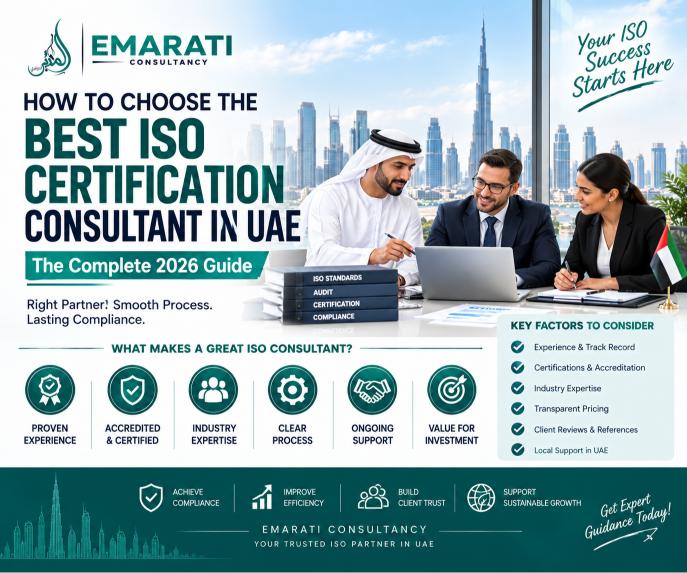
Beyond the questions above there are four specific hidden cost traps that catch UAE businesses after they have committed to an ISO consultancy engagement.
Already mentioned in Question 2 but worth reinforcing as a separate warning. The most common hidden cost in UAE ISO consultancy is a consultancy fee quote that excludes certification body audit fees. These fees add AED 3,000 to AED 15,000 depending on the standard and your organisation size. Always request a total all-inclusive quote in writing before signing.
Some UAE ISO consultancies quote for a minimal scope and then charge additional fees for every element that was actually required for a complete management system implementation. Internal auditor training charged separately. Management review facilitation charged separately. Pre-audit readiness review charged separately. Each individual charge seems reasonable. The total exceeds what a genuinely all-inclusive quote from a quality consultancy would have cost by a significant margin.
Ask for a complete scope of work document before signing — specifying every deliverable included in the quoted price. Anything not listed will be charged as an extra.
Generic template documentation that fails Stage 1 requires rework before Stage 2 can proceed. This rework — whether charged by your original consultant or a replacement consultant — costs money and time that were not in your original budget. The cost of a rushed Stage 2 re-audit after corrective action is significant. The cost of a missed tender deadline while rework proceeds is potentially catastrophic.
If post-certification management system maintenance, surveillance audit preparation and recertification support are not included in your engagement and you discover you need them only when a surveillance audit notification arrives, you will pay whatever rates the consultant or a replacement charges at that point — without the negotiating leverage of a prospective client considering multiple options.
These are the signals that tell you to end the conversation regardless of how competitive the price appears.
Red flag 1 — They cannot name the specific certification body they work with and confirm its EIAC accreditation
If a consultant cannot immediately name the accredited certification body they will recommend for your certification and confirm its EIAC accreditation status, they are either working with unaccredited bodies or have not thought carefully about your specific commercial requirements.
Red flag 2 — They promise certification in significantly less time than realistic industry timelines
ISO 9001 for a small business takes 2 to 4 weeks minimum from implementation start to certificate issue. QHSE IMS takes 4 to 6 weeks minimum. ISO 27001 takes 6 to 10 weeks minimum. Any consultant promising significantly shorter timelines is either cutting implementation corners that will produce audit failures or misrepresenting the timeline to win the engagement.
Red flag 3 — Their price is dramatically lower than market rate without explanation
ISO 9001 certification for a small UAE business from a quality consultancy costs from AED 5,000 all-inclusive. Prices dramatically below this — AED 1,000 to AED 2,000 — indicate either template documentation without genuine implementation support or unaccredited certification bodies. Neither delivers a commercially useful certificate.
Red flag 4 — They pressure you to sign before answering your questions
Any consultant that pressures you to commit before answering the ten questions above — or dismisses your questions as unnecessary — is not a consultant you want managing your ISO certification process. Confidence in their own quality means welcoming scrutiny.
Red flag 5 — They cannot provide industry-specific client references in UAE
A UAE ISO consultancy that cannot provide references from clients in your industry who achieved their specific commercial objective — Dubai Municipality tender qualification, ADNOC vendor registration, DHA supply contract approval — is asking you to trust their general capabilities without evidence of relevant specific outcomes.
After understanding what to avoid it is worth articulating what genuine quality looks like — because the best UAE ISO consultants do several things that average ones do not.
They begin with your commercial objective — not the ISO standard. The right starting question is not which standard do you want to implement but what commercial outcome do you need and which certification achieves it most efficiently. The standard choice follows from the commercial objective — not the other way around.
They know your procurement target better than you do. The best UAE ISO consultants know exactly what documentation language ADNOC requires in a QHSE IMS scope statement, exactly which environmental aspects ADNOC auditors assess most carefully for oil and gas contractors and exactly which management system evidence Dubai Municipality inspectors look for during contractor prequalification. This specific procurement knowledge is what makes the difference between a certificate that satisfies the buyer and one that needs re-scoping.
They build systems that work operationally. The best ISO management systems are not just audit-ready — they are operationally useful. Quality objectives that genuinely guide business decisions. Environmental monitoring that actually prevents incidents. Safety procedures that your workforce follows because they are practical rather than bureaucratic. Management systems built to be used rather than filed are the ones that consistently pass surveillance audits without emergency preparation.
They are transparent about limitations. The best consultants tell you honestly when your timeline is not achievable, when your budget is not realistic for the quality of certification you need or when a specific procurement target will require more implementation depth than initially estimated. This honesty is uncomfortable in the short term and commercially valuable in the long term.
Whatever consultant you choose the certification body they recommend must be independently verifiable. Here is exactly how to verify any certification body before your consultant engages them.
Step 1 — Go to the EIAC website — the Emirates International Accreditation Centre — which operates under the Emirates Authority for Standardisation and Metrology. Search for the certification body by name in the accredited bodies register.
Step 2 — Confirm the specific standards they are accredited to certify. A certification body may hold EIAC accreditation for ISO 9001 but not for ISO 27001 or ISO 13485. Verify that their accreditation covers your specific standard.
Step 3 — Confirm their accreditation is current — not lapsed or suspended. EIAC accreditation must be renewed periodically and accreditations can lapse. A lapsed accreditation means certificates issued during the lapse period may not be accepted by UAE procurement authorities.
Step 4 — Ask the certification body directly which UAE government procurement systems accept their certificates. Dubai Municipality, ADNOC, RTA, DEWA and Abu Dhabi government procurement all verify certification body accreditation differently. Confirm your specific procurement target accepts certificates from this body before your audit begins.
Understanding realistic cost ranges helps you identify quotes that are suspiciously low — indicating hidden fees or poor quality — and quotes that are unjustifiably high for the scope delivered.
| Standard | Small Business All-Inclusive | Medium Business All-Inclusive |
|---|---|---|
| ISO 9001 | AED 5,000 — 8,000 | AED 8,000 — 15,000 |
| ISO 14001 | AED 5,000 — 8,000 | AED 8,000 — 15,000 |
| ISO 45001 | AED 5,000 — 8,000 | AED 8,000 — 15,000 |
| QHSE IMS | AED 10,000 — 15,000 | AED 15,000 — 25,000 |
| ISO 27001 | AED 10,000 — 15,000 | AED 15,000 — 25,000 |
| HACCP | AED 4,000 — 7,000 | AED 7,000 — 12,000 |
All figures above are all-inclusive — covering consultancy fees and certification body audit fees combined. Any quote significantly below these ranges for your organisation size should be questioned carefully using the questions above before committing.
We include this section not because we expect you to take our word for it — but because you should ask every ISO consultant including us these same questions and compare the answers.
On Question 1 — certification body: Emarati Consultancy works exclusively with EIAC accredited certification bodies whose certificates are accepted by Dubai Municipality, ADNOC, RTA, DEWA and international supply chain verification systems. We advise every client on the right certification body for their specific commercial objectives before any engagement begins.
On Question 2 — all-inclusive pricing: Every Emarati Consultancy proposal covers both consultancy fees and certification body audit fees in a single all-inclusive figure. There are no additional fees at any stage. No scope creep. No surprises.
On Question 3 — audit presence: Emarati Consultancy consultants are present throughout Stage 2 audits for every client. We do not deliver documentation and disappear. We are there when it matters.
On Question 4 — customised documentation: Emarati Consultancy develops all documentation specifically for each client’s operations, terminology, processes and UAE regulatory environment. We do not use generic templates.
On Questions 5 and 6 — industry experience and pass rate: Emarati Consultancy has certified UAE businesses across construction, oil and gas, food, healthcare, technology, education, logistics and manufacturing. Our first-time pass rate is the performance metric we are most proud of — contact us to discuss it directly.
ISO certification consultant fees in UAE vary significantly. All-inclusive prices — covering both consultancy fees and certification body audit fees — range from AED 4,000 for HACCP for small food businesses to AED 25,000 for ISO 27001 for medium technology companies. Any price dramatically below these ranges warrants careful questioning about what is included and which certification body is being used. Always request a written all-inclusive quote before committing.
ISO certification is not legally mandatory for all UAE businesses — but it is effectively mandatory for UAE government tender qualification, ADNOC vendor registration and most international supply chain participation. A qualified consultant is not legally required but is commercially advisable. The 70 percent first-time audit failure rate for ISO 27001 and meaningful failure rates for other standards among self-implementing organisations demonstrate the commercial risk of implementation without experienced support. The cost of a failed first audit consistently exceeds the consultant fee savings.
Verify the certification body on the EIAC — Emirates International Accreditation Centre — accredited bodies register. Confirm their accreditation covers your specific standard and is currently valid. Ask the certification body directly which UAE procurement systems accept their certificates. Any certification body that cannot be independently verified on the EIAC register should not be used for UAE government tender or ADNOC vendor registration purposes.
ISO 9001, ISO 14001 and ISO 45001 for small businesses take 2 to 4 weeks each from implementation start to certificate issue. QHSE IMS combining all three takes 4 to 6 weeks. ISO 27001 takes 6 to 10 weeks for small businesses. Any consultant promising significantly shorter timelines is either cutting corners or misleading you. Management commitment is the most important factor — businesses where senior leadership actively champions implementation consistently certify faster than those treating it as a background project.
An ISO consultant helps your organisation build and implement the management system required for ISO certification — conducting gap analysis, developing documentation, training staff, facilitating internal audits and preparing you for the certification body audit. A certification body is the accredited third-party organisation that independently audits your management system and issues your ISO certificate. You need both. The consultant is your preparation partner. The certification body is your independent assessor. They must be separate organisations — a consultant cannot issue the certificate for the client they have been advising.
Yes. There is no regulatory requirement for an ISO consultant. However the first-time audit failure rates for self-implementing organisations consistently exceed those working with experienced consultants — particularly for ISO 27001 where the risk assessment and Statement of Applicability complexity make self-implementation genuinely difficult. The commercial cost of a failed first audit — re-audit fees, delayed certification, missed tender deadlines — consistently exceeds the consultancy fee savings from self-implementation. Emarati Consultancy provides a free consultation that helps you honestly assess whether your organisation has the internal capability for self-implementation before you make this decision.
Ask whether their price is all-inclusive covering certification body fees. Ask which EIAC accredited certification body they recommend and why. Ask whether they will be present throughout Stage 2. Ask for industry-specific documentation examples. Ask for their first-time pass rate. Ask what support is available post-certification. Ask for UAE trade licence and professional indemnity insurance details. A quality consultant welcomes all of these questions. A poor consultant deflects them.
Verify the certificate by checking the certification body name on the EIAC accredited bodies register. Confirm the certificate number with the certification body directly through their published contact details — not through the contact details provided by the company presenting the certificate. Check the certificate scope matches what the procurement authority requires. A genuine certificate from an EIAC accredited body can be independently verified within minutes. A fake or unaccredited certificate cannot withstand this verification.
The right ISO certification consultant in UAE is the one who answers all ten questions above clearly, provides an all-inclusive written quote, demonstrates UAE-specific regulatory knowledge for your procurement target, shows industry-specific UAE experience, commits to audit presence and offers transparent post-certification support. That is the standard every UAE business should hold their ISO consultant to — and the standard Emarati Consultancy holds itself to every day.
Whether you are a construction company preparing for Dubai Municipality tender qualification, an oil and gas contractor pursuing ADNOC vendor registration, a food business needing HACCP for Dubai Municipality compliance, a technology company implementing ISO 27001 or any UAE business investing in ISO certification for the first time or reconsidering a previous choice — Emarati Consultancy provides the UAE-specific expertise, transparent pricing and genuine implementation support that your commercial objectives require.
Phone: +971 52 856 0299
Email: info@emaraticonsultancy.ae
Office: City Bay Business Centre, Office 303, Near Abu Bakr Metro Station, Dubai, UAE
Looking for reliable ISO renewal services in the UAE? Our specialists in Dubai, Abu Dhabi, and Sharjah help you align your OHSMS with updated ISO 45001 requirements, ensuring continuous compliance and smooth recertification.
The great explorer of the truth, the master-builder of human happiness no one rejects dislikes avoids pleasure itself because it is pleasure but because know who do not those how to pursue pleasures rationally encounter consequences that are extremely painful desires to obtain.
Read More