8:00AM - 6:00PM
Monday to Saturday
Monday to Saturday
+971 52 856 0299
Hor Al Anz


By Emarati Consultancy | ISO Certification Consultant Experts in UAE | Updated 2026
There is something the UAE ISO certification market does not talk about openly enough. A significant number of ISO certificates in circulation across Dubai and Abu Dhabi are not genuine. They were not issued following a real audit. They were not issued by an accredited certification body. They will not pass verification by Dubai Municipality, ADNOC, UAE government procurement systems or any serious international client performing supplier due diligence.
And the most important thing to understand about fake ISO certificates in UAE is this. You cannot tell by looking at them. The days when fake certificates were identifiable by poor formatting, wrong logos or clumsy wording are over. Modern fake certificates are visually indistinguishable from genuine ones. The only way to know whether an ISO certificate is real is to verify it against the right registers — independently, following a specific process that most UAE businesses do not know.
This guide tells you everything. What a fake ISO certificate actually is. The four types of certificate fraud operating in UAE. What a fake certificate costs when it is discovered. The exact two-step verification process that tells you in under 60 seconds whether any ISO certificate is genuine. And why the real thing — from the right consultant, through the right certification body — costs a fraction of what the fake one costs when it fails.
The UAE ISO certification market creates specific conditions that make fake certificates commercially attractive to both sellers and buyers.
UAE government procurement systems, ADNOC vendor registration and international client qualification frameworks all require ISO certification as a threshold criterion. A company without certification is excluded from consideration entirely. This creates strong pressure on businesses that need certification quickly — particularly small businesses facing their first government tender with a short submission timeline.
Into this pressure steps a category of providers offering ISO certification at AED 1,000 to AED 2,000 with one-day audits, online-only processes or certificates issued without any site visit at all. The price is attractive to businesses that do not understand what genuine certification costs or why. The certificate looks real. And the problem only becomes visible when the certificate is verified by a procurement authority or client — at which point the consequences are severe.
The problem is not confined to small businesses making naive decisions. Established UAE companies have been caught presenting unaccredited certificates in government tender submissions. The pattern repeats because the upfront cost saving is visible and the discovery risk appears low — until it is not.
Understanding the specific types of certificate fraud in the UAE market helps you recognise them when you encounter them — whether evaluating a supplier’s certificate or assessing whether your own certification process is legitimate.
Forged certificates created by altering genuine certificates from legitimate organisations. A real ISO 9001 certificate held by one company is used as a template — the company name, address, certificate number and dates are changed while the certification body name and accreditation marks remain. The result looks identical to a genuine certificate because most of it is. The only way to identify a complete forgery is to verify the specific certificate number against the certification body’s own registry — which will show either no record or a record belonging to a different organisation.
This is the most dangerous type of fake certificate because it withstands casual verification. A fraudulent body creates a certification organisation with a credible-sounding name — International Quality Assurance Board, Global Standards Certification Institute, World Quality Organisation. They create a professional website, issue certificates with formal-looking accreditation marks and reference their own “accreditation” which they have created themselves. When a recipient searches the certification body name they find a legitimate-looking website with a verification page that confirms the certificate — because the fraudulent body operates its own verification system. The certificate fails only when you verify it against the EIAC accredited bodies register — where it does not appear.
A company held genuine ISO certification that subsequently lapsed — because they missed a surveillance audit, received a major non-conformity that was not resolved or chose not to renew. Their certificate is technically genuine for the period it was valid. But they continue presenting it as current — either deliberately or through genuine confusion about whether it remains valid after the expiry date. An expired certificate is not an active certification. It provides no commercial qualification and does not satisfy any UAE procurement requirement.
The most common type of fake certificate in UAE — and the hardest for most businesses to identify. A certification body issues ISO certificates but does not hold accreditation from EIAC or any recognised IAF member accreditation body. Their audits may be genuine — they may actually visit your site and conduct some form of assessment. Their certificates look professionally produced. But because the certification body is not accredited by a recognised body, their certificates are not accepted by Dubai Municipality, ADNOC, UAE government procurement systems or international supply chain partners. Businesses that purchase these certificates have invested in something with zero commercial value.
This is the most important section of this entire guide — and the insight that most UAE businesses discover too late.
The conventional advice about spotting fake certificates focuses on visual inspection. Check the logo. Check the formatting. Check the certificate number format. Check whether it looks professionally produced.
This advice no longer works. Forgers have caught up with every visual verification technique. Modern certificate fraud produces documents that are visually identical to genuine certificates — correct logos, correct formatting, correct accreditation marks, professional printing, accurate-looking certificate numbers. Visual inspection tells you nothing about whether a certificate is genuine.
There is only one reliable way to verify an ISO certificate — and it requires checking two separate registers independently, navigating to them yourself rather than through any link provided on the certificate or by the certificate holder. Both checks must pass. One passing alone proves nothing.
This is the exact process to follow for any ISO certificate you need to verify — whether you are a procurement officer assessing a supplier submission, a business owner verifying your own certification body before engaging them or someone who has received a cheap certification quote and wants to check whether the body behind it is legitimate.
Navigate independently to the EIAC website — the Emirates International Accreditation Centre, operating under the Emirates Authority for Standardisation and Metrology. Do not use a link provided on the certificate or by the company presenting it. Type the EIAC address directly into your browser or search for it independently.
In the EIAC accredited bodies register search for the certification body name exactly as it appears on the certificate. Confirm that the certification body appears in the register, that their accreditation covers the specific ISO standard on the certificate and that their accreditation is currently valid — not lapsed or suspended.
If the certification body does not appear on the EIAC register the certificate is not acceptable for Dubai Municipality, ADNOC or UAE government procurement regardless of how professional it looks. Stop here. The certificate is not genuine for UAE commercial purposes.
If the certification body appears on the EIAC register proceed to Step 2.
Having confirmed the certification body is EIAC accredited proceed to verify that the specific certificate was actually issued by that body. Navigate independently to the certification body’s own certificate verification system — again using their official website address found through independent search, not a link on the certificate.
Enter the certificate number exactly as shown on the certificate. The search should return a record showing the certificate holder’s name, the certified standard, the certification scope, the issue date and the expiry date. Confirm that all details match what is shown on the certificate presented to you.
If the certificate number returns no record — or returns a record for a different organisation — the certificate is either forged or the certificate number has been fabricated. If the details do not match what is on the presented certificate, the certificate has been altered.
Both steps must be completed and both must pass. Step 1 alone passing confirms the certification body exists and is accredited — it does not confirm that this specific certificate was issued to this specific organisation. Step 2 alone passing against a fraudulent certification body’s own verification system confirms nothing — because a fraudulent body can create any verification result they choose on their own website.
Both steps. Both passing. That is the only reliable verification.
ISO Certification International Organization for Standardization
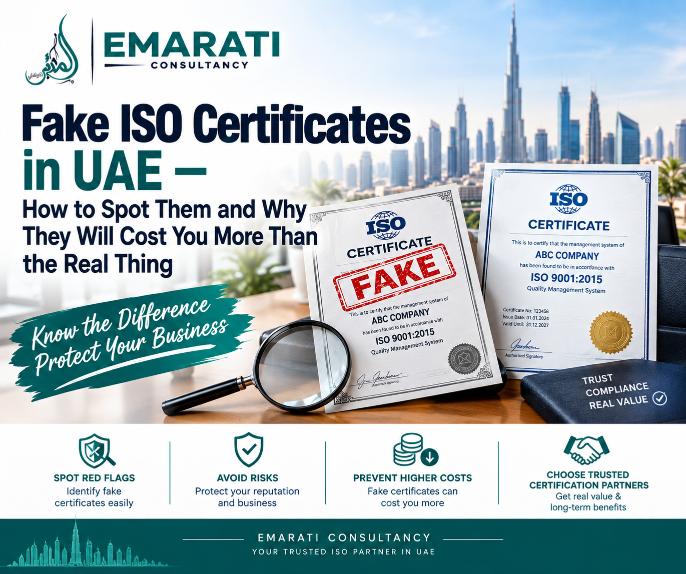
While visual inspection alone cannot confirm a certificate is genuine, certain visual signals are worth noting as reasons to proceed to the two-step verification process immediately.
Legitimate Stage 2 certification audits for a 50-person organisation require a minimum of 3 to 4 days under IAF MD 5 mandatory audit duration rules. If a certificate shows certification for a 100-person company following what the consultant claims was a one-day or two-day audit — the audit duration violated mandatory standards. Either the certification body did not comply with international audit duration requirements or the certificate does not reflect a genuine audit.
Most established accredited certification bodies use specific certificate number formats that follow consistent patterns across their certificate portfolio. Very short certificate numbers, very simple sequential numbers or numbers that do not match the format of other certificates from the same body are worth querying — though this alone does not confirm forgery.
Names like International Quality Standards Board, Global ISO Certification Institute, World Quality Assurance Organisation and similar constructions are specifically designed to sound like legitimate international bodies without being verifiable. If the certification body name is not immediately recognisable and cannot be found on the EIAC accredited bodies register — proceed with maximum caution regardless of how professional the certificate looks.
ISO 27001 for a medium organisation takes 10 to 16 weeks minimum for a quality implementation. QHSE IMS for a medium construction company takes 6 to 10 weeks. If a company claims they achieved ISO 27001 certification in 3 weeks, either their implementation was so superficial it will not satisfy a competent auditor at the next surveillance or the certificate is not genuine.
ISO 9001 from a quality EIAC-accredited consultancy for a small UAE business costs from AED 5,000 all-inclusive covering consultancy and certification body fees. HACCP from AED 4,000. Any ISO certification being offered for AED 500 to AED 2,000 is either from an unaccredited certification body or involves no genuine implementation support. At these prices the certificate has zero commercial value for UAE government tenders or ADNOC vendor registration.
The commercial logic behind purchasing a fake or unaccredited ISO certificate appears straightforward. Genuine certification costs AED 5,000 to AED 25,000 depending on the standard. A fake certificate costs AED 500 to AED 2,000. The saving is real. The risk appears manageable.
The calculation is wrong. Here is the real cost arithmetic.
A UAE construction company presents an ISO 9001 certificate from an unaccredited certification body in a Dubai Municipality tender submission. The procurement officer verifies the certificate using the EIAC register. The certification body is not found. The tender submission is disqualified. The contract value is AED 3,000,000. The saving on the fake certificate was AED 4,000. The cost of using it is AED 3,000,000 in lost revenue.
This calculation repeats across every tender the fake certificate is presented for — because the disqualification happens every time verification is performed by a serious procurement authority.
ADNOC’s vendor management system flags certificate verification failures. A company that presents an unaccredited ISO certificate during ADNOC vendor registration faces not just rejection of the current application but potential suspension from future registration windows. For an oil and gas service company for whom ADNOC contracts represent their primary revenue opportunity, suspension from vendor registration is commercially catastrophic in a way that no certificate cost saving could justify.
Using fraudulent documents in UAE government tender submissions carries serious legal consequences. UAE law treats the submission of false or misleading documents in government procurement as a criminal matter — with penalties that can include fines, imprisonment and deportation for individuals involved. The use of a certificate from an unaccredited body — particularly if the company knew or should have known the body was not genuinely accredited — creates significant legal exposure beyond the commercial consequences of disqualification.
A UAE business discovered to have presented a fake ISO certificate in a government tender submission does not simply lose that tender. The discovery is recorded in procurement databases. Future tender submissions face heightened scrutiny. The business’s reputation with procurement officers — who communicate with each other — is damaged in ways that take years to recover from. For a business whose commercial model depends on government procurement relationships, the reputational cost of one discovered fake certificate can exceed the value of many years of genuine certification investment.
If you hold ISO certification and have not independently verified your certification body on the EIAC accredited bodies register — do it now. Navigate to the EIAC website. Search for your certification body by name. Confirm their accreditation covers your specific standard and is currently valid. If they appear — you are protected. If they do not appear — contact Emarati Consultancy immediately for an assessment of your options before your next tender submission.
If you are a procurement officer or business owner receiving ISO certificates from suppliers, apply the two-step verification process to every certificate before relying on it for qualification decisions. The two-step process takes under 60 seconds once you know the EIAC register and the certification body’s verification system. The alternative — accepting certificates at face value — creates supply chain qualification risk and potential liability for your own procurement decisions.
If you have been considering cheap ISO certification options — or if this article has made you question whether your current certificate is genuine — the right action is to begin genuine accredited certification now. The cost difference between genuine and fake certification is typically AED 3,000 to AED 5,000 for small businesses. The commercial consequence difference — measured in tender wins, ADNOC vendor status and client relationships — is orders of magnitude larger.
Emarati Consultancy works exclusively with EIAC accredited certification bodies. Every certificate we help our clients achieve is independently verifiable on the EIAC accredited bodies register and the certification body’s own certificate registry. Before recommending any certification body to any client we verify their current accreditation status for the specific standard and confirm their acceptance by the specific UAE procurement authorities our client is targeting.
We also provide free certificate verification support for any UAE business that is uncertain about their current certification body’s accreditation status. If you have received a certification quote from an unknown body and want to verify their legitimacy before committing — contact us and we will verify it for you.
Fake and unaccredited ISO certificates are a documented problem in the UAE market. The combination of strong commercial demand for ISO certification — driven by government tender requirements and ADNOC vendor registration — and a significant price differential between genuine and fake certificates creates a market for fraudulent certification. While no official figures exist for the prevalence of fake certificates in UAE, the problem is sufficiently documented that Dubai Municipality, ADNOC and UAE government procurement authorities all actively verify certification body accreditation as part of their supplier qualification processes.
Use the two-step process. Step 1 — navigate independently to the EIAC website and search for the certification body name in the accredited bodies register. Confirm they are accredited for the specific standard and their accreditation is currently valid. Step 2 — navigate independently to the certification body's official website and use their certificate verification system to confirm the specific certificate number was issued to the specific organisation. Both steps must pass. One step alone is insufficient.
Using a fake or unaccredited ISO certificate in a UAE government tender submission results in disqualification of that specific tender. Depending on the circumstances and the specific procurement authority, consequences can include formal blacklisting from future tender submissions, referral for investigation under UAE procurement fraud regulations and potential criminal proceedings for individuals involved in knowingly submitting false documents. The commercial and legal consequences significantly exceed the cost of genuine certification.
No — not reliably. Modern fake certificates are visually indistinguishable from genuine ones. Correct logos, professional formatting, accurate-looking certificate numbers and genuine-looking accreditation marks can all be reproduced by sophisticated forgers. Visual inspection is not a reliable verification method. The only reliable verification is the two-step process checking the EIAC accredited bodies register and the certification body's certificate registry independently.
A self-accreditation scam involves a fraudulent entity creating both a certification body and a fake accreditation body to accredit it — giving the appearance of a properly accredited certification chain. The names sound legitimate — International Quality Standards Board, World Quality Assurance Organisation. Their websites look professional and include verification systems that confirm certificates they issue. The fraud is exposed only by checking the EIAC accredited bodies register — where neither the certification body nor their fake accreditor appears. Always verify on the EIAC register independently.
This is a genuinely complex situation. If your certification body held valid EIAC accreditation when your certificate was issued but subsequently lost it, your certificate's acceptability depends on the specific procurement authority. Some authorities assess accreditation status at the point of tender submission — meaning a certificate from a body that has since lost accreditation may not be accepted even if it was legitimately issued. Contact your certification body immediately if you discover their accreditation has lapsed and seek advice on whether recertification through an accredited body is required.
Genuine ISO certification from an EIAC accredited certification body through a quality consultant costs from AED 4,000 for HACCP for small food businesses, from AED 5,000 for ISO 9001 for small businesses and from AED 10,000 for ISO 27001 for small businesses — all-inclusive covering consultancy and certification body fees. Fake certificates from unaccredited bodies are typically offered for AED 500 to AED 2,000. The cost difference is AED 3,000 to AED 8,000. The commercial consequence difference — measured in tender wins and losses — is typically hundreds of thousands to millions of dirhams.
Contact Emarati Consultancy immediately for a free assessment. Do not use the certificate in any tender submission or client qualification process until you have clarified its status. Depending on your situation the options include transitioning to genuine accredited certification through the most efficient pathway, understanding whether any pending tender submissions need to be addressed urgently and assessing the commercial timeline for achieving genuine certification before your next critical procurement deadline.
An ISO certificate from an EIAC accredited certification body following a genuine audit is one of the most commercially valuable management system credentials a UAE business can hold. It opens government tenders. It enables ADNOC vendor registration. It qualifies you for international supply chains. It demonstrates to clients and partners that your quality, environmental, safety or information security management meets internationally recognised standards.
A fake certificate — regardless of how professionally it looks — is none of these things. It is a document that will fail verification at the moment it matters most. And the moment it fails will always be the moment when the commercial consequences are highest — the tender you most needed to win, the ADNOC registration window you had waited months for, the client relationship you most valued.
The difference in upfront cost between genuine and fake certification is thousands of dirhams. The difference in commercial outcome is potentially millions.
Whether you need to verify a certificate you already hold, assess a supplier’s certification claims or achieve genuine accredited certification from the right body for your specific UAE procurement objectives — Emarati Consultancy provides the UAE-specific expertise, certification body relationships and transparent implementation approach that delivers certificates that pass every verification.
Phone: +971 52 856 0299
Email: info@emaraticonsultancy.ae
Office: City Bay Business Centre, Office 303, Near Abu Bakr Metro Station, Dubai, UAE
Looking for reliable ISO renewal services in the UAE? Our specialists in Dubai, Abu Dhabi, and Sharjah help you align your OHSMS with updated ISO 45001 requirements, ensuring continuous compliance and smooth recertification.
The great explorer of the truth, the master-builder of human happiness no one rejects dislikes avoids pleasure itself because it is pleasure but because know who do not those how to pursue pleasures rationally encounter consequences that are extremely painful desires to obtain.
Read More