8:00AM - 6:00PM
Monday to Saturday
Monday to Saturday
+971 52 856 0299
Hor Al Anz

ADNOC has committed AED 220 billion to the UAE economy through the National In-Country Value Programme over the next five years — as part of a total AED 551 billion capital expenditure plan for 2026 to 2030. Every dirham of that procurement opportunity is accessible only to companies holding a valid ICV certificate. Without one your tender submission receives a score of zero in the ICV evaluation — effectively disqualifying your bid before technical assessment begins.
Emarati Consultancy provides expert ICV certification consultancy for UAE businesses across every sector — preparing your financial documentation, completing the MoIAT ICV template, registering on the National ICV Portal and guiding you through the entire certification process from initial assessment to certificate issued. We help you not just obtain your ICV certificate but maximise your ICV score — because the difference between a 40 percent score and a 70 percent score can determine whether you win or lose an ADNOC contract worth millions of dirhams.
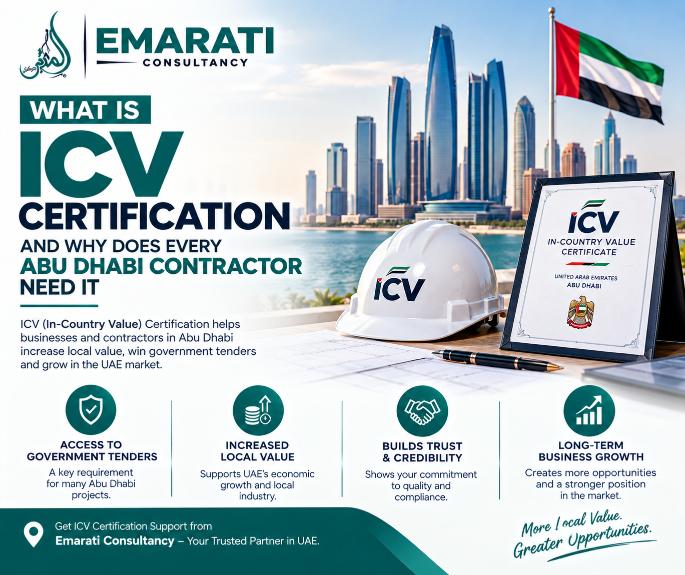
ICV — In-Country Value — is the measure of how much value a company contributes to the UAE economy through local employment, local procurement, local investment and Emiratisation. The National ICV Programme is governed by the Ministry of Industry and Advanced Technology — MoIAT — and applies across all sectors of the UAE economy — not just oil and gas.
An ICV certificate is the official document issued by a MoIAT-approved certifying body confirming your company’s ICV score for a specific financial year. This certificate is required by ADNOC and its subsidiaries, Abu Dhabi government entities, Mubadala, Aldar Properties, Emirates Nuclear Energy Corporation ENEC and every other participating entity when evaluating supplier bids for contracts.
The commercial logic is straightforward. The UAE government wants companies operating in UAE to create economic value locally — through hiring UAE nationals, sourcing from local suppliers, investing in UAE assets and training Emirati talent. Companies that do this more effectively receive higher ICV scores. Higher ICV scores receive more favourable treatment in tender evaluations. The ICV certificate is the independently verified evidence of your local economic contribution.
One of the most commercially important facts about ICV certification that most UAE businesses do not know is this. Your ICV certificate is issued as a single certificate per legal entity — valid for use across every participating entity in the National ICV Programme simultaneously. One certificate covers ADNOC and all its subsidiaries, Mubadala, Abu Dhabi government procurement, Aldar, ENEC and every other entity participating in the national programme. You do not need a separate certificate for each buyer. One properly obtained ICV certificate opens every door simultaneously.
The answer is broader than most UAE businesses realise.
Every company bidding for contracts with ADNOC and any of its operating companies — ADNOC Drilling, ADNOC Offshore, ADNOC Onshore, ADNOC Gas Processing, ADNOC Refining, ADNOC Distribution, ADNOC Logistics and Services and all other ADNOC subsidiaries — needs an ICV certificate. ADNOC’s procurement process builds ICV scoring into every tender evaluation. Companies without a valid ICV certificate receive a score of zero in the ICV component — which in competitive tender evaluations means effective disqualification.
ISO certification in Abu Dhabi
Abu Dhabi government procurement across all departments — Department of Energy, Department of Municipalities and Transport, Abu Dhabi Public Works, Department of Health and all other Abu Dhabi government entities participating in the National ICV Programme — requires a valid ICV certificate from suppliers bidding on qualifying contracts. As Abu Dhabi’s government procurement digitalisation expands, ICV certificate verification is increasingly integrated into procurement portal supplier qualification steps.
The National ICV Programme extends well beyond ADNOC and Abu Dhabi government. Mubadala Investment Company, Aldar Properties, Emirates Nuclear Energy Corporation and the growing number of private and semi-government entities participating in the programme all require ICV certificates from qualifying suppliers. The programme is expanding year on year — meaning more buyers requiring ICV certificates from more suppliers across more sectors than ever before.
ICV certification is not an oil and gas requirement. It is a UAE economic contribution requirement that applies equally to IT companies, construction contractors, healthcare providers, logistics operators, training companies, catering businesses, facilities management firms and professional services providers. If your company is bidding for any qualifying contract with any participating entity — regardless of your industry — you need an ICV certificate.
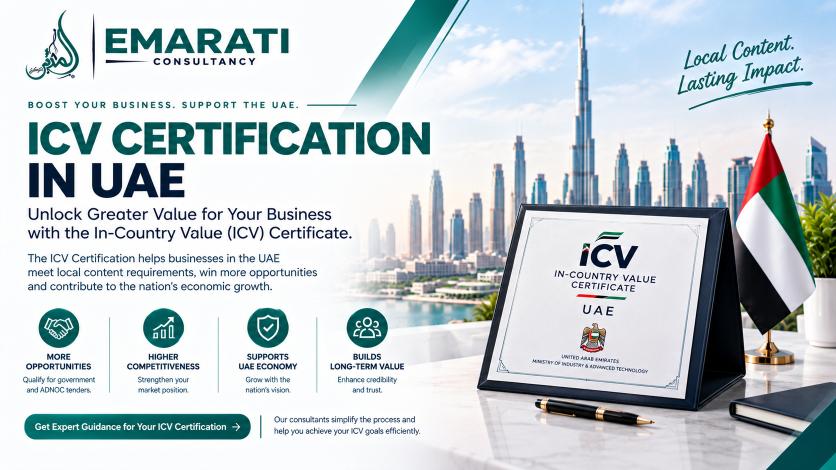
Understanding ICV scoring is the key to understanding why the quality of your ICV submission matters as much as whether you have a certificate at all.
ICV scores range from 0 to 100 percent — representing the percentage of your company’s total economic activity that creates value within the UAE economy. A score of 0 means your company creates no identifiable local economic value. A score of 100 means every dirham your company spends creates value within UAE.
In practice ICV scores in UAE distribute as follows. Scores below 30 percent are considered weak and may indicate that a company is not genuinely contributing to the local economy at a meaningful level. Scores of 30 to 50 percent are considered acceptable and qualify for standard tender participation. Scores of 50 to 70 percent are competitive and provide meaningful advantage in tender evaluations. Scores above 70 percent are strong and provide significant competitive advantage. Top performing UAE companies consistently reach 80 to 90 percent.
In ADNOC tender evaluations ICV scores are incorporated into the commercial bid evaluation — with higher ICV scores generating preference in the supplier selection process. A supplier with an equivalent technical and commercial proposal but a higher ICV score will be preferred. In competitive tenders where technical proposals are comparable, ICV score can be the determining factor between winning and losing a contract.
This means that not just having an ICV certificate — but having a high ICV score — is the genuine commercial objective. Emarati Consultancy does not just help you obtain an ICV certificate. We help you structure your ICV submission to legitimately maximise your score based on a thorough analysis of your actual economic contributions — so your certificate does the maximum commercial work in every tender evaluation.
Your ICV score is calculated from six categories of economic contribution — each carrying a specific weight in the MoIAT formula.
The wages and salaries paid to UAE national employees carry the highest weighting in the ICV formula — reflecting the national priority of Emiratisation. Total employee cost for all employees — both UAE nationals and expatriates — is also included, but UAE national employees generate significantly higher ICV contribution per dirham of salary than expatriate employees.
Spending on products and services sourced from UAE-based suppliers generates ICV contribution. This covers raw materials, components, equipment, consumables and professional services purchased from UAE-registered businesses. Documenting and correctly categorising your local procurement is one of the most impactful areas for ICV score improvement — because many companies undercount their local spend due to poor procurement tracking.
Investment in technology transfer to UAE entities, local research and development and the training of UAE national employees in technical skills generates ICV contribution in this category.
Capital investment in UAE — equipment, machinery, vehicles, property and infrastructure — generates ICV contribution through asset depreciation calculated within the ICV formula.
Spending on third-party services, subcontractors and outsourced activities where those third parties are UAE-registered businesses generates ICV contribution — provided the spending is correctly documented and categorised.
Profits retained and reinvested within the UAE economy rather than repatriated overseas generate ICV contribution in this category.
Valid UAE trade licence — current and covering activities consistent with the operations being certified. IFRS-compliant audited financial statements — not older than two years from the certification year. For established companies these are your annual audited accounts. For startups under 10 months old, management financial statements covering 1 to 9 months audited by an approved accounting firm can be used.
Completed MoIAT ICV template — the official spreadsheet that maps your financial data against the six ICV score components. This template requires detailed categorisation of employee costs, procurement spend, asset values and third-party payments — and its accurate completion is where most companies either maximise or undercount their ICV score.
UAE Pass registration — for portal access and certificate submission. NAFIS registration — required as a prerequisite for ICV certification as part of the Emiratisation tracking requirement.
H3
Supporting documentation for score substantiation
Procurement invoices and contracts with UAE-registered suppliers. Payroll records showing employee nationalities and cost allocation. Asset register with depreciation calculations for UAE-based assets. Subcontractor agreements with UAE-registered third parties. Training records for UAE national employee development programmes. Bank statements or financial records supporting reinvested profit claims.
The quality and completeness of your supporting documentation directly determines whether your claimed ICV score is verified or reduced during the certifying body’s review process. Companies that present well-organised, complete supporting documentation consistently achieve higher verified scores than those presenting incomplete records — even when their actual economic contributions are equivalent.
We begin with a free assessment of your company’s operations — reviewing your employee profile, procurement patterns, asset base and third-party spending — to estimate your likely ICV score before you commit to any certification engagement. This assessment tells you whether your current operations support a competitive ICV score and identifies the specific areas where legitimate improvements could be made before submission.
We review your audited financial statements for IFRS compliance and ICV certification suitability. We identify any gaps in financial documentation that could delay certification or reduce your verified score. We advise on any legitimate operational adjustments — increased local procurement, enhanced UAE national hiring, asset registration improvements — that could improve your score for future certification cycles.
We complete the official MoIAT ICV template on your behalf — mapping your financial data against all six ICV score components with the supporting documentation required for each claim. Accurate template completion is the single most impactful factor in achieving a high verified ICV score. Common template errors — incorrect cost categorisation, missing supporting documentation, wrong currency or entity mapping — consistently reduce verified scores below what companies’ actual economic contributions justify.
We register your company on the MoIAT National ICV Portal via UAE Pass if not already registered, confirm NAFIS registration status and submit your completed ICV application with all supporting documentation to your selected MoIAT-approved certifying body.
We liaise with the MoIAT-approved certifying body throughout their review and verification process — responding to queries, providing additional documentation as required and ensuring the verification process completes as efficiently as possible.
Your ICV certificate is issued and we support you in updating your ICV score on the ADNOC Supplier Portal and any other relevant procurement portals to ensure your verified score is immediately visible to procurement officers evaluating your bid submissions.
ICV certificates are valid for 14 months from the date of the audited financial statements used for certification. We provide annual renewal support — preparing updated financial documentation, completing the refreshed MoIAT template and managing the renewal submission — ensuring your ICV certificate never lapses and your tender eligibility is never interrupted.
ICV certification costs consist of two components — the MoIAT platform fee and the professional verification fee charged by the MoIAT-approved certifying body.
| Company Size | MoIAT Platform Fee | Certifying Body Fee | Emarati Consultancy Fee | Total All-Inclusive |
|---|---|---|---|---|
| Small — up to 30 employees | AED 500 | AED 2,000 — 4,000 | AED 2,000 — 3,000 | AED 4,500 — 7,500 |
| Medium — 30 to 150 employees | AED 500 | AED 4,000 — 7,000 | AED 3,000 — 5,000 | AED 7,500 — 12,500 |
| Large — 150+ employees | AED 500 | AED 7,000 — 10,000 | AED 5,000+ | AED 12,500+ |
| SME Programme eligible | AED 500 reduced | AED 2,000 — 4,000 | AED 2,000 — 3,000 | AED 4,500 — 7,500 |
Note — companies eligible for the UAE National Programme for SMEs benefit from the reduced AED 500 MoIAT certification fee. Emarati Consultancy advises on SME programme eligibility as part of the free initial assessment.
Annual renewal cost is typically 70 to 80 percent of initial certification cost — because your financial documentation foundation is already established and only updates are required.
Get a transparent all-inclusive ICV quote
| Stage | Duration |
|---|---|
| Initial assessment and financial review | 3 to 5 days |
| MoIAT template completion and documentation preparation | 5 to 10 days |
| Portal registration and submission | 1 to 2 days |
| Certifying body review and verification | 1 to 3 weeks |
| Certificate issued | 1 to 2 days after verification |
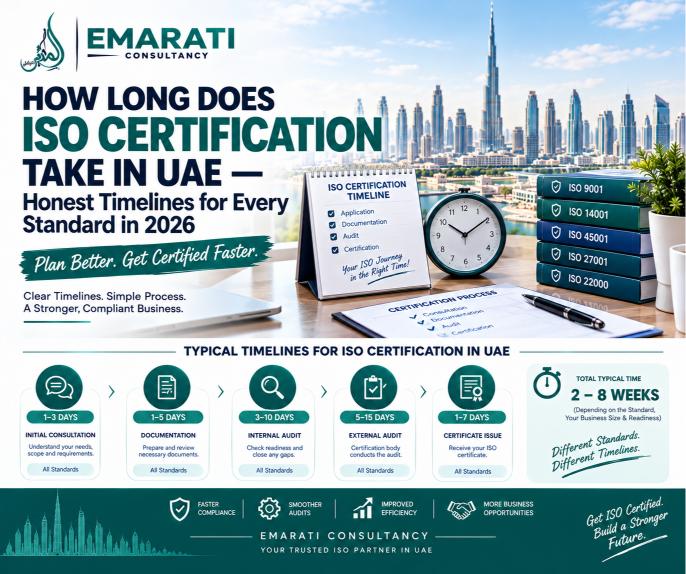
| Total from engagement to certificate | 2 to 6 weeks |
The most significant variable in ICV certification timeline is the completeness and quality of your financial documentation at the start of the process. Companies with well-organised audited financial statements and complete procurement and payroll records consistently complete the process in 2 to 3 weeks. Companies with documentation gaps that require resolution before submission take longer.
Most UAE companies leave ICV score points on the table not through lack of local economic contribution but through poor documentation and incorrect template completion. Here are the legitimate strategies for maximising your ICV score.
UAE national employees generate the highest per-employee ICV contribution. If your Emiratisation programme is active but not fully documented in your payroll and HR records, your ICV template cannot claim full credit for it. Ensure all UAE national employees are correctly identified in payroll records with nationality documentation.
Local procurement generates direct ICV score contribution. Conducting a procurement audit — identifying categories where UAE-registered suppliers offer competitive quality and pricing — and shifting a percentage of international procurement to local alternatives is one of the fastest ways to improve your ICV score for the next certification cycle.
Spending on training, professional development and skills certification for UAE national employees generates ICV contribution. Many companies invest in Emirati employee development but do not maintain the training records and cost documentation needed to claim this contribution in their ICV template.
Capital assets located and used in UAE — vehicles, equipment, machinery, IT infrastructure — generate ICV contribution through depreciation. Ensure your asset register is complete, depreciation is calculated correctly under IFRS and all UAE-located assets are clearly identified and documented.
Third-party spending on UAE-registered subcontractors, professional services firms, maintenance companies and logistics providers generates ICV contribution. Incorrect categorisation of UAE-registered supplier spend as international — due to parent company billing structures or group purchasing arrangements — is one of the most common causes of ICV score undercount.
ICV certification and ISO certification are separate but commercially complementary requirements for ADNOC vendor registration and Abu Dhabi government procurement.
ISO certification — particularly QHSE IMS combining ISO 9001, ISO 14001 and ISO 45001 — demonstrates that your company manages quality, environment and safety to internationally recognised standards. It is a management system credential.
ICV certification demonstrates that your company creates value within the UAE economy. It is an economic contribution credential.
ADNOC vendor registration requires both. A company with excellent ICV score but no ISO certification fails the management system qualification threshold. A company with excellent ISO certification but no ICV certificate receives a zero score in the ICV evaluation. Both are required for ADNOC supply chain participation — and Emarati Consultancy now offers expert consultancy for both under one roof.
QHSE IMS certification UAE ,
ISO certification in UAE
While ICV certification is most associated with Abu Dhabi procurement, the National ICV Programme applies to participating entities across all seven UAE emirates. Companies in Dubai, Sharjah, RAK, Ajman, Fujairah and Umm Al Quwain that supply to ADNOC, Mubadala, ENEC or any other nationally participating entity need ICV certification regardless of their emirate of registration.
Emarati Consultancy provides ICV certification consultancy for UAE businesses across all seven emirates — Dubai, Abu Dhabi, Sharjah, Ajman, Ras Al Khaimah, Fujairah, Al Ain and Umm Al Quwain — with both in-person and remote consultation available.
ISO certification in Dubai ,
ISO certification in Sharjah
The difference between a 40 percent ICV score and a 70 percent ICV score is not usually a difference in your actual economic contributions. It is a difference in how comprehensively those contributions are documented, categorised and presented in your MoIAT template. Emarati Consultancy conducts a thorough review of your economic contribution evidence before template completion — ensuring every legitimate contribution is correctly claimed and properly supported.
Emarati Consultancy is the only UAE consultancy offering both ISO certification and ICV certification consultancy under one roof. For companies pursuing ADNOC vendor registration — which requires both management system certification and ICV certification — working with a single consultancy that understands both requirements eliminates coordination complexity and reduces total qualification cost.
Our experience guiding UAE companies through ADNOC vendor registration and QHSE IMS implementation gives us direct knowledge of what ADNOC procurement officers look for in supplier qualification documentation. This knowledge shapes how we structure ICV submissions — ensuring your certificate and supporting documentation meet ADNOC’s specific portal requirements rather than generic MoIAT submission standards alone.
We manage ICV certificate renewal alongside ISO certification surveillance audits — treating your entire ADNOC qualification portfolio as a single managed programme rather than separate annual projects. This integrated approach ensures nothing lapses, no deadlines are missed and your ADNOC vendor status is never interrupted by an expired certificate.
ICV certification is the official In-Country Value certificate issued under the UAE National ICV Programme by a MoIAT-approved certifying body. It confirms your company’s ICV score — the measure of your contribution to the UAE economy through local employment, procurement, investment and Emiratisation. Your UAE business needs it if you are bidding for any contract with ADNOC, Abu Dhabi government entities, Mubadala, Aldar, ENEC or any other participating entity in the National ICV Programme. Without a valid ICV certificate your tender submission receives a score of zero in the ICV evaluation — effectively disqualifying your bid.
Total all-inclusive ICV certification cost — covering the MoIAT platform fee, MoIAT-approved certifying body verification fee and Emarati Consultancy preparation support — ranges from AED 4,500 to AED 7,500 for small businesses and AED 7,500 to AED 12,500 for medium organisations. Companies eligible for the UAE National Programme for SMEs benefit from a reduced MoIAT platform fee of AED 500. Contact Emarati Consultancy for a transparent all-inclusive quote specific to your company size and complexity.
An ICV certificate is valid for 14 months from the date of the audited financial statements used for certification — or until new financial statements are issued, whichever is earlier. This means most companies need to renew their ICV certificate annually to maintain uninterrupted tender eligibility. Emarati Consultancy provides annual renewal support as part of an ongoing qualification management programme.
ICV scores above 40 percent are considered competitive for ADNOC tender evaluations. Scores above 70 percent are strong and provide significant competitive advantage in bid evaluations. Top-performing UAE companies consistently achieve scores of 80 to 90 percent. Most UAE companies that work with Emarati Consultancy on ICV template preparation achieve scores significantly higher than their self-prepared initial estimates — because our template completion process identifies and correctly claims all legitimate economic contributions.
The core documents required are a valid UAE trade licence, IFRS-compliant audited financial statements not older than two years, the completed MoIAT ICV template, NAFIS registration confirmation and UAE Pass registration for portal access. Supporting documentation includes procurement invoices with UAE-registered suppliers, payroll records with employee nationality information, asset register with depreciation calculations and training records for UAE national employees. Emarati Consultancy prepares all documentation and manages the entire submission process on your behalf.
No. ICV certification is required across all sectors for companies bidding on qualifying contracts with any participating entity in the National ICV Programme. Construction contractors, IT companies, healthcare providers, logistics operators, training companies, facilities management firms, catering businesses and professional services companies all need ICV certification when bidding on qualifying Abu Dhabi government and participating entity contracts — regardless of whether they have any connection to the oil and gas sector.
Yes. Startups under 10 months old can obtain ICV certification using management financial statements covering 1 to 9 months — audited by an approved accounting firm rather than requiring full-year audited accounts. The ICV score for startups will typically be lower than established companies due to the shorter operating history — but having a certificate in place ensures tender participation eligibility from the earliest stage of ADNOC and government procurement engagement.
No. A single ICV certificate per legal entity is valid for use across all participating entities in the National ICV Programme simultaneously. One certificate covers ADNOC and all its subsidiaries, Mubadala, Abu Dhabi government entities, Aldar, ENEC and every other participating entity. You do not need to obtain a separate certificate for each buyer relationship — one properly issued ICV certificate satisfies the requirement across the entire national programme.
ADNOC’s AED 220 billion ICV commitment over the next five years represents one of the largest accessible procurement opportunities in the world for UAE-registered businesses. Every tender for every contract within that programme requires a valid ICV certificate from qualifying bidders. Companies that hold current, high-scoring ICV certificates participate in every evaluation. Companies without one are excluded before their technical proposal is even reviewed.
Whether you are pursuing ADNOC vendor registration for the first time, renewing an existing ICV certificate for the upcoming tender cycle, looking to improve your ICV score before your next major bid or combining ICV certification with ISO certification for a complete ADNOC qualification package — Emarati Consultancy provides the UAE procurement expertise, financial documentation knowledge and ICV template preparation capability to maximise your score and protect your tender eligibility.
Phone: +971 52 856 0299
Email: info@emaraticonsultancy.ae
Office: City Bay Business Centre, Office 303, Near Abu Bakr Metro Station, Dubai, UAE
Looking for reliable ISO renewal services in the UAE? Our specialists in Dubai, Abu Dhabi, and Sharjah help you align your OHSMS with updated ISO 45001 requirements, ensuring continuous compliance and smooth recertification.
The great explorer of the truth, the master-builder of human happiness no one rejects dislikes avoids pleasure itself because it is pleasure but because know who do not those how to pursue pleasures rationally encounter consequences that are extremely painful desires to obtain.
Read More