8:00AM - 6:00PM
Monday to Saturday
Monday to Saturday
+971 52 856 0299
Hor Al Anz


By Emarati Consultancy | ISO Certification Consultant Experts in UAE | Updated 2026
Search “how long does ISO certification take UAE” and you will find answers ranging from 3 days to 9 months — from different sources for the same standards. This range is not just confusing. Some of it is dangerous. A certificate issued in 3 days almost certainly came from an unaccredited certification body that conducted no genuine audit — and that certificate will fail verification by Dubai Municipality, ADNOC or any international client performing supplier due diligence.
This guide gives you honest, realistic timelines for every major ISO standard in UAE in 2026. Based on what genuine accredited certification actually requires under IAF mandatory audit duration rules. Broken down by organisation size, starting position and the specific factors that accelerate or extend your timeline. And with a clear explanation of why some quoted timelines are simply not possible for legitimate certification — so you can identify the difference before committing your budget.
For UAE businesses that need the numbers immediately — here is the complete timeline reference for 2026. All figures assume a genuine accredited certification process conducted to IAF mandatory standards.
| ISO Standard | Small Business | Medium Business | Large Business |
|---|---|---|---|
| ISO 9001 | 2 to 4 weeks | 3 to 6 weeks | 4 to 8 weeks |
| ISO 14001 | 2 to 4 weeks | 3 to 6 weeks | 4 to 8 weeks |
| ISO 45001 | 2 to 4 weeks | 3 to 6 weeks | 4 to 8 weeks |
| QHSE IMS | 4 to 6 weeks | 6 to 10 weeks | 8 to 14 weeks |
| HACCP | 2 to 4 weeks | 3 to 6 weeks | 6 to 10 weeks |
| ISO 22000 | 4 to 8 weeks | 8 to 14 weeks | 14 to 20 weeks |
| FSSC 22000 | 8 to 14 weeks | 12 to 20 weeks | 18 to 28 weeks |
| ISO 27001 | 6 to 10 weeks | 10 to 16 weeks | 16 to 24 weeks |
| ISO 27701 | 4 to 8 weeks | 6 to 12 weeks | 10 to 18 weeks |
| ISO 42001 | 6 to 10 weeks | 10 to 16 weeks | 16 to 24 weeks |
| ISO 22301 | 6 to 10 weeks | 10 to 16 weeks | 16 to 24 weeks |
| ISO 13485 | 8 to 14 weeks | 14 to 20 weeks | 20 to 28 weeks |
| ISO 37001 | 4 to 8 weeks | 8 to 14 weeks | 14 to 20 weeks |
| ISO 50001 | 10 to 14 weeks | 14 to 20 weeks | 18 to 26 weeks |
| ISO 55001 | 8 to 14 weeks | 14 to 20 weeks | 20 to 28 weeks |
| ISO 21001 | 4 to 8 weeks | 6 to 12 weeks | 10 to 16 weeks |
| ISO 14064 | 4 to 8 weeks | 8 to 14 weeks | 12 to 20 weeks |
Small business = up to 30 employees. Medium = 30 to 150. Large = 150+ or multi-site.
Keep reading to understand what drives these timelines — and why the most important factor is not the standard complexity or your company size.
The widest timeline variation you will see across UAE ISO consultancies is not because different consultancies work at different speeds. It is because these three variables create genuinely different certification journeys for different organisations.
The single most important timeline factor is not which standard you are pursuing or how many employees you have. It is how close your current business operations are to what ISO certification requires.
An organisation that already has documented processes, defined responsibilities, some management system infrastructure and a culture of quality management has a much smaller gap to close than one starting from scratch. A UAE construction contractor that has been operating informally to quality standards for years — with site inspection checklists, subcontractor evaluation processes and regular toolbox talks — can achieve QHSE IMS in 4 weeks. A startup with no documented processes at all needs significantly longer.
The gap analysis at the start of your implementation tells you exactly where your organisation sits — and gives you the most accurate timeline prediction available before implementation begins.
H3
Variable 2 — Management commitment is the real timeline multiplier
This is the factor that most UAE businesses underestimate — and that most ISO consultancies understate because it reflects on the client rather than the consultant.
Management commitment — specifically the time and attention that senior leadership and the Management Representative dedicate to the implementation — is the single most powerful accelerator or decelerator of ISO certification timelines. Organisations where the Management Representative can dedicate 50 to 70 percent of their time to the project during implementation, where senior leadership prioritises inspection preparation over competing demands and where staff understand that ISO implementation is a genuine business priority consistently certify 30 to 40 percent faster than equivalent organisations treating it as a background project.
The most common cause of timeline overrun in UAE ISO certifications is not standard complexity. It is a Management Representative who is also managing their regular job simultaneously — with ISO implementation competing for attention against daily operational demands and losing that competition regularly.
H3
Variable 3 — Standard complexity sets the minimum floor
Regardless of your starting position or management commitment level every ISO standard has a minimum implementation timeline — driven by the depth of analysis and evidence generation the standard genuinely requires. You cannot conduct a meaningful information security risk assessment in one day. You cannot generate meaningful management review records in the first week of implementation. You cannot demonstrate operational embedding of food safety controls in 48 hours.
The minimum timeline floors are set by what genuine implementation requires — not by how quickly a consultant can produce documentation. Any timeline that does not allow for genuine implementation depth produces a certificate that will fail either its first surveillance audit or any serious client verification.
This section could protect you from making one of the most expensive mistakes in UAE ISO certification.
Some UAE providers advertise ISO certification in 3 to 15 days. This is not possible for genuine accredited certification under any circumstances. Here is why — with the specific evidence.
Under IAF MD 5 — the mandatory document governing audit duration for all IAF member accreditation bodies — the minimum Stage 2 audit duration for an ISO 9001 certification of a 10-person organisation is 1 day. The minimum for a 30-person organisation is 1.5 days. The minimum for a 50-person organisation is 2 days. These are minimum audit durations — the time the certification body auditor must spend on-site — before any certification decision can be made.
A genuine ISO certification process requires gap analysis, documentation development, implementation, internal audit, management review, Stage 1 documentation review and Stage 2 on-site assessment — in that sequence. Even at maximum speed with perfect preparation and complete management commitment, compressing all of these stages for a small organisation takes a minimum of 2 weeks from start to certificate.
A certificate issued in 3 days cannot reflect genuine implementation, genuine internal audit, genuine Stage 1 review and genuine Stage 2 audit. It either came from an unaccredited certification body that does not comply with IAF mandatory requirements — or it was issued without a genuine audit at all.
Search for ISO 27001 in the UAE and you will meet offers of a certificate in days for a few thousand dirhams. Beware of certificate mills offering instant certification — UAE enterprise and government clients increasingly verify that the issuing body is properly accredited. cybersecuritymea
The commercial consequence of a fake or unaccredited certificate in UAE procurement is severe. Dubai Municipality verification rejects it. ADNOC SAP Ariba flags it. International clients performing supplier due diligence identify it. The 3-day certificate that cost AED 1,500 costs you the AED 3,000,000 tender it was supposed to help you win.
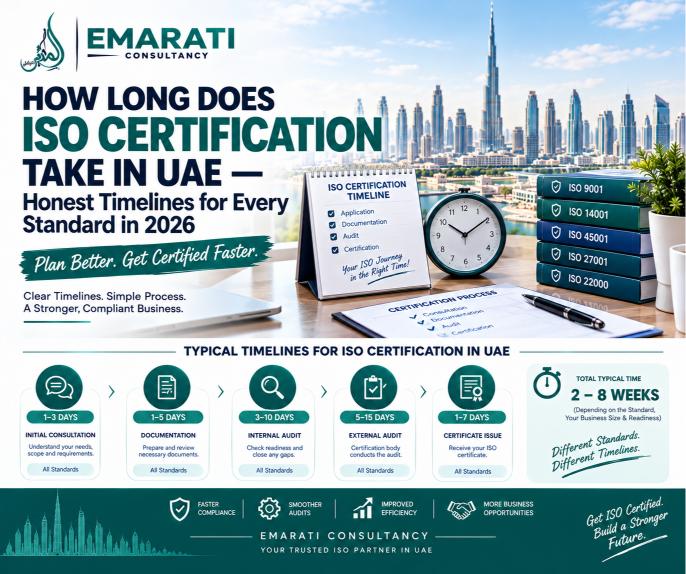
For businesses planning their ISO 9001 certification timeline it helps to understand what genuinely needs to happen — week by week — rather than just seeing a headline figure.
Week 1 — Gap analysis and scope definition
Your consultant assesses your current business practices against ISO 9001:2015 requirements. Existing documentation is reviewed. Key personnel are interviewed. The gap between your current state and certification requirements is mapped precisely. Your scope statement is developed. Your certification body is selected and Stage 1 audit is scheduled approximately 3 to 4 weeks out.
Week 2 — Documentation development
Quality policy is developed and approved by senior management. Core procedures are written — document control, corrective action, internal audit, management review and all process-specific operational procedures relevant to your certification scope. Record templates are created. All documentation is specific to your actual operations — not generic templates.
Week 3 — Implementation and staff training
Documented procedures are deployed into actual operations. Staff awareness training is delivered. Record-keeping systems are operational. The Management Representative confirms that records are being generated consistently across all areas in scope.
Week 4 — Internal audit and management review
Internal audit is conducted across all clauses and all areas in scope. Findings are documented and corrective actions are implemented. Management review is conducted — leadership formally reviews system performance with documented inputs and outputs. All internal audit non-conformities are closed before Stage 1.
Week 4 to 5 — Stage 1 audit
Certification body conducts Stage 1 documentation review. Any Stage 1 findings are addressed. Stage 2 is scheduled.
Week 5 to 6 — Stage 2 audit and certificate
Certification body conducts Stage 2 full on-site assessment. Following successful completion the certificate is issued — typically 2 to 4 weeks after the audit.
Total: 6 to 8 weeks from engagement start to certificate in hand for a well-managed small business.
This is the genuine minimum for a small UAE business implementing ISO 9001 with genuine management commitment and experienced consultancy support.
The timeline difference between ISO 9001 — 2 to 4 weeks for small businesses — and ISO 27001 — 6 to 10 weeks for the same size organisation — is not arbitrary. It reflects the genuine implementation depth that ISO 27001 requires and that certification body auditors assess.
The information security risk assessment cannot be compressed
ISO 27001 is built on a systematic information security risk assessment — identifying all information assets, all threats to each asset, the likelihood and impact of each threat materialising and the controls required to manage risk to an acceptable level. A meaningful risk assessment for a 20-person technology company with cloud-based operations, client data access and multiple software systems takes a minimum of 1 to 2 weeks of genuine analysis. The 70 percent first-time audit failure rate for ISO 27001 globally is primarily driven by inadequate risk assessment depth. Rushing this phase produces a risk assessment that looks complete but misses significant threats — and certification body auditors consistently identify the gaps.
The Statement of Applicability requires genuine analysis
The Statement of Applicability maps all 93 Annex A controls against your identified risks — specifying which are applicable, which are implemented, which are excluded and the business justification for each decision. This document requires careful analysis of each control in the context of your specific risk assessment findings. It cannot be produced in hours. A poorly constructed SoA is one of the most common Stage 1 failure points for UAE ISO 27001 implementations.
Control implementation takes time to evidence
ISO 27001 controls must be genuinely operational — not just documented in policy frameworks. Access management procedures must be working. Security awareness training must be completed and documented. Supplier security assessments must be conducted. Incident response procedures must be tested. Evidence of genuine operational implementation takes time to generate.
A company holding ISO 27001:2022 typically reaches UAE PDPL readiness in six to ten weeks instead of three to five months, because the security controls and most of the documentation already exist. business-ciso
QHSE IMS — implementing ISO 9001, ISO 14001 and ISO 45001 as a single integrated management system — takes longer than a single standard implementation but significantly less than three separate certifications.
For a small UAE construction company QHSE IMS typically takes 4 to 6 weeks. For the same company implementing three separate certifications sequentially — which some UAE consultancies recommend despite the higher cost — the total timeline would be 6 to 12 weeks for the same three certificates.
The reason QHSE IMS is faster than three separate certifications is the shared management system structure. Policy framework, document control system, internal audit programme, management review process and corrective action system are all developed once and cover all three standards simultaneously. The standard-specific elements — environmental aspects for ISO 14001, hazard identification for ISO 45001 — are additive rather than independent.
The additional timeline driver for QHSE IMS in UAE construction:
Construction QHSE IMS implementations require site-specific hazard identification and environmental aspects assessment — which must be conducted for actual project sites and operational activities rather than hypothetical scenarios. For construction companies with active projects the site-specific risk work requires genuine field time that cannot be compressed. This is one reason construction QHSE IMS consistently takes slightly longer than equivalent-size non-construction implementations.
The most commercially urgent ISO certification situation in UAE is a business that discovers it needs ISO certification to submit an imminent government tender or meet an ADNOC registration deadline. Here is the honest expert guidance.
If your deadline is more than 8 weeks away:
ISO 9001, ISO 14001, ISO 45001 or QHSE IMS for a small to medium business is achievable within your timeline with genuine management commitment and experienced consultancy support. Contact Emarati Consultancy immediately to assess your specific situation and confirm achievability.
If your deadline is 4 to 8 weeks away:
ISO 9001 alone for a small business is achievable. QHSE IMS for a small business is tight but potentially achievable with maximum management commitment and dedicated consultancy resource. ISO 27001 is not achievable for a genuine first implementation in this timeframe — the risk assessment alone requires more time than this allows.
If your deadline is less than 4 weeks away:
Honest answer — genuine accredited ISO certification is unlikely to be achievable before your deadline for any standard except HACCP for the smallest food businesses. Focus on the next tender window and begin implementation now to be certified before it opens.
What to do if you have already missed the certification deadline:
You cannot submit a certificate you do not have. Some tender processes accept a letter of engagement from an accredited consultancy confirming that certification is in progress — this does not guarantee acceptance but is sometimes considered by procurement officers for non-critical qualification criteria. Contact the procurement authority directly to understand their specific position. Then begin genuine certification immediately to qualify for the next submission window.
Beyond organisation size and standard complexity these six factors determine where within the timeline ranges above your specific implementation falls.
Factor 1 — Management Representative availability
A dedicated Management Representative able to focus 50 to 70 percent of their time on the project consistently produces timelines at the lower end of the range. A Management Representative managing implementation alongside a full operational role consistently produces timelines at the upper end.
Factor 2 — Existing documentation maturity
Organisations with existing quality management documentation, even if informal or incomplete, close their gaps faster than those starting from zero. The gap analysis at the start of your implementation tells you exactly how your existing documentation affects your timeline.
Factor 3 — Staff cooperation and engagement
Staff who understand why ISO certification matters and engage actively with implementation consistently produce better management system evidence and pass staff awareness assessments more easily during Stage 2 audits. Staff who treat ISO as an imposition on their time create implementation friction that extends timelines.
Factor 4 — Certification body audit scheduling availability
Certification body audit slots in UAE are booked 4 to 8 weeks in advance for most standards. For ISO 27001 and QHSE IMS auditor availability can extend to 6 to 10 weeks. Your implementation timeline must accommodate certification body scheduling — you cannot compress this by preparing faster on your side.
Factor 5 — Number of sites within scope
Multi-site certifications require audit time at every site within scope — extending both implementation time for ensuring consistent management system application across locations and certification body audit time for covering multiple physical locations.
Factor 6 — Operational complexity
A professional services company with 20 employees in a single Dubai office has simpler environmental aspects, fewer safety hazards and more straightforward supplier management than a construction company with 20 employees across three active sites. Operational complexity directly affects the depth of analysis required during gap analysis, risk assessment and environmental aspects identification — and therefore the implementation timeline.
One of the most commercially significant timeline decisions for UAE businesses that need multiple ISO standards is whether to implement them together or sequentially.
| Approach | Timeline for Medium Company | Certificates |
|---|---|---|
| ISO 9001 alone | 3 to 6 weeks | 1 |
| ISO 9001 then ISO 14001 | 6 to 12 weeks | 2 |
| ISO 9001, 14001 and 45001 separate | 9 to 18 weeks | 3 |
| QHSE IMS combined | 6 to 10 weeks | 3 |
| ISO 27001 alone | 10 to 16 weeks | 1 |
| ISO 27001 + ISO 27701 sequential | 16 to 28 weeks | 2 |
| ISO 27001 + ISO 27701 combined | 12 to 20 weeks | 2 |
The timeline saving from combined implementation is significant — QHSE IMS saves 3 to 8 weeks compared to three separate certifications for a medium organisation. ISO 27001 combined with ISO 27701 saves 4 to 8 weeks compared to sequential implementation. Both also save cost — 20 to 40 percent depending on the standard combination.
Many UAE businesses focus entirely on initial certification timelines and do not plan for the ongoing certification maintenance cycle. Here is the honest guide to post-certification timelines.
Annual surveillance audits — Year 1 and Year 2
Annual surveillance audits are shorter than the initial certification audit — typically 50 to 60 percent of the initial Stage 2 audit duration. For a small business that had a 1-day Stage 2 audit, the surveillance audit takes approximately half a day. Preparation should begin 90 days before the scheduled audit date — not two weeks before.
Recertification audit — Year 3
The full recertification audit at the end of the three-year cycle is comparable in depth to the original Stage 2 audit. It assesses the entire management system rather than sampling — requiring a minimum of 3 months preparation for organisations whose management systems have been well-maintained, and significantly longer for those where maintenance has been neglected.
What happens if you miss your surveillance audit
If a surveillance audit is missed without rescheduling with your certification body your certificate is suspended. A suspended certificate does not satisfy UAE government tender prequalification or ADNOC vendor registration requirements. Restoration typically requires a new certification audit at initial certification cost — adding months to your timeline and significant unexpected cost.
ISO 9001 for small UAE businesses — up to 30 employees — typically takes 2 to 4 weeks from engagement start to certificate issued. Medium businesses with 30 to 150 employees require 3 to 6 weeks. Large organisations or multi-site businesses need 4 to 8 weeks. Management commitment is the most important timeline factor — businesses where senior leadership actively champions implementation consistently certify at the lower end of these ranges.
ISO 27001 for small UAE businesses typically takes 6 to 10 weeks. Medium organisations require 10 to 16 weeks. Large or IT-complex organisations need 16 to 24 weeks. The information security risk assessment is the most time-consuming element — this phase cannot be compressed without creating first-time audit failure risk. The 70 percent global first-time failure rate for ISO 27001 is primarily driven by inadequate risk assessment depth from rushed implementations.
No — not through genuine accredited certification. Under IAF MD 5 mandatory audit duration rules the Stage 2 certification audit alone for a 10-person organisation requires a minimum of 1 day on-site. A genuine certification process additionally requires gap analysis, documentation development, implementation, internal audit, management review and Stage 1 review — each of which takes additional time. Any certificate claimed to be issued in 3 days either came from an unaccredited certification body or was issued without a genuine audit. Such certificates will fail Dubai Municipality, ADNOC and international client verification.
QHSE IMS implementing ISO 9001, ISO 14001 and ISO 45001 together typically takes 4 to 6 weeks for small UAE businesses and 6 to 10 weeks for medium organisations. This is faster than three separate certifications — which would take 6 to 12 weeks and 9 to 18 weeks respectively for the same organisations — because the shared management system structure significantly reduces duplication. QHSE IMS is both faster and 25 to 40 percent cheaper than three separate certifications for the same three certificates.
For ISO 9001 alone for a small business with strong management commitment and experienced consultancy support — possibly, but it is tight. For QHSE IMS — unlikely unless your starting position is very strong. For ISO 27001 — not achievable in 4 weeks for a genuine first implementation. Contact Emarati Consultancy immediately for an honest assessment of your specific situation and what is achievable before your deadline. We will give you an honest answer rather than a commercially convenient one.
HACCP certification for small food businesses — restaurants, cafes, small catering operations — typically takes 2 to 4 weeks. Medium food operations require 3 to 6 weeks. Large or multi-site food businesses need 6 to 10 weeks. The most time-consuming element is developing the HACCP plan for your specific menu, ingredients and food preparation processes — which cannot be copied from a generic template and must reflect your actual food safety hazards.
Yes — significantly in most cases. Experienced UAE ISO consultants know exactly which documentation is required, in what format, to what depth. They do not spend time working out what is needed — they execute efficiently from day one. For UAE businesses with specific tender deadlines the difference between an experienced consultant and a less experienced one can be 2 to 4 weeks — which is the difference between qualifying for a tender and missing it. Emarati Consultancy’s structured implementation process is specifically designed around UAE certification body and procurement authority requirements — eliminating the trial and error that extends timelines for self-implementing organisations.
Every ISO certificate issued by an accredited certification body is valid for three years — subject to successful annual surveillance audits in years one and two. If annual surveillance audits are not conducted on schedule the certificate can be suspended before the three-year period ends. A full recertification audit at the end of year three renews the certificate for another three-year cycle.
The most accurate timeline for your specific ISO certification is not a range from a generic blog — it is the specific assessment your consultant provides after conducting a gap analysis of your actual business. Timeline ranges are starting points. Your specific starting position, management commitment level and operational complexity determine where within those ranges your implementation will fall.
Emarati Consultancy provides a free initial consultation and gap analysis assessment for every UAE business considering ISO certification — giving you the most accurate timeline prediction available before you commit to any engagement. We tell you honestly what is achievable before your specific deadline rather than telling you what you want to hear.
Whether you have a tender deadline approaching, an ADNOC registration window opening or are planning ahead with no immediate pressure — Emarati Consultancy gives you an honest timeline before you commit to anything.
Phone: +971 52 856 0299
Email: info@emaraticonsultancy.ae
Office: City Bay Business Centre, Office 303, Near Abu Bakr Metro Station, Dubai, UAE
Looking for reliable ISO renewal services in the UAE? Our specialists in Dubai, Abu Dhabi, and Sharjah help you align your OHSMS with updated ISO 45001 requirements, ensuring continuous compliance and smooth recertification.
The great explorer of the truth, the master-builder of human happiness no one rejects dislikes avoids pleasure itself because it is pleasure but because know who do not those how to pursue pleasures rationally encounter consequences that are extremely painful desires to obtain.
Read More