8:00AM - 6:00PM
Monday to Saturday

Monday to Saturday
+971 52 856 0299
Hor Al Anz


By Emarati Consultancy | ISO Certification Consultant Experts in UAE | Updated 2026
The UAE is one of the world’s three largest re-export hubs. Jebel Ali Free Zone alone handles over 14,000 vessels annually. Dubai South anchors Al Maktoum International Airport — one of the world’s largest cargo airports by capacity. Abu Dhabi’s KEZAD connects Gulf manufacturing to Indian Ocean shipping routes. Fujairah’s port sits outside the Strait of Hormuz managing liquid bulk flows from Gulf oil producers to global markets.
Every logistics company, freight forwarder, warehouse operator, cold chain provider, customs broker and supply chain manager operating within this infrastructure faces the same commercial reality in 2026. International clients require ISO certification before onboarding UAE logistics partners. Government tenders across all seven emirates specify ISO certification as a mandatory qualification criterion. ADNOC supply chain participation requires it. And the UAE’s growing e-commerce sector — with next-day delivery expectations creating complex last-mile operations — is driving quality management certification requirements down through last-mile logistics providers who previously operated below the ISO certification threshold.
This guide tells you exactly which ISO certifications UAE logistics and supply chain companies need in 2026 — by logistics subsector, with realistic AED costs and honest guidance on which standards actually unlock commercial doors versus which are nice-to-have credentials your clients are not asking for yet.
European and North American institutional clients require ISO 9001 quality management certification from their UAE logistics partners as evidence of systematic quality management in service delivery, handling procedures, inventory management and customer complaint handling. This is not a preference — it is a prequalification condition. A UAE freight forwarder or third-party logistics provider without current ISO 9001 certification cannot qualify as a supplier to most international manufacturing, retail and pharmaceutical companies regardless of their actual operational quality. rmcconsultancy
UAE government procurement across all seven emirates specifies ISO 9001 as a mandatory qualification criterion for logistics and supply chain service tenders. Ports and Free Zones Authority procurement, DEWA logistics contracts, Dubai Municipality facility supply tenders, Abu Dhabi government distribution contracts and federal government logistics frameworks all require current ISO 9001 from bidding logistics companies. Without it your tender submission is disqualified before evaluation begins.
International shipping lines, global freight management companies and multinational manufacturers using Jebel Ali as their UAE gateway apply their own supplier qualification frameworks to UAE logistics partners — all of which include ISO certification requirements. Maersk, MSC, CMA CGM and other major shipping lines operating through Jebel Ali require ISO 9001 from their UAE logistics service providers. International manufacturers using JAFZA as a distribution hub require ISO-certified UAE logistics partners in their supply chain audit submissions.
ADNOC’s logistics supply chain — covering oilfield equipment transport, chemical logistics, marine logistics to offshore platforms and pipeline maintenance logistics — requires ISO 9001, ISO 14001 and ISO 45001 from logistics service providers across all relevant supply categories. Up to 30 percent of ADNOC vendor registration applications are initially rejected — primarily due to incomplete compliance documentation including missing ISO certificates, weak HSSE documentation or mismatched licence activities. For UAE logistics companies serving the Abu Dhabi energy sector, missing ISO certification is the most common and most preventable reason for ADNOC vendor registration rejection.
Federal Decree-Law No. 11 of 2024 requires Scope 1 and Scope 2 greenhouse gas reporting from every UAE business by 30 May 2026 — with fines of up to AED 2,000,000 for non-compliance. For logistics companies with significant vehicle fleets — trucks, vans, forklifts, heavy equipment — Scope 1 direct emissions from fuel combustion are among the highest in any service sector. ISO 14001 provides the environmental management framework that demonstrates UAE Federal Climate Law compliance. ISO 14064 provides the specific GHG inventory methodology for producing the verified fleet emissions data that mandatory MRV platform reporting requires.
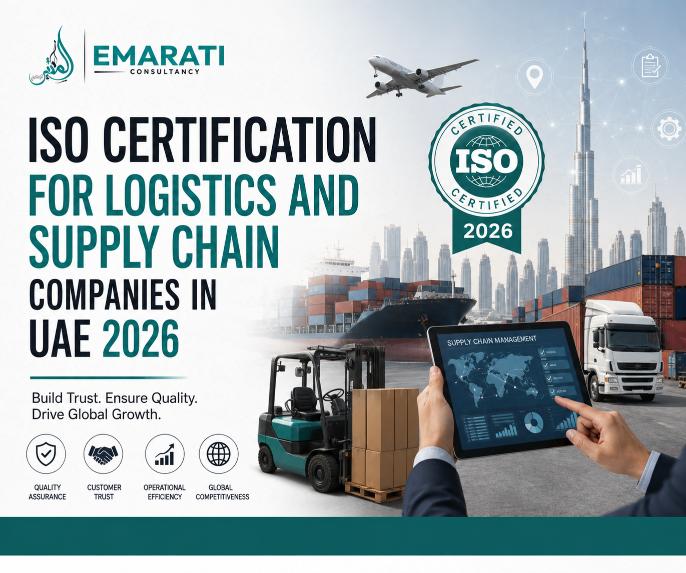
Different logistics subsectors face different certification requirements. Here is the honest breakdown by business type — not a generic list of every possible ISO standard.
ISO 9001 Quality Management System certification is the non-negotiable first certification for every UAE logistics company regardless of subsector, size or service type. It is required for the broadest range of UAE government tenders, international client qualification processes, JAFZA and UAE free zone supply chain participation and international shipping partner onboarding.
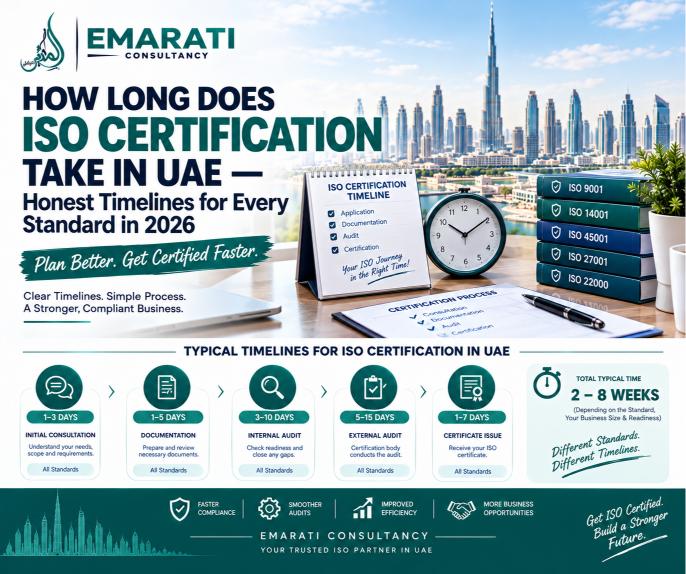
For logistics companies ISO 9001 covers service quality management across order management, transport planning and execution, warehouse operations, customer communication, complaint handling, supplier and subcontractor management and continual service quality improvement. Implementation scope for a logistics company is typically straightforward — the processes are clear, the documentation requirements are manageable and the implementation timeline for small UAE logistics companies is 2 to 4 weeks.
ISO 14001 Environmental Management System certification addresses the environmental impacts of logistics operations — vehicle fleet emissions, fuel consumption, refrigerant losses from cold chain equipment, packaging waste, hazardous goods spillage risk and energy consumption in warehousing operations.
For UAE logistics companies ISO 14001 is required for Dubai Municipality logistics contracts, ADNOC supply chain participation, Abu Dhabi government tender qualification and international client sustainability qualification frameworks. UAE Federal Climate Law makes it both a commercial requirement and a legal compliance obligation for every UAE logistics company with significant fleet operations.
ISO 14001 certification is a mandatory requirement for Dubai Municipality tenders, RTA contractor qualification, ADNOC contractor registration, Abu Dhabi government infrastructure procurement and major private sector supply chain qualification across virtually every industry. RMC Consultancy
Logistics operations are among the highest-risk workplace environments in the UAE. Forklift operations in warehouses, heavy vehicle driving, port handling operations, crane lifts, working at height in racking systems, chemical and hazardous goods handling — all create significant occupational safety risks that ISO 45001 addresses systematically.
ISO 45001 is required for ADNOC logistics supply chain participation, UAE government logistics tenders and international client supply chain safety audits. For logistics companies operating large warehouses, port logistics operations or heavy transport fleets, ISO 45001 is effectively mandatory for accessing premium contract opportunities in the UAE market.
Most UAE logistics companies competing for government contracts and international client qualification need ISO 9001, ISO 14001 and ISO 45001 simultaneously. Implementing them as a QHSE Integrated Management System saves 25 to 40 percent compared to three separate certifications — one documentation framework, one training programme, one internal audit and one combined certification body audit.
For a medium UAE logistics company with 50 to 100 employees, QHSE IMS typically costs AED 15,000 to AED 25,000 covering all three certificates versus AED 24,000 to AED 45,000 for three separate certifications. The saving is real, the certificates are identical and the ongoing maintenance burden is significantly lower.
ISO 28000 is the international standard for Supply Chain Security Management Systems — covering the identification and management of security threats across the supply chain including theft, terrorism, smuggling, counterfeiting and supply chain integrity violations. It is increasingly required by international clients shipping high-value cargo, sensitive electronics, pharmaceutical products, luxury goods and defence-related materials through UAE logistics networks.
ISO 28000:2022 is the current version. For UAE logistics companies handling international cargo through Jebel Ali, Dubai International Airport and Abu Dhabi ports, ISO 28000 positions your business for the highest-value supply chain security-sensitive cargo contracts that standard ISO 9001 alone cannot access. It is the most commercially differentiating certification for UAE logistics companies with international cargo ambitions — and currently held by very few UAE logistics businesses.
Cold chain logistics operators, temperature-controlled warehousing companies, food distribution businesses and pharmaceutical logistics providers face specific food and pharmaceutical safety certification requirements from their clients.
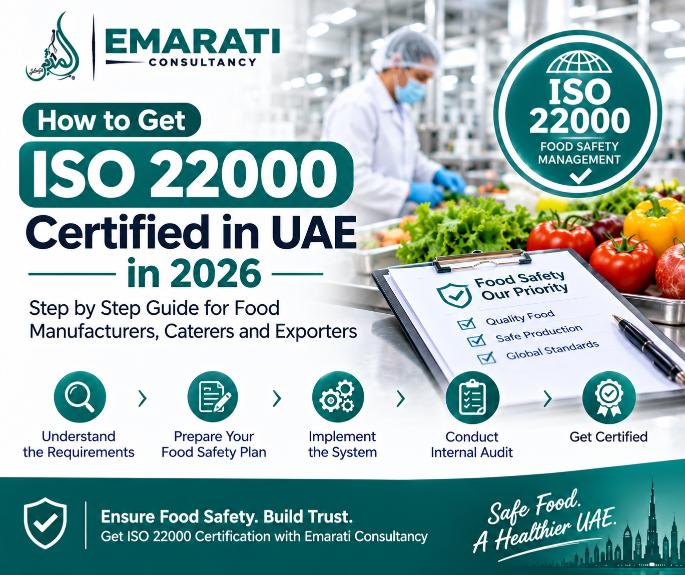
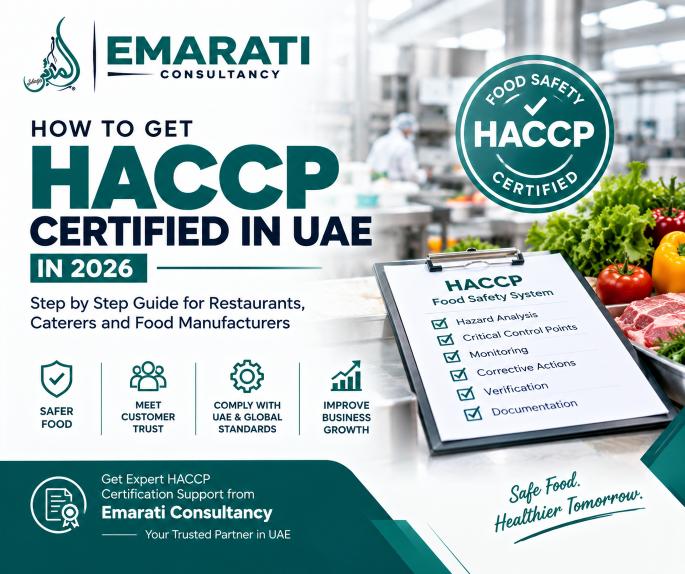
HACCP certification is required by food manufacturers and food retail clients qualifying their UAE cold chain logistics partners. ISO 22000 — incorporating HACCP within a comprehensive food safety management system — is required by international food companies, hotel groups and institutional food buyers requiring certified food safety management from their temperature-sensitive logistics partners.
For pharmaceutical cold chain operators, GDP — Good Distribution Practice — guidelines from UAE Ministry of Health and Prevention add regulatory requirements beyond HACCP that must be addressed within the food safety management system. ISO 22000 provides the management system framework that accommodates both food and pharmaceutical cold chain requirements within a single certification scope.
Logistics technology companies, digital freight platforms, logistics software providers, fleet management technology businesses and 3PL companies with integrated client ERP access are increasingly required to hold ISO 27001 information security certification by enterprise and government clients whose own data security obligations flow through to their logistics technology partners.
For UAE technology-enabled logistics businesses — particularly those operating transport management systems with client data integration, warehouse management systems with real-time inventory visibility for multiple clients or digital customs clearance platforms — ISO 27001 is becoming a standard enterprise client onboarding requirement.
ISO 14064 provides the specific GHG inventory methodology for quantifying and reporting Scope 1 fleet emissions — the direct greenhouse gas emissions from logistics vehicle fleets that are among the most significant GHG sources for UAE logistics companies. With mandatory Scope 1 and Scope 2 reporting required by 30 May 2026 under UAE Federal Climate Law, logistics companies with significant vehicle fleets need ISO 14064 compliant GHG inventories before the deadline. Non-compliance fines of up to AED 2,000,000 make the cost of ISO 14064 implementation a fraction of the regulatory exposure from missing the mandatory reporting deadline.
ISO 14064 certification UAE
| Certification | Priority | Why |
|---|---|---|
| ISO 9001 | Essential | Universal client qualification requirement |
| ISO 14001 | Important | Government tender qualification |
| ISO 45001 | Important | Office and operations safety |
| ISO 28000 | Strategic | High-value cargo client differentiation |
| ISO 27001 | Growing | Digital platform and client data security |
Freight forwarders and customs brokers are the entry point of every import and export supply chain in the UAE. International clients qualifying UAE freight forwarding partners consistently require ISO 9001 as the baseline service quality credential. ISO 28000 is increasingly required by clients shipping sensitive or high-value cargo. ISO 27001 is emerging as a requirement for freight forwarders with digital customs clearance platforms handling client trade data.
| Certification | Priority | Why |
|---|---|---|
| QHSE IMS | Essential | Government tenders and ADNOC supply chain |
| ISO 28000 | Important | Client security audit requirements |
| ISO 27001 | Growing | WMS client data security |
| ISO 14064 | Required | Federal Climate Law fleet emissions |
3PL operators managing warehousing, distribution and value-added logistics services for multiple clients face the most comprehensive ISO certification requirements of any logistics subsector. Government warehouse contracts, JAFZA logistics facility management and ADNOC supply logistics all require QHSE IMS certification from 3PL service providers. Multi-client warehousing operations handling high-value goods face ISO 28000 supply chain security requirements. Digital WMS integration with multiple client ERP systems creates ISO 27001 information security requirements.
| Certification | Priority | Why |
|---|---|---|
| ISO 9001 | Essential | Baseline quality management |
| HACCP | Essential | Food client qualification |
| ISO 22000 | Essential | Comprehensive food safety management |
| ISO 45001 | Important | Cold storage worker safety |
| ISO 14001 | Important | Refrigerant management and environmental |
Cold chain logistics operators serving food manufacturers, food retailers, restaurant chains and pharmaceutical companies face the most complex ISO certification portfolio of any logistics subsector. Food clients require HACCP or ISO 22000 from their UAE cold chain partners. Pharmaceutical clients require GDP-aligned quality management alongside HACCP. Major food retail clients require FSSC 22000 certification. ISO 45001 addresses cold storage worker safety risks from cold temperature exposure and forklift operations.
| Certification | Priority | Why |
|---|---|---|
| ISO 9001 | Essential | Major e-commerce platform qualification |
| ISO 45001 | Important | Delivery driver safety management |
| ISO 14001 | Growing | Fleet emissions management |
| ISO 14064 | Required | Federal Climate Law compliance |
The UAE’s booming e-commerce sector — driven by noon.com, Amazon.ae, Carrefour UAE and international brands entering the market — is creating new ISO certification pressure for last-mile delivery companies. Major e-commerce platforms requiring ISO 9001 from their UAE delivery partners is a recent development that has caught many last-mile operators unprepared. Fleet vehicle emissions from delivery vans make ISO 14064 GHG reporting a specific Federal Climate Law compliance requirement for last-mile operators with significant vehicle fleets.
| Certification | Priority | Why |
|---|---|---|
| QHSE IMS | Essential | Port authority and international operator requirements |
| ISO 28000 | Essential | Port security qualification |
| ISO 22301 | Important | Business continuity for critical port operations |
| ISO 14064 | Required | Port equipment emissions reporting |
Port logistics operators, marine services companies and terminal service providers face the most demanding ISO certification requirements of any logistics subsector. Port authority contracts require QHSE IMS as the baseline management system credential. International shipping lines and terminal operators require ISO 28000 for supply chain security management. Business continuity requirements for critical port infrastructure make ISO 22301 increasingly relevant for port logistics operations.
| Certification | Small Logistics Co. | Medium Logistics Co. | Large Logistics Co. |
|---|---|---|---|
| ISO 9001 | AED 5,000 — 8,000 | AED 8,000 — 15,000 | AED 15,000+ |
| ISO 14001 | AED 5,000 — 8,000 | AED 8,000 — 15,000 | AED 15,000+ |
| ISO 45001 | AED 5,000 — 8,000 | AED 8,000 — 15,000 | AED 15,000+ |
| QHSE IMS | AED 10,000 — 15,000 | AED 15,000 — 25,000 | AED 25,000+ |
| ISO 28000 | AED 8,000 — 14,000 | AED 14,000 — 22,000 | AED 22,000+ |
| HACCP | AED 4,000 — 7,000 | AED 7,000 — 12,000 | AED 12,000+ |
| ISO 22000 | AED 6,000 — 10,000 | AED 10,000 — 18,000 | AED 18,000+ |
| ISO 27001 | AED 10,000 — 15,000 | AED 15,000 — 25,000 | AED 25,000+ |
| ISO 14064 | AED 6,000 — 10,000 | AED 10,000 — 18,000 | AED 18,000+ |
| ISO 22301 | AED 8,000 — 12,000 | AED 12,000 — 20,000 | AED 20,000+ |
Small logistics company = up to 30 employees. Medium = 30 to 150 employees. Large = 150+ employees or multi-site.
All figures cover both Emarati Consultancy fees and certification body audit fees combined. No hidden costs.
JAFZA is one of the world’s largest logistics and manufacturing free zones — home to over 9,500 companies including the regional headquarters of major global logistics brands. JAFZA logistics businesses face ISO certification requirements driven by international corporate clients operating their Middle East distribution through JAFZA. ISO 9001 is the universal baseline. ISO 28000 is increasingly required for JAFZA logistics operators handling high-value electronics, luxury goods and sensitive cargo. ISO 45001 is required for JAFZA warehouse and port logistics operations.
Dubai South logistics companies serve one of the world’s largest planned cargo airports — creating specific aviation logistics quality requirements. International cargo handling companies at Dubai South face IATA ground handling quality requirements alongside standard ISO certification. ISO 9001 is the baseline quality credential. ISO 45001 is critical for airside and ramp operations. ISO 28000 is required for aviation security-sensitive cargo handling.
Logistics businesses in Hamriyah and SAIF Zone serving the UAE’s northern emirate industrial base face ISO 9001 requirements from their manufacturing clients and government tender qualification requirements from Sharjah government entities. QHSE IMS is the most commonly pursued certification for logistics businesses in these zones serving industrial and manufacturing supply chains.
Manufacturing, logistics and industrial companies operating across KEZAD typically require ISO 9001, ISO 14001 and ISO 45001 — both for KEZAD operational compliance and for the qualification requirements of ADNOC and Abu Dhabi government clients. KEZAD logistics businesses serving the Abu Dhabi industrial supply chain effectively need QHSE IMS as their baseline certification package.
ISO 9001:2026 will raise the bar for supplier management and data monitoring for logistics firms in Jebel Ali and other UAE trade hubs. The four confirmed changes in ISO 9001:2026 have specific logistics sector implications. Isocertifications
The climate change Clause 4.1 assessment already in force since February 2024 requires UAE logistics companies to formally assess whether climate change is relevant to their quality management system context. For logistics companies with significant vehicle fleets — whose Scope 1 fuel combustion emissions are among the largest of any UAE business type — the answer is clearly yes. This assessment must be in your context analysis documentation before your next surveillance audit regardless of your ISO 9001:2026 transition timeline.
The strengthened supplier management requirements in ISO 9001:2026 are directly relevant to logistics companies that manage complex subcontractor networks — last-mile delivery subcontractors, warehouse space subcontractors, specialist handling subcontractors and cross-border logistics partners. Your subcontractor qualification and monitoring processes should be reviewed and strengthened now regardless of when your transition audit occurs.
Many UAE logistics companies pursue ISO 9001 alone — then discover six months later that their target government tender or ADNOC supply chain application also requires ISO 14001 and ISO 45001. Implementing all three as QHSE IMS from the start saves AED 9,000 to AED 20,000 compared to returning for two additional certifications.
ISO 28000 supply chain security certification is the most underestimated ISO standard in the UAE logistics sector. Logistics companies that discover a major international client requires it and attempt a rushed implementation consistently face timeline challenges that cost them the contract. ISO 28000 takes 8 to 14 weeks for medium logistics companies. Starting before clients ask rather than after is the commercially intelligent approach.
HACCP satisfies UAE regulatory requirements for domestic food logistics operations. It does not satisfy the food safety management requirements of international food manufacturers, hotel brand supply chain audits, airline catering supply qualification or major retail chain supplier audits. Cold chain operators that pursue HACCP for its lower cost and faster timeline — then need to upgrade to ISO 22000 for a major client — pay twice. Identify your most demanding client requirement first and implement to that level from the start.
Logistics companies with significant vehicle fleets are among the most exposed UAE businesses for UAE Federal Climate Law non-compliance. The 30 May 2026 mandatory Scope 1 reporting deadline applies to every UAE logistics company with a fleet — regardless of size. AED 2,000,000 fines for non-compliance are not theoretical. ISO 14064 GHG inventory development takes 4 to 8 weeks for small logistics companies. Any logistics company that has not started their GHG inventory development needs to act immediately.
UAE logistics companies serving international clients whose contracts specify ISO certification from EIAC accredited certification bodies — which includes most major international shipping lines and manufacturers — face immediate contract qualification failure if their certificate is issued by a non-EIAC accredited body. The cost saving from a cheap unaccredited certificate is irrelevant when the certificate fails the client’s verification check.
ISO 9001 is the mandatory first certification for every UAE freight forwarder. It is required by international client supply chain qualification processes, UAE government logistics tenders and JAFZA free zone supply chain participation. For freight forwarders with significant vehicle operations or warehousing ISO 45001 and ISO 14001 should follow — most efficiently implemented together as QHSE IMS.
It depends on your clients. HACCP satisfies UAE regulatory requirements for domestic food logistics — Dubai Municipality and ADAFSA inspections. ISO 22000 satisfies international food manufacturer supply chain requirements, hotel brand supply qualification and airline catering contract prerequisites. If your clients include international food companies or major hotel groups implement ISO 22000 from the start rather than upgrading from HACCP later.
ISO 28000 is the international standard for Supply Chain Security Management Systems — covering security threat identification and management across the supply chain. UAE logistics companies handling high-value cargo, pharmaceuticals, luxury goods, sensitive electronics or defence-related materials face ISO 28000 requirements from international clients and shipping partners. It is currently held by few UAE logistics companies — making early certification a significant competitive differentiator.
Yes. ADNOC vendor registration via the SAP Ariba Supplier Hub requires ISO 9001, ISO 14001 and ISO 45001 as mandatory compliance documents across virtually all supply categories. ADNOC logistics supply chain participants — oilfield equipment transport, chemical logistics, marine logistics and pipeline maintenance logistics — need QHSE IMS certification as their baseline qualification package. Missing certificates are among the most common reasons for ADNOC application rejection.
Small UAE logistics companies — freight forwarders and small 3PL operators with up to 30 employees — achieve ISO 9001 in 2 to 4 weeks. QHSE IMS takes 4 to 6 weeks. ISO 28000 takes 8 to 14 weeks. ISO 22000 or HACCP for cold chain operators takes 3 to 6 weeks for small businesses. Medium logistics companies with 30 to 150 employees should add 2 to 4 weeks to each of these timelines.
Yes — if your company has a significant vehicle fleet generating Scope 1 fuel combustion emissions. UAE Federal Climate Law requires mandatory Scope 1 and Scope 2 GHG reporting from every UAE business by 30 May 2026. Logistics companies with vehicle fleets are among the highest Scope 1 emitters in the UAE service sector. ISO 14064 provides the GHG inventory methodology that satisfies UAE Climate Law MRV platform reporting requirements. Non-compliance fines of up to AED 2,000,000 apply from 30 May 2026.
Yes. ISO 9001 for small UAE logistics companies starts from AED 5,000 covering all fees. HACCP for cold chain operators starts from AED 4,000. QHSE IMS for small logistics companies starts from AED 10,000 — covering three certificates simultaneously. The commercial return from ISO certification — access to government tenders, international client qualification and ADNOC supply chain participation — consistently exceeds the certification cost within the first qualified contract.
Yes. Emarati Consultancy provides ISO certification consultancy for logistics companies across all seven UAE emirates — including JAFZA, Dubai South, Hamriyah, SAIF Zone, KEZAD, Khalifa Industrial Zone, Port of Fujairah and all other logistics hubs — with both in-person and remote consultation available. We cover all ISO standards relevant to logistics including ISO 9001, QHSE IMS, ISO 28000, HACCP, ISO 22000, ISO 27001, ISO 22301 and ISO 14064.
ISO certification is the commercial infrastructure that UAE logistics companies need to compete for international client contracts, government tenders, ADNOC supply chain participation and free zone operator qualification. The logistics sector’s complexity — multiple subsectors with different certification requirements, different client demands and different regulatory obligations — makes expert guidance the most efficient and cost-effective path to the right certification.
Emarati Consultancy helps UAE logistics companies identify the right ISO standards for their specific client base and commercial objectives, implement management systems that function as operational tools rather than audit documentation, achieve certification efficiently with UAE’s most commercially relevant accredited certification bodies and maintain their management systems throughout the three-year certification cycle.
Phone: +971 52 856 0299
Email: info@emaraticonsultancy.ae
Office: City Bay Business Centre, Office 303, Near Abu Bakr Metro Station, Dubai, UAE
Looking for reliable ISO renewal services in the UAE? Our specialists in Dubai, Abu Dhabi, and Sharjah help you align your OHSMS with updated ISO 45001 requirements, ensuring continuous compliance and smooth recertification.
The great explorer of the truth, the master-builder of human happiness no one rejects dislikes avoids pleasure itself because it is pleasure but because know who do not those how to pursue pleasures rationally encounter consequences that are extremely painful desires to obtain.
Read More