8:00AM - 6:00PM
Monday to Saturday
Monday to Saturday
+971 52 856 0299
Hor Al Anz


By Emarati Consultancy | ISO Certification Consultant Experts in UAE | Updated 2026
ISO 9001:2026 publishes in September 2026. If your UAE business holds ISO 9001:2015 certification — whether you are a construction contractor qualifying for Dubai Municipality tenders, an ADNOC vendor registered to ISO 9001 or any other UAE business that depends on ISO 9001 for commercial access — this revision affects you directly.
The good news is that this is an evolutionary update, not a revolutionary rebuild. The core clause structure stays the same. The fundamental quality management requirements stay the same. You are not starting over. But four specific areas of the standard have confirmed changes — and one of them is already in force right now, meaning UAE businesses that have not addressed it are already non-compliant regardless of whether their certificate is current.
This guide tells you exactly what is changing, what you need to do before September 2026, what you can safely defer until the transition deadline in September 2029, and the critical fact that most UAE ISO consultancies are not telling their clients about ISO 9001:2026 certification timing
Before discussing what is changing it is essential to address the single most important operational fact about ISO 9001:2026 — one that directly affects every UAE business planning its transition.
ISO 9001:2026 publishes in September 2026. But publishing the standard and being able to certify to it are two different things. After publication certification bodies must be trained and then accredited to the new standard by their national accreditation bodies — a process that typically takes 9 to 12 months. This means the first ISO 9001:2026 certificates issued by EIAC accredited certification bodies in the UAE are not expected until at least mid to late 2027.
This matters enormously for UAE businesses that are planning their certification timeline. If you are currently certified to ISO 9001:2015 your certificate remains fully valid and commercially accepted throughout the entire transition period. Dubai Municipality, ADNOC, UAE government procurement systems and international supply chain partners will all continue accepting ISO 9001:2015 certificates through the transition period. There is no commercial urgency to rush your transition — but there is regulatory urgency to address the one change that is already in force right now.
| Milestone | Date |
|---|---|
| Final Draft International Standard issued | June 2026 |
| ISO 9001:2026 official publication | September 2026 |
| Transition period begins | September 2026 |
| Certification bodies trained and accredited | Late 2026 to mid 2027 |
| First ISO 9001:2026 certificates expected | Q3 2027 |
| ISO 9001:2015 certificates retire | September 2029 |
| Transition deadline — all certificates must be upgraded | September 2029 |
The three-year transition period from September 2026 to September 2029 gives UAE businesses meaningful time to plan and execute their transition properly. The businesses that will struggle are those that assume September 2029 is far away — and then find certification body audit slots fully booked, consultants unavailable and commercial consequences from any certification gap during a last-minute scramble.
Four specific areas of ISO 9001:2015 have confirmed changes in ISO 9001:2026. Understanding exactly what changes — and what does not — is what allows UAE businesses to plan their transition efficiently rather than responding to panic-inducing generalisations about a major new standard.
This is the most urgent change for UAE businesses — and it is not a future requirement. It is already in force.
In February 2024 ISO published ISO 9001:2015/Amd 1:2024 — a mandatory amendment adding climate change to Clause 4.1 and Clause 4.2 of the current standard. ISO 9001:2026 formally integrates this amendment into the revised standard’s core requirements. But the requirement to assess whether climate change is relevant to your quality management system context is not waiting for September 2026. Certification body auditors are checking this right now at every ISO 9001 surveillance and recertification audit globally — including in UAE.
What this means for UAE businesses in practice: You must record your assessment of whether climate change is relevant to your QMS context — even if your conclusion is that it is not relevant to your specific scope. A blank gap in your context analysis is a non-conformance waiting to be identified at your next surveillance audit. If your QMS context analysis has not been updated since February 2024 this is your most immediate action item regardless of everything else in this article.
For UAE businesses this requirement also has local regulatory resonance. UAE Federal Climate Law Federal Decree-Law No. 11 of 2024 requires environmental compliance from every UAE business by 30 May 2026. A QMS that has formally assessed climate change relevance demonstrates alignment with both international ISO requirements and UAE Federal Climate Law simultaneously — a dual compliance signal that strengthens your position with procurement authorities and regulatory bodies.
ISO 9001:2026 adds an explicit requirement for top management to promote and demonstrate a quality culture and ethical behaviour within the organisation. Previously quality culture was implied through leadership commitment requirements. From 2026 it is a documented requirement with evidence expected during certification audits.
A new note in the standard clarifies that culture and ethics can be demonstrated through shared values, beliefs, history, attitudes and observed behaviours — not through a separate culture programme or ethics consultant. What auditors will look for is a light but consistent evidence trail.
For UAE businesses this means three practical actions. First, your quality policy must more explicitly reflect your organisation’s strategic context and values — not just a commitment to customer satisfaction and continual improvement. Second, management review records should include discussion of quality culture and ethical conduct alongside the standard performance metrics. Third, internal communication about quality should reference your organisation’s values and ethical commitments — not just procedural compliance.
The sector where this change requires the most practical attention in the UAE is government contracting, construction and professional services — where the connection between ethical conduct and quality delivery is most scrutinised by procurement authorities and clients.
Under ISO 9001:2015, risks and opportunities are addressed together in Clause 6.1. ISO 9001:2026 restructures this into separate sub-clauses — giving opportunities dedicated explicit attention rather than treating them as a secondary consideration alongside risk management.
This change acknowledges what well-managed organisations already know — that systematic opportunity identification and exploitation is as important to quality management excellence as risk mitigation. For the past ten years many UAE businesses have met the Clause 6.1 requirement by documenting risks comprehensively and treating opportunities as an afterthought. ISO 9001:2026 closes this gap.
For UAE businesses the practical implication is straightforward. Your existing risk register — which already identifies quality risks — should be reviewed and supplemented with a separate opportunity register documenting specific, actionable commercial and operational opportunities your QMS planning process has identified. These opportunities should appear in your management review agenda and their exploitation should be tracked against objectives. This is not a significant implementation burden for well-run organisations — it is primarily a documentation and review process adjustment.
ISO 9001:2026 includes a brand new Annex A — approximately 15 pages of supplementary guidance covering every clause from 4 through 10. This is the first time in ISO 9001’s history that the standard has included this type of implementation guidance annex.
Crucially Annex A creates no new mandatory requirements. It is informative not normative — certification body auditors cannot cite it as the basis for a non-conformance finding. What it will do is shape how auditors interpret and apply the standard’s requirements — and certification body training programmes will use it extensively.
For UAE businesses this means that audit conversations from 2026 onwards will increasingly reference the language and framing of Annex A even though the requirements themselves have not changed. Being familiar with Annex A — and being able to articulate how your QMS addresses the intent it clarifies — is a practical audit preparation advantage.
Understanding what is not changing is as important as understanding what is — because the most significant risk for UAE businesses is investing time and money addressing changes that do not exist.
The core clause structure — Clauses 4 through 10 — remains unchanged. The process approach remains unchanged. The fundamental requirements for context analysis, leadership commitment, planning, support, operation, performance evaluation and improvement all remain in their current form with only the targeted refinements described above. The basic documentation requirements remain unchanged. There is no significant new requirements for emerging technologies — artificial intelligence, digital transformation and automation are not addressed with specific requirements in ISO 9001:2026.
This last point is worth emphasising for UAE technology companies. ISO 9001:2026 does not require you to document your AI systems, digital transformation initiatives or technology investment decisions as part of your quality management system. ISO 42001 — the AI management system standard — addresses AI governance specifically. ISO 9001:2026 addresses quality management generally. They remain distinct standards with distinct purposes.
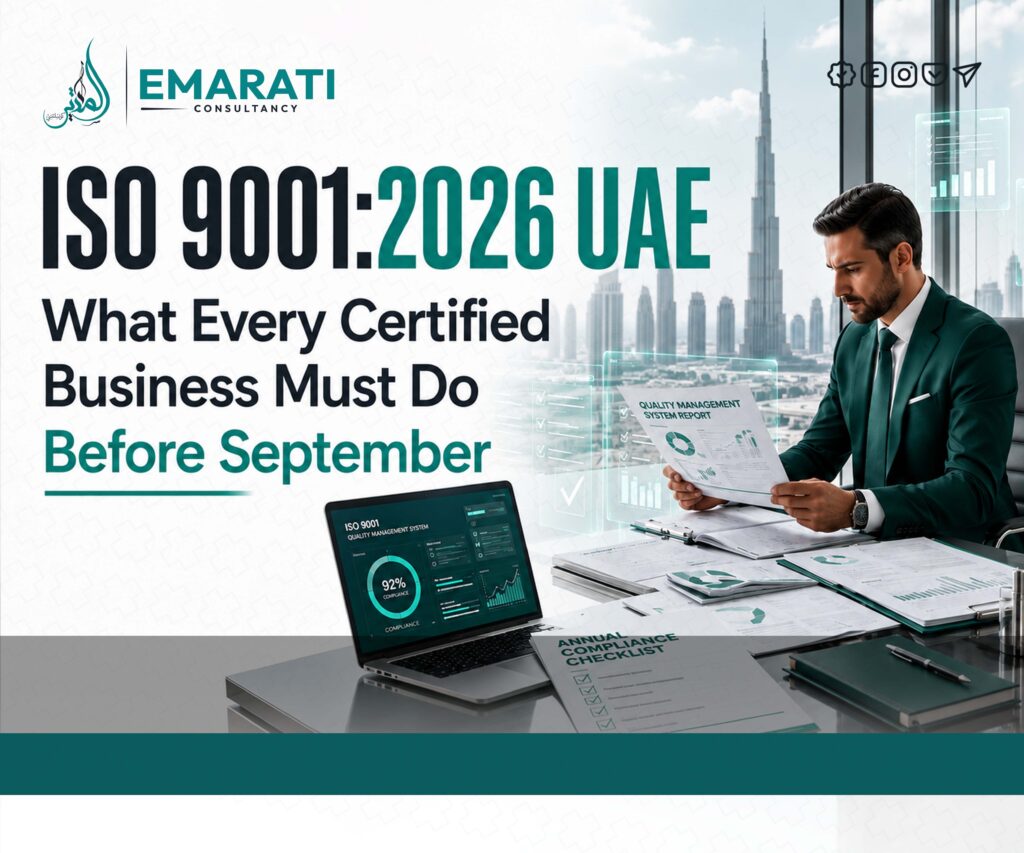
This is not a future action. If your Clause 4.1 context analysis does not include a documented assessment of whether climate change is relevant to your QMS — even if your conclusion is that it is not relevant — you have an existing non-conformance that your certification body auditor will identify at your next surveillance audit. Review your context analysis today. Add a documented climate change relevance assessment. This takes a maximum of one hour for most UAE businesses and eliminates a non-conformance risk that is entirely preventable.
Your quality policy must more explicitly reflect your organisation’s strategic context and values in preparation for the quality culture requirement. Review your current quality policy and ask two questions. Does it reference your organisation’s strategic environment — not just generic quality commitments? Does it reference ethical conduct alongside quality management? If not update it before your next audit. Also review whether your management review records show any discussion of quality culture — if not add it to your management review agenda at your next meeting.
Review your current Clause 6.1 documentation. If your existing document only addresses risks — even if it technically includes a column for opportunities — create a supplementary opportunities register that identifies specific actionable quality and commercial improvement opportunities identified through your QMS processes. Link these opportunities to your quality objectives and track progress at management review. This positions you well ahead of the Clause 6.1 restructuring in ISO 9001:2026 and demonstrates systematic opportunity management that many UAE certification body auditors will respond positively to even under the current 2015 standard.
Your ISO 9001:2026 transition can be combined with a scheduled recertification audit — minimising cost and operational disruption. Check where your current certificate sits in its three-year cycle:
If your next recertification audit falls in 2027 — plan your transition at that audit. Certification bodies should be accredited to ISO 9001:2026 by mid-2027 enabling a combined recertification and transition audit.
If your next recertification falls in 2028 — plan your transition at that audit. Full three years of transition time available with no commercial pressure.
If your next recertification falls in 2029 — do not wait until 2029. Plan your transition in 2028 to avoid the certification body booking pressures and consultant unavailability that will characterise the final year of the transition period. The ISO 9001:2015 to 2026 transition will follow the same last-minute scramble pattern as the 2008 to 2015 transition — businesses that start early will have the best audit scheduling, the most consultancy support availability and the lowest transition costs.
Most ISO 9001:2026 guidance published internationally addresses generic implementation considerations. These four UAE-specific factors are absent from most guides — and the most commercially relevant for UAE certified businesses.
Dubai Municipality, RTA, DEWA, Abu Dhabi government procurement and ADNOC will all continue accepting ISO 9001:2015 certificates throughout the transition period. Your current certificate is commercially valid for every UAE tender until September 2029. There is no risk of tender disqualification due to holding a 2015 certificate during the transition period — procurement systems will accept both versions simultaneously.
The commercial risk only materialises after September 2029 when ISO 9001:2015 certificates become invalid. Any UAE business with an uncompleted transition at that point faces the same tender disqualification consequences as a business with a lapsed certificate — immediate exclusion from government procurement regardless of operational quality.
ADNOC’s SAP Ariba vendor management system monitors ISO certificate validity actively. During the transition period ADNOC will accept both ISO 9001:2015 and ISO 9001:2026 certificates — whichever your certification body has issued. After the September 2029 transition deadline only ISO 9001:2026 certificates will satisfy ADNOC’s mandatory ISO 9001 vendor registration requirement.
For ADNOC contractors with complex vendor registration categories requiring multiple ISO certifications — ISO 9001, ISO 14001 and ISO 45001 — planning your QHSE IMS transition as a single integrated exercise in 2027 or 2028 is the most cost-efficient approach. Three standard transitions conducted separately will cost significantly more than a single integrated transition audit.
The explicit quality culture and ethical behaviour requirement in ISO 9001:2026 has particular relevance for UAE construction companies. Construction procurement across Dubai Municipality, RTA, DEWA and Abu Dhabi government entities already assesses governance quality alongside technical capability. An ISO 9001:2026 management system that explicitly addresses quality culture — through documented leadership behaviours, values-referenced quality policies and management review discussions that go beyond performance metrics — demonstrates organisational maturity that differentiates contractors in competitive tender evaluations.
The climate change relevance assessment required by the 2024 amendment to Clause 4.1 has direct regulatory resonance in UAE. Federal Decree-Law No. 11 of 2024 requires environmental compliance from every UAE business by 30 May 2026. A QMS that formally assesses climate change relevance within its context analysis demonstrates alignment with UAE Federal Climate Law — providing documented evidence that your quality management system addresses national climate policy requirements alongside international ISO standards.
For UAE construction, manufacturing and logistics companies this Clause 4.1 climate assessment should acknowledge UAE Federal Climate Law as a relevant external factor in your organisational context — connecting your ISO 9001 management system to the national regulatory environment in a way that demonstrates governance awareness to procurement authorities assessing quality management maturity.
ISO 9001:2026 is expected to be officially published in September 2026. UAE businesses currently certified to ISO 9001:2015 have until September 2029 to complete their transition — a three-year transition period. Both versions are commercially valid throughout this period. UAE government procurement systems, ADNOC vendor registration and international supply chain partners will accept both versions during the transition period.
No. After ISO 9001:2026 publishes in September 2026, certification bodies must complete training and accreditation to the new standard through their national accreditation bodies — a process taking 9 to 12 months. EIAC accredited certification bodies in UAE are not expected to issue ISO 9001:2026 certificates until mid to late 2027 at the earliest. This means the practical transition window for most UAE businesses is 2027 to 2029 — not 2026.
Yes. ISO 9001:2015/Amd 1:2024 came into force in February 2024 and added climate change assessment to Clause 4.1. UAE businesses that have not updated their context analysis to include a documented climate change relevance assessment are already non-compliant with the current standard — not just the upcoming 2026 revision. Certification body auditors are checking this at surveillance and recertification audits right now. Address this immediately.
Four confirmed changes in ISO 9001:2026. Climate change formally integrated into core requirements — already in force since February 2024. Quality culture and ethical behaviour added as an explicit top management requirement — evidence of culture and ethics expected at audits from 2026. Risks and opportunities separated into distinct sub-clauses — requiring separate treatment rather than combined documentation. New Annex A added providing clause-by-clause implementation guidance — informative not mandatory, but will shape audit conversations.
No. ISO 9001:2026 does not include specific requirements for artificial intelligence, digital transformation or emerging technologies. These topics were considered during the revision process but were not included in the confirmed DIS changes. AI governance is addressed by ISO 42001 — the AI management system standard. Quality management is addressed by ISO 9001. They remain distinct standards with distinct purposes.
Transition cost depends entirely on how well-maintained your current ISO 9001:2015 management system is. For UAE businesses with active, well-maintained QMS the four confirmed changes require relatively modest updates — context analysis revision, quality policy update, opportunities register development and Annex A familiarisation. Transition consultancy support for well-maintained systems typically costs AED 2,500 to AED 7,000 for small to medium UAE businesses. Businesses with neglected management systems that need comprehensive updating before transitioning will face higher costs — reinforcing the commercial logic of maintaining your management system actively throughout the certification cycle.
Implement ISO 9001:2015 now. This is the unanimous recommendation of every ISO technical body and certification organisation globally — and for compelling commercial reasons specific to UAE. Your ISO 9001:2015 certificate is commercially valid for UAE government tenders, ADNOC vendor registration and international supply chain qualification immediately on issue. Waiting until 2026 means missing commercial opportunities in the interim period that your certified competitors are winning today. The transition from a well-implemented 2015 system to 2026 is straightforward and cost-effective. Starting fresh in 2026 or 2027 provides no commercial advantage and significant commercial delay.
Plan your transition audit to coincide with your next scheduled recertification audit — minimising cost and operational disruption. If your recertification falls in 2027 or 2028 plan to combine the transition and recertification in a single audit engagement with your certification body. If your recertification falls in 2029 plan your transition in 2028 to avoid the last-minute booking pressure that will characterise the final transition year. Contact Emarati Consultancy for a transition planning assessment specific to your certification cycle.
ISO 9001:2026 represents an evolutionary update — not a management system rebuild. UAE businesses that address the one immediately urgent action — the climate change amendment already in force — and plan the remaining three changes into their normal audit and management review cycles will transition smoothly and cost-effectively within the three-year window.
Emarati Consultancy supports UAE businesses throughout their ISO 9001:2026 transition — from immediate climate change amendment gap assessments through to full transition audit preparation when certification bodies begin issuing 9001:2026 certificates from 2027.
Whether you need to address the climate change amendment before your next surveillance audit, plan your quality culture documentation for the 2026 publication, understand how the transition affects your ADNOC vendor registration or combine your recertification and transition into a single cost-efficient audit — Emarati Consultancy has the ISO 9001:2026 expertise, UAE regulatory knowledge and certification body relationship management experience to guide you through efficiently.
Phone: +971 52 856 0299
Email: info@emaraticonsultancy.ae
Office: City Bay Business Centre, Office 303, Near Abu Bakr Metro Station, Dubai, UAE
Looking for reliable ISO renewal services in the UAE? Our specialists in Dubai, Abu Dhabi, and Sharjah help you align your OHSMS with updated ISO 45001 requirements, ensuring continuous compliance and smooth recertification.
The great explorer of the truth, the master-builder of human happiness no one rejects dislikes avoids pleasure itself because it is pleasure but because know who do not those how to pursue pleasures rationally encounter consequences that are extremely painful desires to obtain.
Read More