8:00AM - 6:00PM
Monday to Saturday
Monday to Saturday
+971 52 856 0299
Hor Al Anz


By Emarati Consultancy | ISO Certification Consultant Experts in UAE | Updated 2026
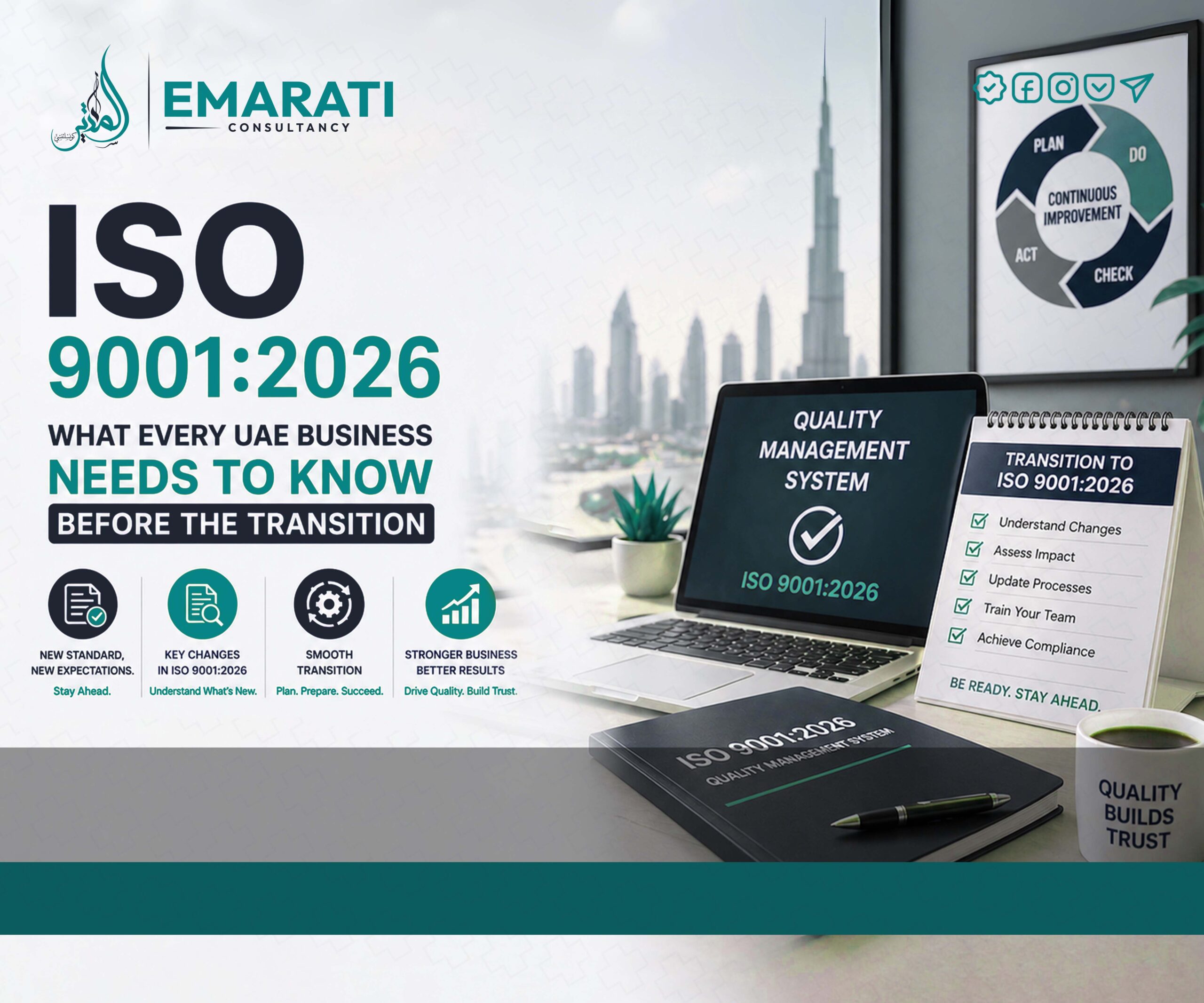
ISO 9001 is changing. For the first time since 2015 the world’s most widely held quality management standard is being revised — and every UAE business currently certified to ISO 9001:2015 needs to understand what is happening, when it happens and what they need to do before the transition deadline arrives.
The good news is that you have time. The final publication of ISO 9001:2026 is expected in September 2026 and organisations will have until approximately September 2029 to complete the transition. The bad news is that three years disappears faster than you expect — especially when UAE certification body audit slots fill up, management priorities compete for attention and the cost of transition rises the longer you wait.
This guide gives you everything you need to understand ISO 9001:2026 — what is changing, what the transition timeline looks like, what the specific UAE implications are and exactly what you should be doing right now to protect your certification and your tender eligibility.
ISO 9001 was last revised in 2015. The 2015 version introduced risk-based thinking, a stronger emphasis on leadership commitment and the High Level Structure that all modern ISO management standards share. It was a significant update that fundamentally changed how quality management systems are structured and implemented.
ISO 9001:2026 is an evolutionary revision — not a fundamental rebuild. The ten-clause structure remains. The process approach remains. The core requirements for context, leadership, planning, support, operation, performance evaluation and improvement all remain. But several areas are being updated to reflect how business has changed since 2015 — the rise of digital operations, growing sustainability obligations, evolving supply chain risks and increasing expectations around organisational culture and ethical conduct.
The Draft International Standard was released in August 2025 and approved by ISO member bodies. Final publication is on track for September 2026. A three-year transition period follows — meaning all ISO 9001:2015 certificates must be upgraded to the 2026 version by approximately September 2029.
Here is what the current Draft International Standard confirms is changing. Note that some details may be refined before final publication — but the direction is clear and UAE businesses can begin preparing now based on what is already known.
The 2024 climate change amendment to ISO 9001:2015 — which came into force in February 2024 — required organisations to assess whether climate change is a relevant issue within their quality management system context. ISO 9001:2026 absorbs this amendment directly into the standard’s core requirements. For UAE businesses this means climate change consideration is no longer an add-on — it is a built-in requirement of your QMS context analysis under Clause 4.1. UAE businesses that have not yet incorporated the 2024 climate change amendment into their existing ISO 9001:2015 systems are already non-compliant with current requirements — and need to address this before their next surveillance audit regardless of the 2026 transition.
ISO 9001:2026 introduces explicit leadership accountability for promoting organisational culture and ethical behaviour within the quality management system framework. Under the 2026 standard, top management must demonstrate active commitment not just to quality system compliance but to embedding a genuine quality culture across the organisation — including ethical conduct, transparent decision-making and values-driven leadership. For UAE businesses this adds a cultural accountability dimension to leadership review that goes beyond the process and resource oversight that ISO 9001:2015 required.
Under ISO 9001:2015 risks and opportunities are addressed together in Clause 6.1. ISO 9001:2026 separates them into distinct sub-clauses — giving opportunities explicit dedicated attention rather than treating them as a secondary consideration alongside risks. This change acknowledges that well-managed organisations pursue opportunities systematically — not just manage risks defensively. For UAE businesses this means your planning processes need to demonstrate structured opportunity identification and exploitation — not just risk assessment and mitigation.
ISO 9001:2026 tightens supplier oversight requirements — recognising that modern supply chains are more complex, more globalised and more risk-prone than they were in 2015. The new requirements place greater emphasis on supplier performance monitoring, supply chain risk assessment and documented evidence that externally provided products and services meet quality requirements consistently. For UAE manufacturers, construction companies and trading businesses with complex supply chains — particularly those sourcing internationally — this requires more robust supplier qualification and monitoring programmes than many currently maintain.
ISO 9001:2026 acknowledges digital transformation as a business reality — addressing cloud-based quality management, digital process monitoring, AI-assisted quality control and remote working arrangements within the quality management system framework. The standard does not mandate specific technologies — but it requires that whatever digital tools your organisation uses for quality management are appropriately controlled, documented and integrated into your QMS. For UAE technology companies and digitally-forward businesses this formalises digital quality governance requirements that progressive organisations are already applying informally.
ISO 9001:2026 includes a new Annex A providing implementation guidance for key requirements — particularly useful for smaller organisations and those implementing ISO 9001 for the first time. While Annex A guidance is not mandatory, it provides valuable clarity on how the standard’s requirements are intended to be applied — reducing the interpretation ambiguity that has caused unnecessary non-conformities in ISO 9001:2015 audits.
Understanding the transition timeline is the most practically important element of ISO 9001:2026 planning for UAE businesses. Here is the confirmed timeline based on current information:
| Milestone | Date |
|---|---|
| Draft International Standard published | August 2025 |
| Final Draft International Standard expected | Early to mid 2026 |
| ISO 9001:2026 official publication | September 2026 |
| Transition period begins | September 2026 |
| Transition deadline — all certificates must be upgraded | September 2029 |
| ISO 9001:2015 certificates no longer valid | After September 2029 |
The transition period is three years from publication — following the same pattern as the 2015 revision when organisations certified under ISO 9001:2008 had until September 2018 to upgrade. Both versions remain valid throughout the transition period — your ISO 9001:2015 certificate is not invalid the moment ISO 9001:2026 publishes.
This is the question UAE businesses need to understand clearly before assuming they have plenty of time.
When the September 2029 transition deadline arrives, ISO 9001:2015 certificates will no longer be valid. For UAE businesses that depend on ISO certification for commercial access this means immediate and serious consequences.
UAE government tender submissions require currently valid ISO certification. An ISO 9001:2015 certificate presented after September 2029 will not satisfy Dubai Municipality, RTA, DEWA or Abu Dhabi government procurement requirements. Your tender submission will be rejected before technical evaluation begins.
ADNOC vendor registration requires currently valid ISO certification. ADNOC’s SAP Ariba system actively monitors certificate validity. An expired or non-transitioned certificate results in vendor status suspension — cutting off access to one of the world’s largest oil and gas procurement ecosystems.
International supply chain qualification requires currently valid certification. International clients and buyers that verify supplier certification through IAF CertSearch will see your lapsed certificate immediately — with consequences for client relationships that extend beyond the administrative lapse period.
The transition deadline is not a soft deadline. September 2029 is the date after which ISO 9001:2015 certification ceases to exist as a valid credential — and for UAE businesses whose revenue depends on government tenders and ADNOC registration, losing that credential even temporarily has immediate and measurable commercial impact.
Most ISO 9001:2026 transition guidance published internationally misses the specific UAE context. Here is what makes the transition uniquely important for UAE businesses.
UAE government procurement cycles operate on specific tender calendars. Construction contracts, infrastructure projects, technology procurement and service agreements all have tender submission deadlines that do not wait for certification body availability. UAE businesses that time their ISO 9001:2026 transition poorly risk either presenting an outdated certificate during a critical tender window or attempting to rush a transition that cannot be compressed without quality risk.
The expert recommendation for UAE businesses dependent on government tenders is to plan the ISO 9001:2026 transition in 2026 or 2027 — not 2028 or 2029. Planning early means choosing your transition timeline rather than accepting whatever certification body availability remains when the deadline approaches.
DMCC and DIFC companies face a particular challenge during the ISO 9001:2026 transition. Their quality management systems must satisfy both the revised ISO 9001 standard requirements and the expectations of free zone authorities during tender evaluations — which are increasingly incorporating sustainability, digital governance and supply chain accountability criteria that align with the 2026 standard’s new emphasis areas. Free zone businesses that transition proactively and align their QMS with 2026 requirements early will be better positioned for free zone tender evaluation than those presenting 2015-aligned systems.
The UAE’s Net Zero 2050 strategic initiative is actively shaping what government procurement authorities and major private sector organisations expect from certified suppliers. ISO 9001:2026’s formal integration of climate change into QMS context requirements directly aligns with UAE sustainability expectations — meaning the transition is not just a standards compliance exercise for UAE businesses. It is an opportunity to align your quality management system with the sustainability credentials that UAE government procurement is increasingly assessing.
ISO 9001:2026’s tightened supply chain oversight requirements are particularly relevant for ADNOC contractors and oil and gas sector service companies. ADNOC’s existing vendor qualification framework already requires documented supplier performance monitoring — and the 2026 standard’s strengthened supply chain requirements bring the ISO 9001 framework into closer alignment with what ADNOC prequalification auditors already expect to see. For ADNOC contractors this means the transition may require less additional work than for businesses in other sectors — but the documentation of supply chain oversight needs to be more explicitly connected to the QMS risk assessment than many current systems demonstrate.
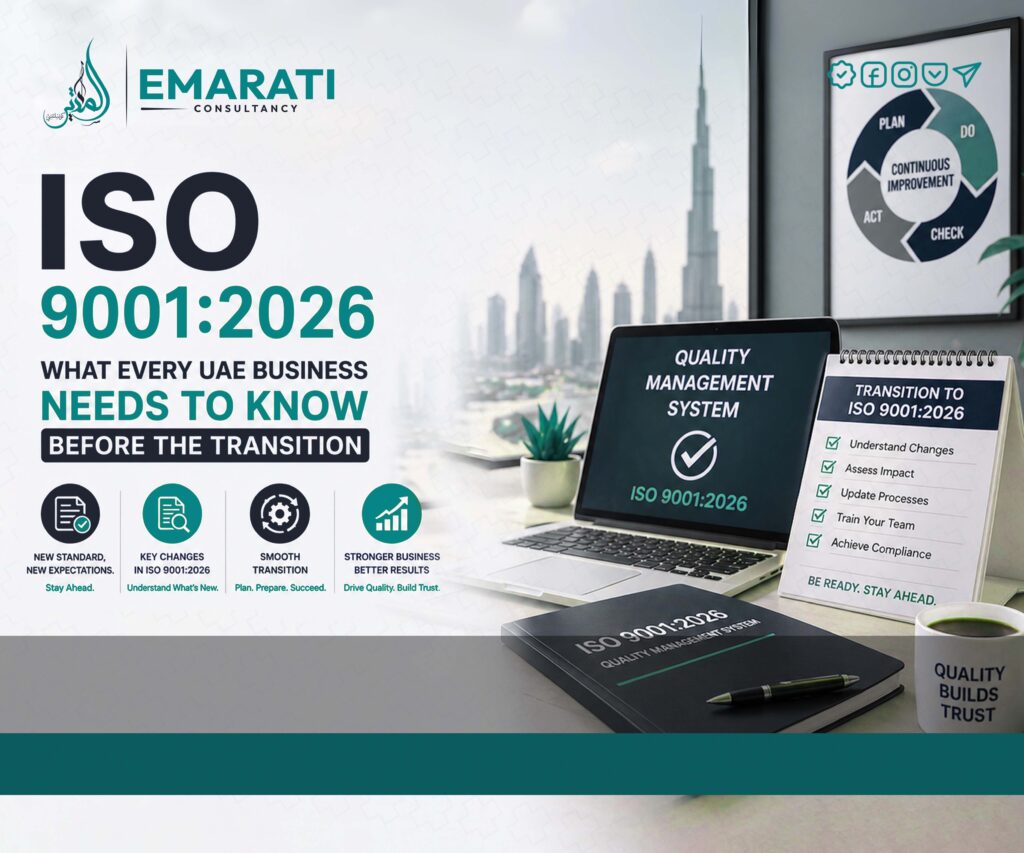
Whether your ISO 9001:2015 certificate was issued recently or is approaching its three-year renewal, here is the expert recommended action plan for UAE businesses right now.
ISO 9001:2026 Draft International Standard from ISO.org
The climate change amendment to ISO 9001:2015 came into force in February 2024. Every UAE business currently certified to ISO 9001:2015 should have already incorporated climate change assessment into their Clause 4.1 context analysis and Clause 6.1 risk and opportunity planning. If your current QMS documentation does not include a documented assessment of whether climate change is a relevant issue for your organisation, you have an existing non-conformity that your certification body will identify at your next surveillance audit — regardless of the 2026 transition. Address this now, not when the 2026 standard publishes.
Your ISO 9001:2026 transition timing should be coordinated with your existing certification cycle — specifically your next scheduled recertification audit. The transition audit can be combined with a recertification audit to minimise cost and disruption. Businesses whose recertification audit falls in 2027 or 2028 should plan to conduct their transition at that recertification — requiring preparation work to begin in 2026 or 2027. Businesses whose recertification falls in 2029 need to ensure they do not leave transition to the last possible audit given certification body booking pressures.
The Draft International Standard is published and available. A gap analysis against the known changes — climate change integration, leadership culture accountability, separated risk and opportunity planning, strengthened supplier oversight and digital quality management acknowledgement — gives you a clear picture of what your existing QMS needs to address before the transition audit. Most well-maintained ISO 9001:2015 systems will have manageable gaps. Organisations with minimal compliance systems will face more significant transition work — and should begin planning that work now rather than in 2028.
The transition from ISO 9001:2008 to ISO 9001:2015 demonstrated a consistent pattern. Most organisations assumed they had plenty of time and left their transition to the final year. Certification body audit slots filled rapidly as the deadline approached. Businesses that delayed faced higher costs, compressed timelines and reduced consultant availability. The same pattern will repeat with the ISO 9001:2026 transition — and for UAE businesses dependent on government tenders, any certification gap during a compressed last-minute transition carries real commercial risk.
Transition timeline depends on the maturity of your existing management system and how significant the gaps are between your current QMS and the 2026 requirements.
| Organisation Status | Estimated Transition Timeline |
|---|---|
| Well-maintained system, minor gaps | 4 to 8 weeks |
| Adequate system, moderate gaps | 8 to 16 weeks |
| Minimal compliance system, significant gaps | 4 to 6 months |
| System not properly maintained | 6 to 12 months |
The most time-consuming elements of the transition are incorporating climate change assessment into your context analysis with documented evidence, restructuring risk and opportunity documentation into separate processes and strengthening supplier oversight evidence to meet the tightened 2026 requirements. Leadership culture documentation — the new ethical conduct requirement — is typically the quickest element to address with updated quality policy language and management review records.
Transition cost depends entirely on the state of your existing management system and the extent of gaps identified in the gap analysis. Here are realistic 2026 figures for UAE businesses:
| Organisation | System Status | Estimated Transition Cost AED |
|---|---|---|
| Small business | Well-maintained system | AED 2,500 — 4,000 |
| Small business | Gaps to address | AED 4,000 — 7,000 |
| Medium business | Well-maintained system | AED 4,000 — 7,000 |
| Medium business | Significant gaps | AED 7,000 — 14,000 |
| Large business | Well-maintained system | AED 7,000 — 12,000 |
| Large business | Major rework required | AED 12,000 — 20,000+ |
These figures cover consultancy transition support — gap analysis, documentation updates, staff awareness training and transition audit preparation. Certification body transition audit fees are additional and vary by body and organisation size. Combining the transition audit with a scheduled recertification audit reduces total cost significantly — typically saving AED 2,000 to AED 6,000 compared to conducting a standalone transition audit.
This is one of the most common questions UAE businesses ask when they hear about the upcoming revision. The expert answer is clear.
If you are pursuing ISO 9001 certification for the first time — proceed. Do not wait. Implementing ISO 9001:2015 now gives you immediate commercial access to UAE government tenders, ADNOC vendor registration and international supply chain participation. The 2026 standard is evolutionary — your 2015 implementation provides an excellent foundation for the transition when it comes. Waiting until 2026 or later means missing commercial opportunities in the interim period.
Emarati Consultancy implements all new ISO 9001 certifications with the 2026 requirements in mind — building management systems that address climate change, digital quality management and supply chain oversight from the outset, making the eventual transition minimal in scope and cost.
ISO 9001:2026 is expected to be officially published in September 2026. The Draft International Standard was released in August 2025 and approved by ISO member bodies. Final publication may shift slightly depending on the ballot process — but September 2026 is the confirmed target date based on current information from the ISO Technical Committee.
The transition deadline is expected to be September 2029 — three years after the September 2026 publication date. After this date ISO 9001:2015 certificates will no longer be valid. UAE businesses must complete their transition to ISO 9001:2026 before this deadline to maintain tender eligibility, ADNOC vendor status and international supply chain qualification.
The main changes confirmed in the Draft International Standard include formal integration of climate change into QMS context requirements, explicit leadership accountability for quality culture and ethical conduct, separation of risk and opportunity planning into distinct sub-clauses, tightened supplier and supply chain oversight requirements, acknowledgement of digital quality management and a new Annex A with implementation guidance. The core ten-clause structure and process approach remain unchanged.
Yes — ISO 9001:2015 certificates remain fully valid until the September 2029 transition deadline. You do not need to take any immediate action on your certificate. However you should address the 2024 climate change amendment if you have not already done so, as this is a current requirement that certification body auditors are checking at surveillance audits right now.
Yes — and this is the recommended approach for most UAE businesses. Combining the transition audit with a scheduled recertification or surveillance audit minimises cost, reduces operational disruption and makes efficient use of the certification body's audit time. Emarati Consultancy coordinates transition timing with your existing certification cycle to achieve the most cost-effective transition pathway for your organisation.
During the three-year transition period both ISO 9001:2015 and ISO 9001:2026 certificates are valid. UAE government procurement systems, ADNOC vendor registration and international supply chain partners will accept both versions throughout the transition period. The commercial risk arises after September 2029 when only ISO 9001:2026 certificates are valid — organisations that have not transitioned by then face immediate tender disqualification.
Yes. If your organisation holds QHSE IMS certification combining ISO 9001, ISO 14001 and ISO 45001, all three standards within the integrated system need to be assessed against their respective 2026 versions during the transition. ISO 14001:2026 is already published. ISO 9001:2026 publishes in September 2026. ISO 45001 is not currently undergoing revision. Emarati Consultancy plans all QHSE IMS transitions as integrated exercises — addressing all applicable standard revisions simultaneously to minimise transition cost and audit disruption.
Start now. ISO 9001:2015 remains valid and commercially effective. Implementing it now gives you immediate access to UAE government tenders, ADNOC vendor registration and international supply chain participation. The 2026 transition from a well-implemented 2015 system is manageable and cost-effective. Waiting until 2026 means losing commercial opportunities in the interim that your certified competitors are winning today.
The ISO 9001:2026 transition is manageable for UAE businesses that plan ahead. The businesses that will struggle are those that assume September 2029 is far away and leave transition planning until certification body auditors are fully booked, consultants are occupied and the commercial cost of any certification gap becomes real.
Emarati Consultancy is already preparing UAE clients for the ISO 9001:2026 transition — conducting readiness assessments, addressing the 2024 climate change amendment for existing clients and implementing new ISO 9001 systems with the 2026 requirements built in from day one.
Whether you need to understand what the transition means for your existing certificate, address the 2024 climate change amendment before your next surveillance audit or implement ISO 9001 for the first time with the 2026 revision in mind — Emarati Consultancy has the expertise, UAE regulatory knowledge and ISO 9001 implementation experience to guide you through efficiently.
Phone: +971 52 856 0299 Email: info@emaraticonsultancy.ae Office: City Bay Business Centre, Office 303, Near Abu Bakr Metro Station, Dubai, UAE
Looking for reliable ISO renewal services in the UAE? Our specialists in Dubai, Abu Dhabi, and Sharjah help you align your OHSMS with updated ISO 45001 requirements, ensuring continuous compliance and smooth recertification.
The great explorer of the truth, the master-builder of human happiness no one rejects dislikes avoids pleasure itself because it is pleasure but because know who do not those how to pursue pleasures rationally encounter consequences that are extremely painful desires to obtain.
Read More