8:00AM - 6:00PM
Monday to Saturday
Monday to Saturday
+971 52 856 0299
Hor Al Anz


By Emarati Consultancy | ISO Certification Consultant Experts in UAE | Updated 2026
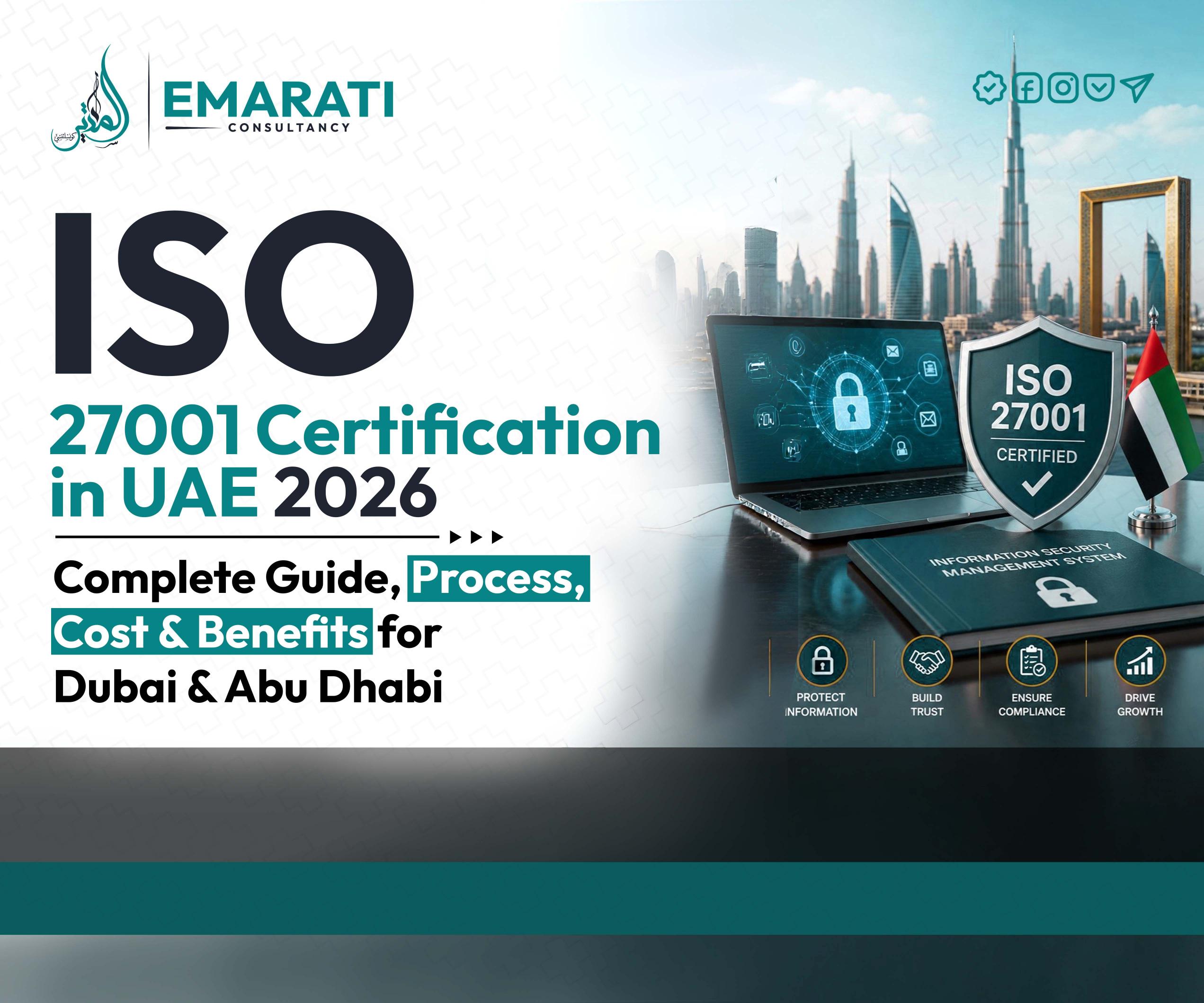
If your UAE business handles sensitive data — customer information, financial records, employee data, intellectual property or any digital system that matters to your operations — ISO 27001 certification UAE is the internationally recognised standard that proves you manage information security systematically. Not through claims. Through independently audited evidence.
In 2026 ISO 27001 certification has moved from a nice-to-have credential for UAE technology companies to a commercial necessity for a broad range of sectors. Government technology tenders require it. DIFC and ADGM regulated organisations need it. UAE Central Bank licensed financial institutions are expected to demonstrate it. International clients performing vendor due diligence ask for it. And the UAE National Cybersecurity Strategy 2025-2031 has positioned it as the recognised benchmark for information security governance across the emirates.
This guide covers everything UAE businesses need to know about ISO 27001 in 2026 — what it is, who needs it, what the process involves, how long it takes, what it costs in AED and why the cost of not having it is significantly higher than the cost of getting certified.
ISO 27001 — formally ISO/IEC 27001:2022 — is the international standard for Information Security Management Systems published by the International Organisation for Standardisation and the International Electrotechnical Commission. It is the most widely recognised information security standard in the world — providing organisations with a structured framework for identifying information security risks, implementing appropriate controls and continuously improving the protection of sensitive data, digital systems and business-critical information assets.
The standard applies to any organisation — regardless of size, industry or sector — that manages sensitive information and wants to demonstrate that information security is governed systematically rather than managed reactively. ISO 27001 certification is issued by accredited third-party certification bodies following an independent audit of your Information Security Management System and is valid for three years subject to annual surveillance audits.
ISO 27001:2022 updated the previous 2013 standard significantly — restructuring the Annex A control framework from 114 controls across 14 domains to 93 controls across four domains. The four domains are Organisational controls, People controls, Physical controls and Technological controls. New controls added in the 2022 version include threat intelligence, cloud security, information security for cloud services, ICT readiness for business continuity, data masking, monitoring activities, web filtering and secure coding. Organisations still certified to ISO 27001:2013 must transition to the 2022 version — the transition deadline was October 2025. Any UAE business currently holding an ISO 27001:2013 certificate should have already transitioned or needs to act immediately.
Federal Decree-Law No. 45 of 2021 — the UAE Personal Data Protection Law — requires all organisations handling personal data to implement appropriate technical and organisational security measures. ISO 27001:2022 provides the internationally recognised information security management framework that directly addresses UAE PDPL technical security requirements. For UAE businesses subject to PDPL obligations ISO 27001 certification provides the most credible, independently verified evidence of compliance — significantly stronger than internal policy statements or self-assessment declarations.
The Dubai Cyber Security Strategy 2023, developed by the Dubai Electronic Security Centre under the Digital Dubai Authority, sets out a blueprint for protecting Dubai’s digital infrastructure and reinforces requirements for documented security management systems aligned with recognised international frameworks. The strategy applies to organisations operating within Dubai and makes ISO 27001 the recognised benchmark for information security governance in the emirate. Government technology vendors, managed service providers and any Dubai business operating critical digital infrastructure face increasing pressure to demonstrate ISO 27001 alignment.
The UAE National Cybersecurity Strategy 2025-2031 positions the UAE as a regional cybersecurity leader — establishing ISO 27001 as a de facto standard for organisations managing sensitive information across all seven emirates. The strategy creates specific governance expectations for technology companies, financial institutions, healthcare providers and critical infrastructure operators — and ISO 27001 certification is the most credible internationally recognised evidence that your organisation meets those expectations.
Organisations operating within the Dubai International Financial Centre are subject to DIFC Data Protection Law No. 5 of 2020. The law sets requirements for data security, consent, processing accountability and breach notification. ISO 27001 certification provides the information security management foundation that satisfies DIFC regulatory expectations and is increasingly specified in DIFC client procurement requirements. DIFC-regulated firms often reach ISO 27001 certification faster because their existing DIFC regulatory framework overlaps significantly with ISO 27001 Annex A controls — typically achieving certification in 4 to 6 months compared to 8 to 12 months for organisations without a regulatory baseline.
Organisations within Abu Dhabi Global Market are subject to ADGM Data Protection Regulations applying requirements similar to GDPR across data security, breach notification and processing accountability. ISO 27001 certification provides the information security governance framework that satisfies ADGM regulatory expectations and the due diligence requirements of international financial counterparties operating within ADGM.
The UAE Central Bank requires licensed financial institutions to implement robust information security controls and maintain documented evidence of compliance. ISO 27001 is widely recognised as fulfilling this requirement and is routinely requested during enterprise vendor due diligence by banks, insurance companies and financial institutions regulated by the Central Bank. For UAE fintech companies and technology vendors supplying to the banking sector ISO 27001 is effectively a commercial entry requirement.
UAE government departments and public sector entities across all seven emirates increasingly mandate ISO 27001 certification from technology vendors, system integrators, cloud service providers and managed service providers as a mandatory prequalification criterion. Government technology tenders explicitly require bidders to hold a current ISO 27001 certificate — making it one of the strongest commercial drivers for information security certification in the UAE market in 2026.
Before discussing what ISO 27001 costs — it is worth understanding what not having it costs. This is the calculation that most UAE technology companies only make after missing it.
A Dubai-based technology firm calculated that they had been excluded from government tenders worth over AED 2 million during the 14 months their ISO 27001 certification project stalled due to budget uncertainty. Their implementation ultimately cost AED 140,000 — a fraction of what they lost in tender eligibility during the delay. Their own procurement team confirmed the figure.
This pattern is not unusual. UAE technology companies, financial services firms and professional services organisations that delay ISO 27001 certification consistently find that the commercial cost of delay — in lost tenders, missed contracts, higher insurance premiums and client attrition — significantly exceeds the total implementation cost. The implementation is a one-time investment. The commercial cost of not having it compounds monthly.
ISO 27001 certification qualifies your organisation for UAE government technology tenders and public sector contracts that require certified information security management as a mandatory prequalification criterion — opening procurement opportunities worth billions of dirhams annually that are completely unavailable to uncertified competitors.
ISO 27001 provides the documented, independently audited information security evidence that satisfies UAE PDPL obligations, DIFC Data Protection Law requirements, ADGM Data Protection Regulations and UAE Central Bank information security standards — across a single certified management system framework.
ISO 27001 gives your organisation a systematic risk-based approach to identifying cybersecurity threats, assessing their potential impact and implementing proportionate controls. This proactive approach to information security consistently reduces the likelihood and business impact of data breaches, ransomware attacks and insider security incidents compared to reactive security postures.
ISO 27001 certification signals to enterprise and government clients that sensitive data entrusted to your organisation is protected by an independently audited management system — not just good intentions and informal practices. This trust signal consistently differentiates certified organisations in competitive enterprise procurement evaluations.
UAE businesses holding ISO 27001 certification increasingly achieve more favourable cyber insurance terms. Insurers recognise that certified organisations have documented, tested security controls that demonstrably reduce the probability and severity of insurable information security incidents — translating into lower premium rates for equivalent coverage levels.
Define the boundaries of your Information Security Management System — which information assets, systems, locations, people and processes fall within the certification scope. Scope definition is a critical strategic decision that directly affects both implementation complexity and certification body audit fees. Starting with a focused scope covering your highest-risk information assets is consistently more efficient than attempting to certify your entire organisation in the first cycle.
Document all information assets within your certification scope — data sets, applications, systems, infrastructure, people and processes. Every risk assessment and control selection decision in ISO 27001 flows from the completeness and accuracy of your asset inventory. Organisations that shortcut this stage produce risk assessments that miss significant threats — and subsequently fail certification audits.
Conduct a systematic risk assessment identifying all threats to your information assets — data breaches, unauthorised access, system failures, insider threats, phishing attacks and supply chain compromises. Assess the likelihood and potential impact of each threat materialising. This risk assessment is the foundation of your entire ISMS and the document that certification body auditors examine most closely. The 70 percent first-time audit failure rate for ISO 27001 in UAE is primarily driven by inadequate risk assessment depth — organisations that shortcut this stage consistently fail their Stage 2 audit.
Develop your Statement of Applicability — the core document that maps all 93 Annex A controls against your identified risks. The SoA specifies which controls are applicable, which are implemented, which are excluded and the business justification for each decision. Certification body auditors review the SoA closely during Stage 1 documentation review — a poorly constructed SoA is one of the most common reasons for Stage 1 failures in UAE ISO 27001 certification audits.
Implement information security controls across your organisation covering access management, cryptography, physical security, supplier security management, incident response, business continuity and all other applicable control domains identified in your risk treatment plan. Controls must be genuinely operational — not just documented in policy frameworks — to withstand Stage 2 audit scrutiny.
Every person within the certification scope must understand information security responsibilities, their role in protecting information assets and how to respond to security incidents and phishing attempts. Security awareness training is assessed by certification body auditors as evidence of genuine ISMS implementation — not just documentation.
Conduct a comprehensive internal audit of your Information Security Management System before the external certification audit — assessing all control implementations, documentation completeness and management system effectiveness against ISO 27001:2022 requirements. All non-conformities identified must be addressed and closed before the external assessor arrives.
Conduct your first ISMS management review — ensuring top management evaluates risk treatment progress, security objective performance, incident trends and regulatory compliance status with documented outputs and action items.
The accredited certification body conducts Stage 1 — a documentation and readiness review assessing your ISMS documentation, scope, risk assessment quality and Statement of Applicability. Stage 1 is typically conducted remotely. Issues identified at Stage 1 must be resolved before Stage 2 proceeds.
Stage 2 is the full on-site assessment of your implemented ISMS — evaluating whether your controls are genuinely operational, your staff understand their security responsibilities and your management system functions as documented. Following a successful Stage 2 audit your ISO 27001 certificate is issued — valid for three years with annual surveillance audits.
ISO 27001 is consistently the most complex and therefore the most expensive common ISO management standard to implement. Cost depends on organisation size, scope complexity, IT environment complexity and current security maturity. Here are realistic 2026 figures covering both Emarati Consultancy fees and certification body audit fees combined:
| Organisation | Employees | Total Cost AED |
|---|---|---|
| Small business | Up to 30 | AED 10,000 — 15,000 |
| Medium business | 30 to 150 | AED 15,000 — 25,000 |
| Large business | 150+ | AED 25,000 upward |
| DIFC or ADGM regulated | Any size | Add AED 5,000 — 10,000 |
| Multi-site UAE organisations | Multiple locations | Quote required |
These figures cover consultancy implementation support and certification body audit fees. Additional costs UAE businesses should budget for separately include annual penetration testing for organisations with significant external attack surface, GRC platform licensing if using dedicated information security governance tools, and internal staff time during implementation — typically significant for IT and compliance team members throughout the implementation period.
ISO 27001 takes longer than most other ISO standards because the risk assessment and Statement of Applicability require significant technical depth that cannot be compressed without quality risk.
| Organisation | Status | Timeline |
|---|---|---|
| Small business | No existing security framework | 6 to 10 weeks |
| Medium business | Partial security controls | 10 to 16 weeks |
| Large business | Complex IT environment | 16 to 24 weeks |
| DIFC or ADGM regulated | Regulatory baseline exists | 4 to 6 months |
| Transitioning from ISO 27001:2013 | Certificate exists | 6 to 12 weeks |
The most important factor affecting ISO 27001 timeline is the quality and depth of the information security risk assessment. Organisations that rush the risk assessment phase — particularly those attempting self-implementation — face a high probability of Stage 2 audit failure. The 70 percent first-time audit failure statistic for ISO 27001 globally is almost entirely explained by inadequate risk assessment depth during implementation.
Dubai’s position as a regional technology and financial hub creates specific ISO 27001 demand across multiple sectors simultaneously.
Technology companies across Dubai Internet City and Dubai Silicon Oasis implement ISO 27001 as their primary information security credential for government technology procurement, enterprise client qualification and international technology partner requirements. Dubai Internet City hosts many of the world’s largest technology companies — and their enterprise vendor qualification programmes consistently require ISO 27001 from UAE technology suppliers at mid-market and enterprise level.
DMCC-based financial services firms, commodities traders and professional services companies implement ISO 27001 to satisfy the information security requirements of their international counterparties — European financial institutions, Asian trading partners and global commodity buyers all apply information security due diligence requirements that ISO 27001 satisfies comprehensively.
DIFC businesses face the most explicit information security governance requirements of any Dubai free zone — combining DIFC Data Protection Law No. 5 of 2020 with the information security expectations of international financial counterparties. ISO 27001 is effectively the baseline information security credential for any DIFC-regulated entity or organisation supplying technology services to DIFC firms. The alignment between DIFC regulatory requirements and ISO 27001 Annex A controls means DIFC-regulated firms consistently achieve ISO 27001 certification faster and at lower cost than equivalent-sized organisations without a regulatory baseline.
Abu Dhabi Global Market creates the most explicit information security regulatory environment in Abu Dhabi — combining ADGM Data Protection Regulations with the security expectations of international institutional counterparties. ISO 27001 provides the information security management foundation that satisfies ADGM regulatory requirements and positions ADGM-based organisations credibly for international financial sector due diligence.
Abu Dhabi government technology procurement requirements increasingly mandate ISO 27001 from technology vendors, system integrators and managed service providers — particularly for contracts involving sensitive government data, digital identity infrastructure and smart city technology systems. Technology vendors pursuing Abu Dhabi government contracts should budget for ISO 27001 as a prerequisite qualification requirement rather than a differentiating credential.
The National Electronic Security Authority Information Assurance Standards — whose functions have been absorbed by the Signals Intelligence Agency — historically governed critical infrastructure security requirements across Abu Dhabi. NESA IAS is closely aligned with ISO 27001 controls and ISO 27001 certification is widely accepted as strong evidence of NESA IAS compliance for organisations operating critical infrastructure in Abu Dhabi.
ISO Certification in Abu Dhabi
ISO 27001 covers information security management broadly — protecting confidentiality, integrity and availability of all information assets. ISO 27701 extends ISO 27001 specifically to privacy information management — adding requirements for personally identifiable information protection that directly addresses UAE PDPL compliance. For UAE businesses processing significant personal data volumes, implementing ISO 27001 alongside ISO 27701 provides comprehensive governance covering both information security and privacy management simultaneously — the most complete regulatory compliance framework available for UAE data-intensive organisations.
ISO 27001 focuses on protecting information assets from security threats. ISO 22301 focuses on ensuring critical business functions continue operating through disruption — including cyberattacks, system failures and ransomware incidents. Many UAE technology companies and financial institutions implement both standards simultaneously because cybersecurity incidents are among the most common triggers for business continuity events. Together they provide comprehensive digital resilience governance.
ISO 27001 governs information security management across all organisational information assets. ISO 42001 governs artificial intelligence management systems — ensuring AI development, deployment and use is responsible, transparent and accountable. For UAE technology companies building or deploying AI systems, implementing both standards positions your organisation at the frontier of digital governance — satisfying information security due diligence and AI governance expectations simultaneously.
Studies of ISO 27001 certification outcomes consistently show that approximately 70 percent of organisations attempting ISO 27001 certification fail their first Stage 2 audit. This failure rate is significantly higher than any other common ISO management standard. Understanding why this happens — and how to avoid it — is the most practically valuable section of this guide.
The most common causes of first-time ISO 27001 audit failure in UAE are an inadequate information security risk assessment that misses significant threats or applies insufficient rigour to likelihood and impact assessment. A Statement of Applicability that cannot justify control inclusions and exclusions with documented business reasoning. Controls that exist in policy documentation but show no evidence of genuine operational implementation. Security awareness training that was conducted but not documented with attendance records and competence evidence. Internal audits that were not conducted properly or whose findings were not adequately addressed before the external audit. Management reviews that were held informally without proper documentation of inputs, outputs and action items.
Every one of these failure causes is preventable with proper implementation support. Emarati Consultancy’s ISO 27001 process specifically targets these failure points — building risk assessments that withstand auditor scrutiny, Statements of Applicability that are defensible and documented and control implementations that demonstrate genuine operational effectiveness.
Any UAE technology company — software developer, managed service provider, cloud service provider, IT consultancy or system integrator — that handles client data, operates client systems or supplies technology services to government or enterprise clients needs ISO 27001. For technology companies this is the primary quality credential for information security — equivalent to what ISO 9001 is for quality management across all sectors.
Banks, insurance companies, investment firms, payment processors and fintech organisations across UAE mainland, DIFC and ADGM need ISO 27001 to satisfy UAE Central Bank requirements, DIFC and ADGM data protection regulatory obligations and institutional client due diligence requirements. ISO 27001 is effectively the baseline information security credential for the UAE financial services sector in 2026.
Hospitals, clinics, healthcare technology providers and pharmaceutical businesses handling patient data need ISO 27001 to protect sensitive health information, satisfy Dubai Health Authority and Abu Dhabi Department of Health information security expectations and demonstrate information security governance to healthcare accreditation bodies and international partners.
Any organisation supplying technology products, systems or services to UAE federal or emirate government entities needs ISO 27001 as a tender prequalification credential. Government technology procurement specifications across all seven emirates increasingly mandate ISO 27001 — making it a commercial prerequisite rather than a differentiating credential for this segment.
Law firms, management consultancies, accounting firms and professional services organisations handling confidential client information need ISO 27001 to satisfy client contractual security requirements and demonstrate information security governance to enterprise and government clients whose own security obligations flow down to their service providers.
ISO 27001 is not legally mandatory for all UAE businesses — but UAE PDPL compliance is mandatory, and ISO 27001 is the most credible framework for demonstrating it. ISO 27001 is also effectively mandatory for technology companies competing for government contracts, DIFC and ADGM regulated organisations, UAE Central Bank licensed financial institutions and any UAE business with international clients that require certified information security management as a vendor qualification condition.
ISO 27001:2022 restructured the Annex A control framework from 114 controls across 14 domains to 93 controls across four domains — incorporating new controls for cloud security, threat intelligence, data masking, web filtering and secure coding that reflect the modern cybersecurity threat landscape. The transition deadline from the 2013 standard was October 2025. UAE businesses still holding ISO 27001:2013 certificates must transition to the 2022 version immediately — an expired transition presents significant commercial and regulatory risk.
ISO 27001 for small UAE businesses costs from AED 10,000 covering both consultancy and certification body fees. Medium businesses typically pay AED 15,000 to AED 25,000. Large or complex organisations from AED 25,000 upward. DIFC and ADGM regulated organisations should add AED 5,000 to AED 10,000 for the additional regulatory mapping and documentation depth required. Separate budget is required for annual penetration testing and any GRC platform licensing.
Small UAE businesses with limited IT complexity typically achieve ISO 27001 in 6 to 10 weeks. Medium organisations require 10 to 16 weeks. Large or complex organisations need 16 to 24 weeks. DIFC and ADGM regulated firms with existing regulatory frameworks typically certify in 4 to 6 months due to the depth of risk assessment and control implementation required. Rushing the risk assessment phase is the single most common cause of first-time audit failure.
The Statement of Applicability is the core documentation output of the ISO 27001 risk treatment process — a structured document listing all 93 Annex A controls, stating whether each is applicable to your organisation, confirming implementation status and providing documented justification for any excluded controls. Certification body auditors review the SoA closely during Stage 1 — a poorly constructed SoA is a common Stage 1 failure point. Emarati Consultancy develops a thorough, defensible Statement of Applicability as a core deliverable of every ISO 27001 engagement.
Yes. ISO 27001:2022 Annex A controls covering access management, encryption, incident response and supplier security management correspond directly to UAE PDPL technical and organisational security requirements. ISO 27001 certification provides independently verified evidence of PDPL-aligned information security management — significantly stronger compliance evidence than internal policy statements or self-assessments.
The 70 percent first-time failure rate for ISO 27001 is primarily driven by inadequate information security risk assessment depth, poorly constructed Statements of Applicability that cannot justify control decisions, controls that exist in documentation but show no operational implementation evidence and internal audits that were not conducted properly. Every one of these failure causes is preventable with experienced implementation support — Emarati Consultancy's structured process specifically targets each of these failure points.
Yes. Emarati Consultancy provides full ISO 27001 consultancy services remotely for UAE businesses — covering gap analysis, risk assessment, documentation development, training and audit preparation through secure online collaboration. Remote implementation is particularly suitable for technology companies with distributed teams and cloud-based infrastructure. We also provide full in-person consultancy across all seven UAE emirates for organisations preferring on-site engagement.
ISO 27001 certification protects your organisation’s most valuable information assets, demonstrates compliance with UAE data protection law, qualifies your business for government technology contracts and positions you as a credible, security-conscious organisation in a market where information security governance is increasingly the deciding factor in enterprise and government procurement decisions.
The AED 2 million in lost tenders experienced by one Dubai technology firm during a 14-month implementation delay is not an extreme case. It is a pattern that repeats across the UAE technology sector every year. The businesses that act now — building their ISMS correctly, passing their certification audit on the first attempt and maintaining their certificate actively — are the businesses winning the contracts their uncertified competitors cannot access.
Whether you are pursuing ISO 27001 for the first time, transitioning from ISO 27001:2013 to the current 2022 standard or extending your existing ISMS to include ISO 27701 for privacy management — Emarati Consultancy has the information security expertise, UAE regulatory knowledge and structured implementation process to guide you through certification efficiently and successfully.
Phone: +971 52 856 0299 Email: info@emaraticonsultancy.ae Office: City Bay Business Centre, Office 303, Near Abu Dakr Metro Station, Dubai, UAE
Looking for reliable ISO renewal services in the UAE? Our specialists in Dubai, Abu Dhabi, and Sharjah help you align your OHSMS with updated ISO 45001 requirements, ensuring continuous compliance and smooth recertification.

The great explorer of the truth, the master-builder of human happiness no one rejects dislikes avoids pleasure itself because it is pleasure but because know who do not those how to pursue pleasures rationally encounter consequences that are extremely painful desires to obtain.
Read More