8:00AM - 6:00PM
Monday to Saturday
Monday to Saturday
+971 52 856 0299
Hor Al Anz

This ISO certification FAQ UAE page answers every question UAE businesses ask about ISO certification, ISO consultancy, HSE audits, third-party safety audits, ISO implementation and ISO documentation. Whether you are considering certification for the first time, preparing for a government tender, qualifying for ADNOC vendor registration, or looking to understand a specific standard, Emarati Consultancy has answered everything below — clearly, directly and without jargon. If you cannot find your answer here, call us on +971 52 856 0299 or WhatsApp us and one of our consultants will respond within the hour.
ISO certification is formal recognition from an independent, accredited certification body that your organisation's management systems meet the requirements of a specific international standard published by the International Organisation for Standardisation. It is issued following an independent audit of your operations and is valid for three years, subject to annual surveillance audits. ISO certification is recognised globally by governments, procurement authorities, international clients and supply chain partners as proof that your organisation manages its operations to internationally accepted best practice standards.
UAE businesses need ISO certification to qualify for government tenders, register as ADNOC vendors, comply with Dubai Municipality regulations, satisfy international client requirements and demonstrate credibility to partners and stakeholders. ISO certification is a mandatory qualification requirement for most UAE government and semi-government procurement processes across all seven emirates. It is also increasingly required by large private sector organisations including banks, developers, hotel groups and multinational corporations operating in the UAE.
ISO certification is mandatory in the UAE for businesses bidding on government tenders, registering as ADNOC contractors, operating food businesses under Dubai Municipality regulation, and working with clients who include ISO certification in their supplier qualification requirements. While ISO certification is not a general legal requirement for all businesses, it is effectively mandatory for any company competing for government, oil and gas, or large corporate contracts in the UAE.
ISO certification and ISO registration mean exactly the same thing — both refer to the formal recognition issued by an accredited third-party certification body following a successful audit of your management system. The term "certification" is more commonly used internationally and in the UAE market. Your ISO certificate confirms that your management system has been independently assessed and meets the requirements of a specific ISO standard.
The International Organisation for Standardisation has published over 24,000 international standards covering virtually every industry and management discipline. For UAE businesses, the most relevant management system standards include ISO 9001 for quality, ISO 14001 for environment, ISO 45001 for health and safety, ISO 27001 for information security, ISO 22000 for food safety, HACCP for food hazard control, ISO 22301 for business continuity, ISO 37001 for anti-bribery, ISO 42001 for artificial intelligence, and ISO 50001 for energy management. Emarati Consultancy specialises in 17 of the most important standards for UAE businesses.
Yes. ISO certification is available to businesses of any size — from sole traders and startups to large corporations. Many small businesses in the UAE pursue ISO 9001 certification specifically to access government contracts and corporate supply chains that would otherwise be unavailable to them. Implementation scope, timeline and cost are proportionate to the size and complexity of the organisation. Emarati Consultancy has helped businesses of all sizes across all UAE emirates achieve ISO certification efficiently and affordably.
A company can hold as many ISO certifications as are relevant to its operations — and many UAE businesses hold three or more simultaneously. The most common combination in the UAE is QHSE IMS, which integrates ISO 9001, ISO 14001 and ISO 45001 into a single unified management system. This approach is more efficient and cost-effective than implementing each standard separately. Emarati Consultancy designs and implements integrated management systems that cover multiple standards under one framework.
ISO certification cost in UAE depends on the standard being pursued, the size and complexity of your organisation, and the certification body selected. As a general guide for small to medium UAE businesses: ISO 9001 costs from AED 5,000, ISO 14001 from AED 5,000, ISO 45001 from AED 5,000, HACCP from AED 4,000, ISO 22000 from AED 6,000, ISO 27001 from AED 10,000, and QHSE IMS combining three standards from AED 12,000. These figures include both consultancy fees and certification body audit fees. Contact Emarati Consultancy for a transparent fixed-scope quote with no hidden costs.
ISO 9001, ISO 14001 and ISO 45001 certifications typically take 4 to 6 weeks for small to medium UAE businesses. HACCP and ISO 22000 take 4 to 8 weeks depending on food operation complexity. ISO 27001 takes 8 to 12 weeks due to the depth of information security risk assessment required. QHSE IMS integrating three standards takes 8 to 12 weeks. The biggest factor affecting timeline is management commitment — organisations that actively support implementation consistently achieve certification faster than those that treat it as a part-time project.
Reputable ISO consultancies provide transparent, fixed-scope proposals with no hidden costs. The two main cost components are the consultancy fee — covering gap analysis, documentation development, training, and audit support — and the certification body fee — covering the external audit and certificate issuance. Some consultancies quote a low initial fee and add costs later for documentation, training or corrective action support. Emarati Consultancy provides detailed fixed-scope proposals upfront so you know exactly what you are paying before you commit.
Low-cost ISO certification that bypasses proper implementation is a risk, not a saving. Certificates obtained without genuine implementation are increasingly flagged during procurement verification and can result in disqualification from tenders, loss of contracts and reputational damage. UAE government procurement systems and major private sector clients verify ISO certificates through accredited certification body databases. Emarati Consultancy offers competitive, transparent pricing for genuine, audit-ready ISO certification that holds up under scrutiny.
Yes. ISO certification cost increases with organisational size because larger organisations require more consultancy hours for gap analysis, documentation and training, and certification bodies charge higher audit fees based on employee count and number of sites. A company with 10 employees will pay significantly less than one with 200 employees for the same ISO standard. Emarati Consultancy provides fixed-scope proposals based on your specific size and operational complexity.
An ISO certificate is valid for three years from the date of issuance. During this three-year cycle, your certification body conducts annual surveillance audits in year one and year two to verify ongoing compliance. At the end of year three, a full recertification audit is conducted to renew the certificate for another three-year cycle. Emarati Consultancy provides ongoing maintenance and audit preparation services throughout the full certification cycle.
ISO 9001 is the international standard for Quality Management Systems. It provides a framework for consistently delivering products and services that meet customer expectations and regulatory requirements. In the UAE, ISO 9001 is required for qualification in virtually all government tender processes, ADNOC vendor registration, and supplier qualification with major private sector corporations. It is the most universally required ISO standard across all industries and the recommended starting point for any UAE business pursuing ISO certification for the first time.
ISO 14001 is the international standard for Environmental Management Systems. It provides a framework for managing your organisation's environmental impacts, reducing waste, improving resource efficiency and demonstrating environmental responsibility. In the UAE, ISO 14001 is required alongside ISO 9001 for most government construction and infrastructure tenders, and is increasingly demanded by international clients and major developers including Emaar, DEWA and Abu Dhabi government entities. It also supports UAE Net Zero 2050 compliance commitments.
ISO 45001 is the international standard for Occupational Health and Safety Management Systems. It provides a framework for preventing workplace injuries and illnesses through systematic hazard identification, risk assessment and operational controls. For construction companies in the UAE, ISO 45001 is effectively mandatory — it is required for Dubai Municipality contractor qualification, RTA and DEWA project tenders, ADNOC vendor registration and most major developer contracts. It is almost always implemented together with ISO 9001 and ISO 14001 as a QHSE IMS package.
QHSE IMS stands for Quality, Health, Safety and Environment Integrated Management System. It combines ISO 9001 for quality, ISO 14001 for environmental management, and ISO 45001 for health and safety into a single unified management system framework. QHSE IMS is the most popular certification package among UAE construction, oil and gas, and engineering companies because it satisfies all three requirements in one integrated implementation — saving time, reducing duplication and lowering the overall cost compared to implementing each standard separately.
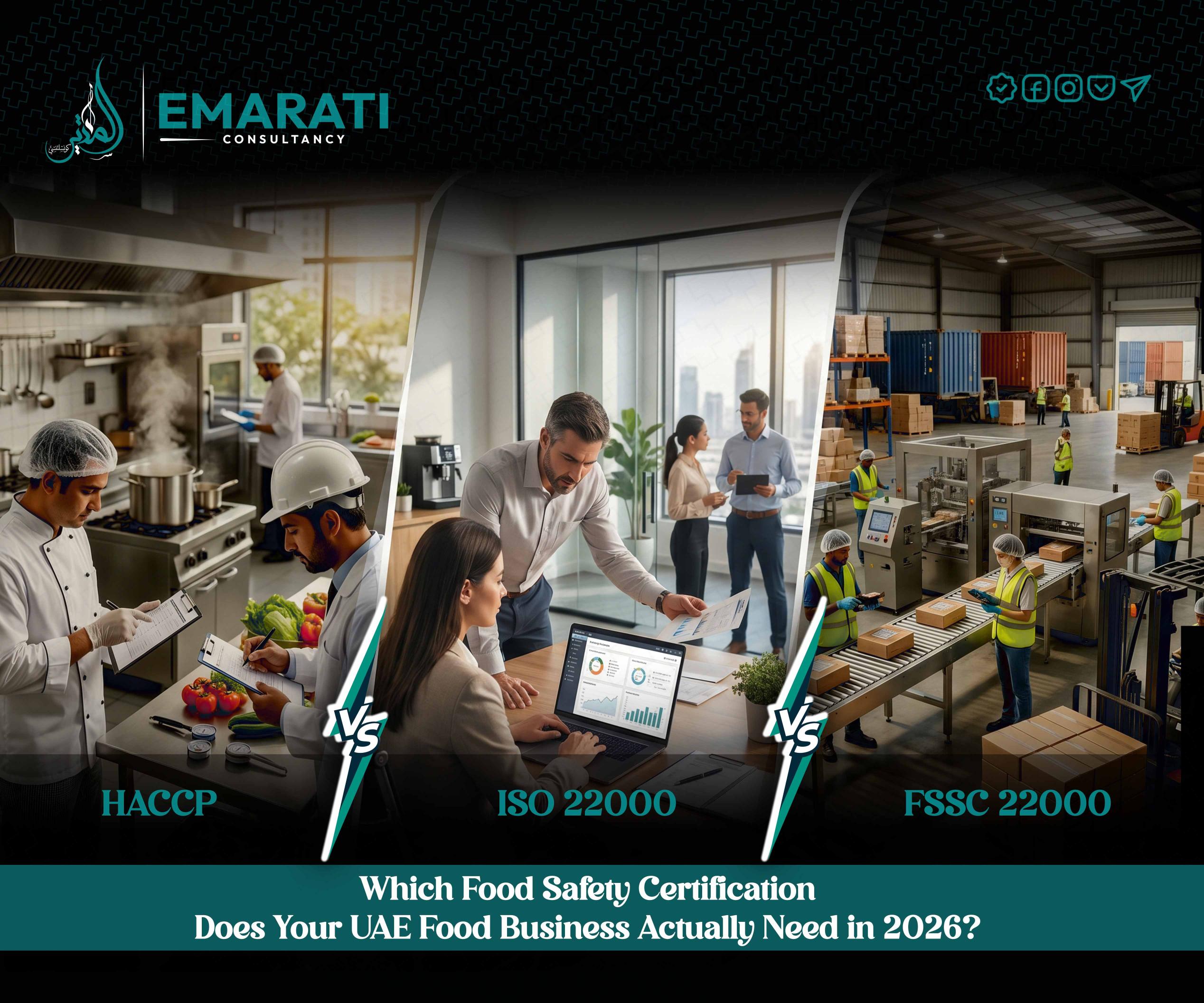
HACCP stands for Hazard Analysis and Critical Control Points. It is a systematic approach to identifying and controlling food safety hazards throughout the food production and service process. In Dubai, HACCP certification is required by Dubai Municipality for all food businesses including restaurants, catering companies, hotel kitchens, food manufacturers, food packagers and food distributors. Without valid HACCP certification, food businesses risk penalties, closure orders and licence revocation from Dubai Municipality food safety inspections.
HACCP is a food safety management methodology focused specifically on identifying and controlling biological, chemical and physical hazards in food production. ISO 22000 is a comprehensive international standard that incorporates HACCP principles within a full management system framework, adding requirements for management commitment, communication, continual improvement and emergency preparedness. ISO 22000 is more comprehensive than HACCP alone and is required by international food buyers, export markets and multinational food companies. Dubai Municipality accepts both, but export-oriented food businesses typically need ISO 22000 or FSSC 22000.
ISO 27001 is the international standard for Information Security Management Systems. It provides a framework for managing information security risks through systematic asset identification, risk assessment and security control implementation. In the UAE, ISO 27001 is required by technology companies serving government clients, financial institutions operating in DIFC and ADGM, healthcare providers handling patient data, and any organisation subject to UAE Personal Data Protection Law obligations. It is also increasingly demanded by international clients as a supplier qualification requirement.
ISO 42001 is the international standard for Artificial Intelligence Management Systems, published in 2023. It provides a framework for responsible AI development, deployment and governance — covering risk management, transparency, accountability and ethical AI practices. For UAE businesses developing or deploying AI systems, ISO 42001 is becoming increasingly relevant as the UAE positions itself as a global AI hub under the UAE AI Strategy 2031. Technology companies, financial institutions, healthcare providers and government contractors working with AI systems should consider ISO 42001 as both a regulatory preparedness measure and a competitive differentiator. Emarati Consultancy is among the first UAE consultancies to offer ISO 42001 implementation.
ISO 22301 is the international standard for Business Continuity Management Systems. It provides a framework for ensuring that critical business functions can continue during and after a disruptive event — whether a cyberattack, natural disaster, supply chain failure or pandemic. In the UAE, ISO 22301 is required or strongly recommended for banks, insurance companies, telecommunications providers, healthcare organisations, government entities and any organisation whose operational disruption would have significant impact on clients or the public.
ISO 37001 is the international standard for Anti-Bribery Management Systems. It provides a framework for preventing, detecting and responding to bribery within an organisation. In the UAE, ISO 37001 is increasingly required by government agencies and multinationals from their contractors and suppliers as evidence of ethical governance and anti-corruption commitment. It is particularly relevant for companies operating in public sector procurement, construction, oil and gas, and any organisation involved in high-value contract bidding processes.
ISO 50001 is the international standard for Energy Management Systems. It provides a framework for improving energy performance, reducing energy consumption and lowering energy costs through systematic energy monitoring, analysis and optimisation. In the UAE, ISO 50001 supports compliance with the UAE's Net Zero 2050 targets and increasingly features in sustainability reporting requirements for listed companies and large government-linked organisations. It is particularly relevant for manufacturing, industrial, hospitality and large commercial facility operators.
ISO 13485 is the international standard for Quality Management Systems specifically designed for medical device manufacturers, distributors and suppliers. In the UAE, ISO 13485 is required for medical device registration with the UAE Ministry of Health and Prevention and for supplier qualification with Dubai Health Authority and Abu Dhabi healthcare institutions. Any company manufacturing, importing, distributing or servicing medical devices in the UAE should hold ISO 13485 certification.
ISO 27701 is the international standard for Privacy Information Management Systems. It extends ISO 27001 by adding specific requirements for the protection of personally identifiable information. In the UAE, ISO 27701 is directly relevant to compliance with the UAE Personal Data Protection Law, DIFC Data Protection Law, and ADGM Data Protection Regulations. Technology companies, fintech firms, healthcare providers and any organisation processing significant volumes of personal data should consider ISO 27701 as part of their data governance framework.
FSSC 22000 is the Food Safety System Certification standard — a higher-level food safety certification scheme that incorporates ISO 22000 plus additional sector-specific technical specifications and scheme requirements. FSSC 22000 is required by many major international retailers and food manufacturers including those supplying to global supermarket chains, international hotel groups and food export markets. It carries GFSI (Global Food Safety Initiative) recognition, making it the preferred certification for food businesses engaged in international trade. Emarati Consultancy implements both ISO 22000 and FSSC 22000 for UAE food manufacturers and exporters.
An ISO consultant guides your organisation through the full ISO certification process — from initial gap analysis through documentation development, staff training, system implementation, internal audit preparation and external certification audit support. A qualified ISO consultant reduces implementation time significantly, minimises the risk of audit failure, ensures your management system is practical and usable rather than just paper-based, and helps your team understand and maintain the system after certification. Emarati Consultancy provides end-to-end ISO consultancy for all 17 standards we offer.
While it is possible to pursue ISO certification without a consultant, most UAE businesses find that professional consultancy significantly reduces the time, cost and stress of certification. Common challenges for self-implementation include accurately interpreting the standard's requirements, developing compliant documentation from scratch, identifying all applicable legal and regulatory requirements, and preparing for the external audit. Organisations that use qualified ISO consultants have substantially higher first-time certification pass rates and implement more practical management systems than those that attempt self-implementation.
ISO implementation is the process of developing, documenting and applying the management system required by your chosen ISO standard across your organisation's operations. It covers gap analysis, policy and procedure development, risk assessment, operational control establishment, staff training and awareness, internal audit and management review. ISO implementation is the core work that happens between engaging a consultancy and the external certification audit. Emarati Consultancy manages the entire implementation process for all 17 standards we offer, ensuring your system is practical, compliant and audit-ready.
ISO documentation refers to the written records, policies, procedures, work instructions, risk assessments, forms and registers required by your chosen ISO standard. Every ISO standard has specific documentation requirements — for example, ISO 9001 requires a quality policy, quality objectives, process documentation and records of monitoring and measurement. ISO 27001 requires an information security policy, risk assessment register, statement of applicability and control implementation records. Emarati Consultancy develops all required documentation tailored specifically to your business — not generic templates that need extensive customisation.
When choosing an ISO consultant in UAE, assess their direct experience with your specific industry, their knowledge of UAE regulatory requirements relevant to your sector, their approach to documentation (bespoke versus generic templates), their transparency on pricing and scope, and whether they provide support through the external audit and beyond. Ask for client references and verify that the certifications they have helped achieve are from accredited certification bodies. Emarati Consultancy offers free initial consultations so you can assess our expertise and approach before committing.
The ISO certification process follows six steps. Step one is a free consultation to identify the right standard and understand your business. Step two is a gap analysis comparing your current systems against the ISO standard's requirements. Step three is documentation development — creating all required policies, procedures and records. Step four is training and implementation — preparing your team and deploying the new system. Step five is an internal audit to verify compliance before the external assessment. Step six is the external certification audit conducted by an accredited certification body, resulting in your ISO certificate.
During an ISO certification audit, an auditor from an accredited certification body visits your premises — or conducts a remote audit — to assess whether your management system meets the requirements of the ISO standard. The auditor reviews your documentation, interviews staff at various levels, observes operational processes and checks records of system implementation and monitoring. If the audit identifies non-conformities, you are given time to implement corrective actions before the certificate is issued. Emarati Consultancy prepares clients thoroughly for certification audits and provides support throughout the process.
An internal audit is a systematic, documented assessment of your management system conducted by your own organisation — or by an external consultant on your behalf — before the external certification audit. Its purpose is to verify that your system is implemented correctly, compliant with the ISO standard's requirements, and functioning effectively. Internal audits also identify gaps and non-conformities so they can be corrected before the external assessor identifies them. All ISO standards require regular internal audits as an ongoing maintenance activity after certification. Emarati Consultancy conducts internal audits for clients both during initial implementation and as part of ongoing maintenance programmes.
An HSE audit is a systematic, documented assessment of an organisation's Health, Safety and Environment management systems, practices and performance against applicable standards, legal requirements and best practice benchmarks. HSE audits identify gaps in safety management, evaluate compliance with UAE labour law and environmental regulations, assess the effectiveness of existing controls, and provide recommendations for improvement. Emarati Consultancy conducts HSE audits for UAE businesses across all industries — standalone assessments and as part of ISO 45001 and ISO 14001 implementation programmes.
A third-party safety audit is an independent assessment of an organisation's health and safety management systems and practices, conducted by an external organisation that is not part of the business being audited. Third-party safety audits provide an objective evaluation that internal reviews cannot — they identify risks, non-compliances and improvement opportunities without the bias that can affect internal assessments. In the UAE, third-party safety audits are required by many major contractors, developers and government entities as a condition of contractor qualification and ongoing supply chain management. Emarati Consultancy provides independent third-party safety audits for UAE businesses across all sectors.
UAE companies need HSE audits to verify compliance with UAE Federal Labour Law, Ministry of Human Resources regulations, Abu Dhabi OSHAD requirements, Dubai Municipality safety standards, and industry-specific health and safety regulations. HSE audits also identify workplace hazards before they result in incidents, demonstrate due diligence to clients and regulators, support ISO 45001 implementation and maintenance, and provide documented evidence of safety management that protects organisations in the event of workplace incidents or regulatory investigations.
An HSE audit is a broad assessment of an organisation's health, safety and environmental management practices and compliance against applicable standards and regulations — it is flexible in scope and methodology. An ISO 45001 audit is a specific assessment against the requirements of the ISO 45001 international standard for Occupational Health and Safety Management Systems, conducted by an accredited certification body for the purpose of issuing or maintaining ISO 45001 certification. HSE audits support and prepare organisations for ISO 45001 certification audits but are also conducted independently of the certification process.
UAE companies should conduct HSE audits at least annually as a minimum — and more frequently for high-risk industries such as construction, oil and gas, manufacturing and industrial operations. ISO 45001 certification requires documented internal audits at planned intervals determined by the organisation's risk profile and operational complexity. Many UAE companies in high-risk sectors conduct quarterly or bi-annual HSE reviews with a comprehensive annual audit. Emarati Consultancy designs audit programmes appropriate to your industry and risk level.
Yes. Emarati Consultancy provides full ISO certification consultancy services in Abu Dhabi covering all 17 standards we offer. We have particular experience supporting Abu Dhabi businesses with ADNOC vendor registration requirements, Abu Dhabi government tender qualification, and OSHAD occupational health and safety compliance. Our consultants work with Abu Dhabi clients in person and remotely. Contact us at +971 52 856 0299 for an Abu Dhabi-specific consultation.
Yes. Emarati Consultancy provides ISO certification consultancy across Sharjah covering all 17 standards. Sharjah's manufacturing and industrial sectors frequently require ISO 9001, ISO 14001, ISO 45001 and QHSE IMS for tender qualification and international client requirements. Our consultants serve Sharjah businesses directly and the process can also be managed remotely for clients who prefer online consultation.
Yes. Emarati Consultancy works with companies registered in UAE free zones including DMCC, DIFC, JAFZA, ADGM, Dubai Internet City, Dubai South and others. Free zone companies have the same ISO certification requirements as mainland UAE companies for the purposes of government tenders, international client qualification and regulatory compliance. ISO 27001 is particularly in demand among DIFC and ADGM-registered financial and technology firms due to data protection regulatory expectations.
Yes. Emarati Consultancy provides full ISO consultancy services remotely for clients across the UAE and GCC who prefer online engagement. Gap analysis, documentation development, training sessions, internal audit preparation and certification audit support can all be conducted effectively via video call, document sharing platforms and online communication tools. Remote delivery is particularly suitable for smaller organisations and for the documentation and training phases of larger implementation projects.
After receiving your ISO certificate, you enter a three-year certification cycle. In year one and year two, your certification body conducts annual surveillance audits to verify that your management system remains compliant and continues to improve. At the end of year three, a full recertification audit is conducted to renew your certificate for another three-year cycle. You are also required to maintain ongoing records, conduct internal audits, hold management reviews and monitor your system's performance throughout the cycle. Emarati Consultancy provides ongoing support for all post-certification maintenance activities.
ISO certification renewal is the process of extending your ISO certificate at the end of the three-year certification cycle through a full recertification audit. Before the recertification audit, your management system should be reviewed and updated to reflect any changes in your operations, updated ISO standard requirements and lessons learned from surveillance audits and internal reviews. Emarati Consultancy manages the full renewal process — updating documentation, preparing your team and coordinating the recertification audit with your certification body.
Yes. ISO certification can be suspended or withdrawn if your organisation fails a surveillance or recertification audit, if significant non-conformities are identified and not resolved within the required timeframe, or if you request withdrawal. Certification suspension or withdrawal can have serious consequences for UAE businesses — including disqualification from government tenders and loss of contracts that require ISO certification. Regular internal audits, management reviews and ongoing maintenance prevent the conditions that lead to certification loss.
ISO certification is not renewed annually — it follows a three-year cycle with annual surveillance audits in years one and two and a full recertification audit in year three. Surveillance audits verify ongoing compliance but do not result in a new certificate — they maintain the validity of your existing certificate. The certificate itself is renewed through the recertification audit at the end of the three-year cycle.
ISO 9001 for quality management is required for virtually all UAE government tenders across all emirates. ISO 14001 for environmental management and ISO 45001 for health and safety are required for construction, engineering and infrastructure tenders with Dubai Municipality, RTA, DEWA, Abu Dhabi government entities and Sharjah authorities. The QHSE IMS package combining all three standards is the most efficient way to meet all government tender requirements in one implementation. Emarati Consultancy specialises in preparing UAE businesses for government tender qualification.
ADNOC vendor registration requires ISO 9001 for quality management, ISO 14001 for environmental management, and ISO 45001 for occupational health and safety as standard prerequisites. Some ADNOC group companies and specific procurement categories may require additional standards depending on the nature of the services or products being supplied. All three certifications must be issued by internationally accredited certification bodies. Emarati Consultancy has direct experience preparing Abu Dhabi and UAE-wide businesses for ADNOC vendor registration requirements.
Dubai restaurants are required by Dubai Municipality to implement and maintain HACCP food safety management. HACCP certification demonstrates compliance with Dubai Municipality's food safety regulations and is assessed during Dubai Municipality food safety inspections. ISO 22000 provides a higher level of food safety management system certification that incorporates HACCP principles and is suitable for larger food operations or those supplying to international buyers. Emarati Consultancy helps Dubai food businesses achieve both HACCP and ISO 22000 certification efficiently.
Technology companies in Dubai typically need ISO 27001 for information security management as the primary certification — demonstrating to enterprise and government clients that sensitive data is managed securely. ISO 9001 for quality management is also commonly required for government tender qualification. Technology companies developing or deploying AI systems should consider ISO 42001 for AI management system governance. Companies operating in DIFC should also consider ISO 27701 for privacy information management in line with DIFC data protection regulatory expectations. Emarati Consultancy provides all of these standards for Dubai technology companies.
If your question is not answered above, our consultants are ready to help. We provide free, no-obligation consultations for UAE businesses at any stage of their ISO certification journey — whether you are just starting to explore options or ready to begin implementation today. Phone: +971 52 856 0299 Email: info@emaraticonsultancy.ae WhatsApp: +971 52 856 0299 Office: City Bay Business Centre, Office 303, Near Abu Bakr Metro Station, Dubai, UAE
Looking for reliable ISO renewal services in the UAE? Our specialists in Dubai, Abu Dhabi, and Sharjah help you align your OHSMS with updated ISO 45001 requirements, ensuring continuous compliance and smooth recertification.
The great explorer of the truth, the master-builder of human happiness no one rejects dislikes avoids pleasure itself because it is pleasure but because know who do not those how to pursue pleasures rationally encounter consequences that are extremely painful desires to obtain.
Read More