8:00AM - 6:00PM
Monday to Saturday

Monday to Saturday
+971 52 856 0299
Hor Al Anz


By Emarati Consultancy | ISO Certification Consultant Experts in UAE | Updated 2026
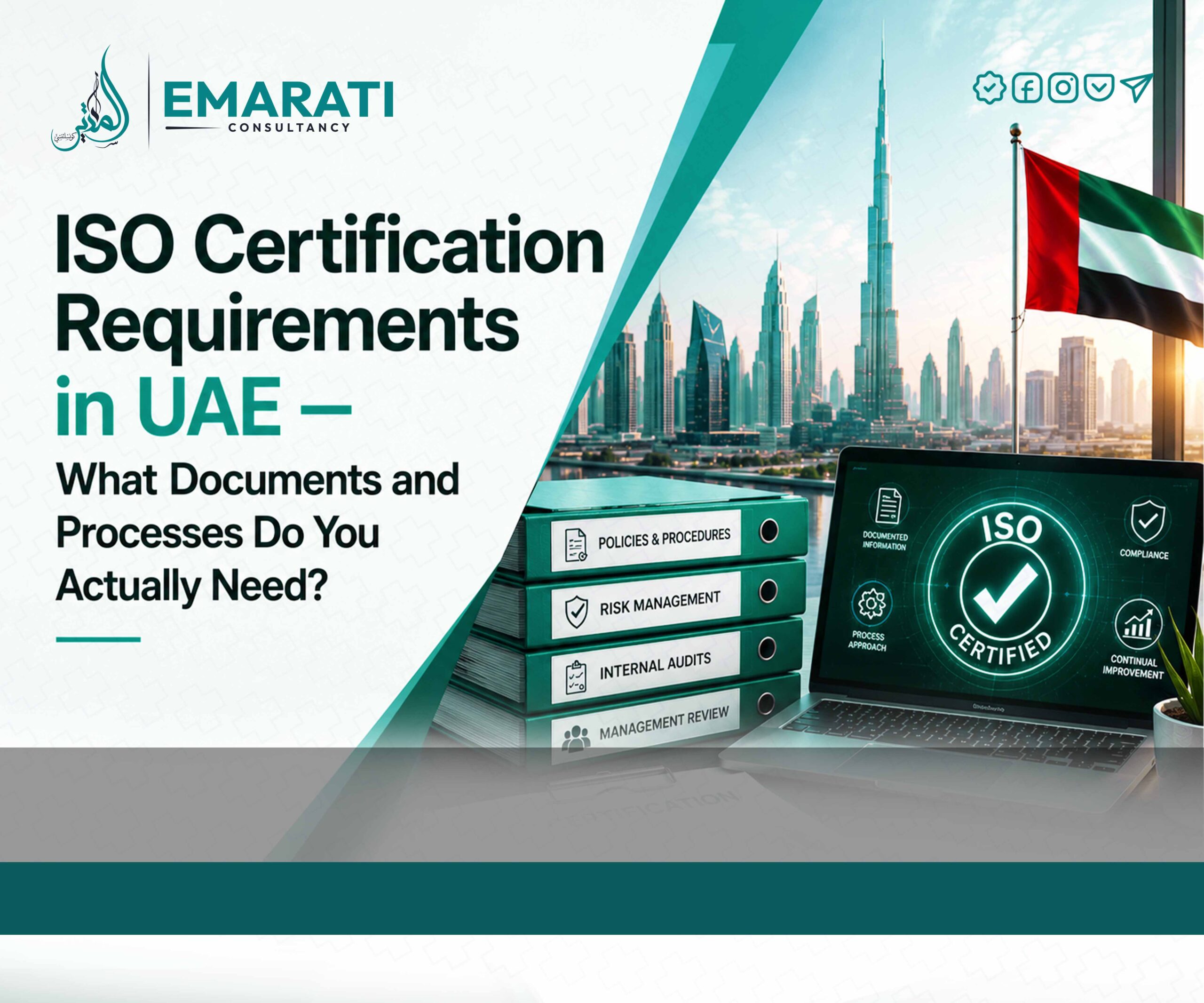
Here is the question most UAE business owners ask before starting ISO certification and almost nobody answers clearly. What do I actually need to prepare? What documents must I create? What processes must I have? And how do I know if what I already have is sufficient?
The answer depends on which ISO standard you are pursuing — but the underlying logic is the same for all of them. ISO certification requires you to demonstrate two things. First that your management system is documented — that you have defined how your organisation operates, who is responsible for what and how performance is measured. Second that your management system is implemented — that people actually follow what is documented and that records exist proving it.
Documentation alone does not pass an ISO audit. Implementation without documentation does not either. This guide tells you exactly what documents and processes every UAE business needs for the most common ISO certifications — with a plain-language explanation of why each element matters and what certification body auditors are actually looking for when they assess it.
Before listing specific documents it is worth understanding the auditor’s mindset — because this changes how you approach documentation preparation entirely.
An ISO auditor is not looking for impressive documentation. They are looking for consistent implementation. The most common cause of ISO audit failure in UAE is documentation that describes processes your organisation does not actually follow — or processes that exist in practice but are nowhere documented. Auditors verify both sides of this equation. They read your documents and then they observe your operations, interview your staff and check your records. If the three do not align you receive non-conformities regardless of how professionally formatted your documentation is.
This means the right approach to ISO documentation is not to create the most comprehensive documentation possible. It is to document how your organisation actually operates — clearly, practically and in a way your staff can follow without consulting a consultant every time a situation arises.
Every ISO management system uses three types of documentation. Understanding this hierarchy saves significant time and prevents the most common documentation mistake UAE businesses make — over-documenting processes that do not need detailed procedures and under-documenting the areas auditors examine most closely.
Policies are top-level statements of intent and commitment. Your quality policy, environmental policy, health and safety policy or food safety policy is a brief document — typically one page — that states what your organisation commits to achieving and why. Policies require senior management signature. They must be communicated to all staff and made available to interested parties. They do not describe how processes work — they describe what the organisation stands for and what it is committed to.
Procedures describe how specific processes are carried out — who does what, in what sequence and to what standard. A document control procedure describes how documents are created, reviewed, approved and distributed. A corrective action procedure describes how non-conformities are identified, investigated and resolved. Procedures are the backbone of your management system and the documents auditors read most carefully. They must be realistic — describing how your business actually operates, not how an ideal business would theoretically operate.
Records are the evidence that your procedures are being followed. Temperature monitoring logs, internal audit reports, training attendance records, corrective action registers, supplier evaluation records, management review minutes — these are all records. Records are what auditors check to verify that your documented processes are genuinely implemented rather than merely described. UAE businesses consistently underestimate the importance of records until their first audit reveals how thoroughly auditors review them.
ISO 9001:2015 does not require a quality manual — this surprises many UAE businesses who assume they need to produce a large formal document before their audit. The 2015 revision removed the mandatory quality manual requirement. What it does require is documented information demonstrating that your quality management system meets the standard’s requirements. Here is what that means in practice.
Your quality policy must be documented and communicated — stating your organisation’s commitment to quality, customer satisfaction and continual improvement. The scope of your quality management system must be documented — defining which products, services, sites and processes are covered. Procedures for document control, record control, internal audit, corrective action and management review must be documented with sufficient detail that they can be consistently applied.
All significant operational processes within the certification scope must be documented to the level of detail needed to ensure consistent implementation. For a construction company this might include tender management, design review, procurement control, site quality inspection and project handover procedures. For a food distributor it includes order management, receiving inspection, storage control, delivery management and customer complaint handling. The processes you document must match the processes your business actually performs — not an idealised version of them.
ISO 9001 requires specific records to be maintained as evidence of implementation. These include records of management review meetings with documented inputs, outputs and action items. Internal audit records including audit plans, findings and corrective actions. Corrective action records documenting non-conformities, root cause analyses and effectiveness verification. Customer feedback and complaint records. Supplier evaluation and monitoring records. Training and competence records for all personnel in roles affecting quality. Calibration records for any measuring equipment used to verify product or service quality.
UAE ISO 9001 auditors consistently focus their verification effort on three document types above all others. Corrective action records — because these demonstrate whether your organisation addresses problems systematically or informally. Internal audit records — because these demonstrate whether you identify and address your own system weaknesses before external auditors do. Management review minutes — because these demonstrate whether leadership is genuinely involved in quality management governance rather than treating ISO as a compliance department exercise.
ISO 14001:2015 requires documentation specifically related to environmental management — building on the general management system requirements with environment-specific evidence.
The most important ISO 14001 document is your environmental aspects and impacts register — systematically identifying every activity, product and service that could interact with the environment and assessing the significance of each potential impact. This register drives all subsequent planning decisions and is the first document auditors review. It must be specific to your actual operations — not a generic template listing every possible environmental aspect regardless of whether it applies to your business.
A documented register identifying all applicable environmental legislation and regulations — UAE Federal Climate Law, Dubai Municipality environmental regulations, ADAFSA standards, emirate-specific environmental requirements and any international regulations applicable to your products or export markets. The register must include compliance status for each requirement and evidence that compliance is monitored regularly.
Documented environmental objectives aligned with your significant aspects — with supporting records showing progress against targets, corrective actions where targets are missed and management review of overall environmental performance against objectives.
Documented emergency response procedures for potential environmental incidents — spills, leaks, fires or other events that could cause environmental harm. UAE businesses in manufacturing, oil storage, chemical handling or logistics must have tested, current emergency response procedures addressing the specific environmental risks of their operations.
ISO 45001:2018 has the most extensive documentation requirements of the three main management system standards — reflecting the safety-critical nature of occupational health and safety management.
Your hazard identification and risk assessment records are the most important documents in your ISO 45001 system. They must systematically identify every workplace hazard across every activity within the certification scope — physical hazards, chemical exposures, ergonomic risks, working at height, machinery hazards, electrical risks, biological hazards and any other potential source of harm to workers. For each hazard the risk level must be assessed and controls documented. In UAE construction, oil and gas and manufacturing environments these records are among the most extensively reviewed during certification audits.
Documented safe work procedures for all high-risk activities — permit to work procedures, working at height procedures, confined space entry procedures, hot work procedures, electrical isolation procedures, chemical handling procedures and any other safety-critical activity within your certification scope. These procedures must reflect how work is actually controlled on your sites — not generic template procedures that your workforce has never seen.
Records of all workplace incidents, injuries, near misses and dangerous occurrences — including investigation reports with root cause analysis and documented corrective actions with effectiveness verification. Near miss reporting records are specifically assessed by UAE ISO 45001 auditors as evidence of a proactive safety culture rather than reactive incident management.
Documented competence requirements for every role within the certification scope — defining what qualifications, training and experience are required for each position. Training records demonstrating that competence requirements are met for every individual. Safety induction records for all new employees and contractors. These records must be current — outdated training records or gaps in competence documentation are consistently identified as non-conformities during UAE ISO 45001 audits.
HACCP Certification documentation requirements are the most specific of any UAE management system certification — because they must reflect your actual food products, ingredients, processes and hazards rather than generic food safety principles.
Your HACCP plan must document the complete hazard analysis for every food product and process within your certification scope — identifying every biological, chemical, physical and allergen hazard, assessing its significance and documenting the basis for each Critical Control Point identified. Dubai Municipality Food Watch inspectors and certification body auditors both assess HACCP plan quality as their primary audit focus — a generic or incomplete HACCP plan is the most common cause of HACCP certification failure in UAE.
Temperature logs, pH measurement records, time monitoring records and any other CCP monitoring data — maintained consistently throughout every operational period. These records must show that critical limits are being met daily — not just during audit preparation weeks. Auditors request monitoring records from random historical periods to verify consistent implementation rather than audit-week compliance.
Written procedures and records for all prerequisite programmes — personal hygiene, cleaning and sanitation schedules with completion records, pest control records, supplier qualification documentation, temperature management procedures and cross-contamination prevention controls.
Records of all CCP deviations — documenting what happened, what immediate corrective action was taken, what root cause investigation was conducted and how effectiveness was verified. Verification records demonstrating that the HACCP system is periodically reviewed and updated when menus, processes or ingredients change.
ISO 27001:2022 has the most technically demanding documentation requirements of any common ISO standard — reflecting the complexity of information security risk management.
Your information security risk assessment is the foundation document of your entire ISMS — identifying all information assets within scope, assessing all threats to each asset, evaluating the likelihood and impact of each threat materialising and documenting the risk treatment decisions that drive control selection. UAE ISO 27001 auditors spend more time reviewing the risk assessment than any other document. Shallow or generic risk assessments are the primary cause of ISO 27001 Stage 2 audit failures in UAE.
The Statement of Applicability documents all 93 Annex A controls from ISO 27001:2022 — stating which are applicable, which are implemented, which are excluded and the business justification for each decision. This document is reviewed during Stage 1 audits and must be completed with genuine analysis — not a default inclusion of every control regardless of relevance.
Information security policy, access control policy, acceptable use policy, incident response procedure, supplier security management procedure, business continuity and disaster recovery plan and all other policies and procedures required by your applicable controls. These must be genuinely operational — evidenced by staff awareness, implementation records and consistent application.
Records demonstrating that all personnel within scope have received information security awareness training — covering phishing awareness, password management, incident reporting and their specific security responsibilities. Training records must show completion dates, topics covered and individual acknowledgement.
Regardless of which ISO standard you are pursuing there are six document categories that every management system requires.
A documented definition of what is included within your management system — which products, services, processes, sites and activities fall within the certification boundary and which are explicitly excluded with justification.
Documented management system objectives — specific, measurable targets that demonstrate your organisation is genuinely committed to improving performance rather than just maintaining compliance. For UAE government tender qualification these objectives must be realistic enough to be achievable — auditors verify progress against objectives at every surveillance audit.
A documented internal audit programme covering the full scope of your management system across the certification cycle — with completed audit records, findings and corrective actions for every audit conducted. Organisations that skip internal audits or conduct them superficially consistently receive major non-conformities during external certification audits.
Minutes of formal management review meetings — documenting the inputs reviewed, outputs decided and action items assigned. Management review must demonstrate genuine leadership engagement — not a rubber-stamp meeting where the ISO manager presents a report that leadership signs without discussion.
A systematic record of all non-conformities identified — through internal audits, external audits, customer complaints, incidents or staff observations — with documented root cause analyses, corrective actions, responsibilities, timelines and effectiveness verification. This register is the single most important evidence of continual improvement in your management system.
Records demonstrating that all personnel in roles affecting management system performance are competent — with documented qualifications, training completion, experience records and awareness assessment where required.
Understanding the most common documentation mistakes prevents the most expensive and frustrating ISO audit outcomes.
The most common and costly ISO documentation mistake in UAE. Businesses create professionally formatted procedures describing how processes should ideally work — then auditors observe actual operations that bear little resemblance to the documented procedures. This produces major non-conformities that can delay certification and require extensive rework. Always document how your processes actually work first — then identify improvements you can make within a reasonable timeframe before your audit.
Generic ISO documentation templates are widely available and widely misused. A quality policy for a construction company copied from a template designed for a trading company will contain irrelevant content and miss critical construction-specific elements. Auditors immediately identify template documentation — because it does not reflect the specific terminology, processes, products or risks of your actual business. Templates are useful starting points. They are not finished documents.
Many UAE businesses implement processes correctly but fail to maintain systematic records throughout the year — then attempt to reconstruct records in the weeks before their audit. Auditors request records from specific historical dates — not just the most recent month. Gaps in monitoring records, training records or corrective action logs from earlier in the year are visible to auditors regardless of how comprehensive recent records appear.
Management review is consistently the most underprepared element of ISO management systems in UAE. Many businesses conduct a meeting, sign some papers and call it a management review. Auditors assess management review records in detail — looking for evidence that specific inputs were reviewed, that outputs were documented with clear action items and that leadership demonstrated genuine engagement with management system performance rather than a compliance formality.
Document control — the system for managing which version of each document is current, where documents are stored, who has access and how obsolete documents are removed — is assessed at every ISO audit. Businesses that use shared drives without version control, email procedures without formal approval records or printed documents without revision history consistently receive document control non-conformities that could easily be avoided.
This is one of the most searched questions by UAE businesses planning ISO certification — and the most honestly answered by factoring in your starting point.
| Starting Position | ISO 9001 Documentation | ISO 14001 Documentation | ISO 45001 Documentation |
|---|---|---|---|
| No existing processes documented | 4 to 8 weeks | 4 to 8 weeks | 6 to 10 weeks |
| Informal processes exist | 2 to 4 weeks | 3 to 6 weeks | 4 to 8 weeks |
| Some formal documentation exists | 1 to 3 weeks | 2 to 4 weeks | 3 to 6 weeks |
| Existing management system | Less than 2 weeks | Less than 2 weeks | 2 to 4 weeks |
Documentation time is not the same as total certification time. Documentation must be implemented and records generated before your external audit — meaning the total time from documentation completion to certification typically adds 4 to 12 weeks for implementation, internal audit and management review regardless of how quickly documentation is prepared.
ISO documentation requirements from ISO.org
Yes — and this is one of the most significant cost and time advantages of implementing multiple standards together. The High Level Structure shared by ISO 9001, ISO 14001, ISO 45001, ISO 27001 and all other modern ISO management standards means that the following documents can be shared across all standards implemented simultaneously.
Scope statement — one document covering all standards. Management system policy — can be a combined QHSE policy covering quality, environmental and safety commitments simultaneously. Objectives and targets — can be a combined objectives register covering all standards. Document control procedure — one procedure covering all management system documents. Internal audit procedure — one procedure covering all standards with standard-specific audit criteria. Management review procedure and records — one meeting covering all standards simultaneously. Corrective action procedure and register — one system covering non-conformities across all standards.
This shared documentation approach is why QHSE IMS — implementing ISO 9001, ISO 14001 and ISO 45001 together — consistently costs 25 to 40 percent less than three separate certifications. The documentation overlap reduces the total documentation workload by approximately 40 percent compared to three independent documentation sets.
No. ISO 9001:2015 removed the mandatory quality manual requirement. You are required to maintain documented information demonstrating that your quality management system meets the standard's requirements — but this can be in any format and does not need to be called a quality manual. Many UAE organisations maintain a brief scope statement and policy document as their top-level QMS document alongside their procedures and records. Some still choose to maintain a quality manual as a useful overview document — but it is optional not mandatory.
ISO 9001:2015 does not specify a minimum number of procedures. You need documented information to the extent necessary to ensure consistent process implementation — which varies significantly between a five-person trading company and a 500-person construction contractor. A small UAE service business might have six to ten core procedures. A medium manufacturing company might have twenty to thirty. The right number is whatever your specific operations require for consistent implementation — not a number prescribed by the standard.
Yes — but only as starting points that require significant customisation for your specific business. Generic templates that describe processes your organisation does not perform, use terminology that does not reflect your business or reference responsibilities that do not exist in your structure will be identified by auditors immediately. Emarati Consultancy develops documentation specifically for each client's operations — never from uncustomised generic templates.
A procedure describes what process is performed, by whom, in what sequence and to what standard — at a process level. A work instruction provides step-by-step guidance for performing a specific task — at an activity level. Not all processes require work instructions — only those where the detailed steps must be controlled because deviations create quality, safety or environmental risk. ISO standards require procedures where necessary for effective process implementation. Work instructions are additional detail where specific tasks require it.
Records must cover the period since your last audit — or since the start of your current certification cycle for initial certification. For initial ISO certification audits in UAE, auditors typically request records from the implementation period immediately preceding the audit — covering your internal audit, management review, corrective actions and monitoring records from the period after your management system was implemented. For surveillance audits records from the entire period since the previous audit are potentially in scope.
Stage 1 is a documentation readiness review — if your documentation is significantly incomplete the certification body will typically not proceed to Stage 2 until gaps are addressed. This delays your certification timeline and increases costs if additional Stage 1 review is required after corrections. The most cost-effective approach is thorough documentation preparation before Stage 1 is scheduled — not a partially prepared submission that requires multiple review cycles.
All employees within the certification scope need to be aware of the management system's existence, their role within it and how their work contributes to management system objectives. They do not all need to read every procedure — they need access to the procedures relevant to their specific roles and evidence of training and awareness relevant to their responsibilities. Widespread awareness of the management system without detailed procedural knowledge of irrelevant processes is the right balance.
Yes — absolutely. If your business already has documented processes, job descriptions, work instructions, training records, maintenance logs or quality control checklists these can all be assessed against ISO requirements and either adopted as-is, updated to meet specific requirements or supplemented with additional documentation where gaps exist. Starting an ISO implementation by reviewing what already exists — rather than building from scratch — consistently produces faster, more practical and more cost-effective management systems.
ISO documentation does not need to be complex to be effective. It needs to be accurate — reflecting how your business actually operates. It needs to be practical — written in language your team understands and follows. And it needs to be maintained — kept current as your business evolves rather than left unchanged from the day it was created.
Emarati Consultancy develops ISO documentation for UAE businesses across all 17 standards and all seven UAE emirates — creating management system documentation that satisfies certification body auditors and functions as a practical operational tool simultaneously. Our documentation is never copied from generic templates and never describes processes your organisation does not actually perform.
Whether you are beginning your ISO certification journey and need to understand what to prepare, approaching an audit with documentation gaps that need urgent resolution or maintaining an existing certified system that needs professional updating — Emarati Consultancy provides the documentation expertise and UAE regulatory knowledge to get it right.
Phone: +971 52 856 0299
Email: info@emaraticonsultancy.ae
Office: City Bay Business Centre, Office 303, Near Abu Bakr Metro Station, Dubai, UAE
Looking for reliable ISO renewal services in the UAE? Our specialists in Dubai, Abu Dhabi, and Sharjah help you align your OHSMS with updated ISO 45001 requirements, ensuring continuous compliance and smooth recertification.

The great explorer of the truth, the master-builder of human happiness no one rejects dislikes avoids pleasure itself because it is pleasure but because know who do not those how to pursue pleasures rationally encounter consequences that are extremely painful desires to obtain.
Read More