8:00AM - 6:00PM
Monday to Saturday
Monday to Saturday
+971 52 856 0299
Hor Al Anz

Your ISO certificate is valid for three years. But maintaining it — and the commercial access it gives you to UAE government tenders, ADNOC vendor registration and international supply chains — requires active management throughout that three-year cycle. Emarati Consultancy provides complete ISO certification renewal support for UAE businesses — covering annual surveillance audit preparation, recertification audit management and ongoing management system maintenance — ensuring your ISO certificate never lapses and your tender eligibility is never interrupted.
Every ISO certificate issued by an accredited certification body follows the same three-year certification cycle. Understanding this cycle is essential for every UAE business that depends on ISO certification for tender qualification, vendor registration and client credibility.
Your ISO certification journey begins with the initial certification audit — Stage 1 documentation review followed by Stage 2 on-site assessment. Following a successful audit your ISO certificate is issued and the three-year cycle begins. Approximately 10 to 12 months after your initial certification date your certification body conducts the first annual surveillance audit — a partial assessment covering mandatory review areas and a sample of your management system to verify continued compliance.
Approximately 10 to 12 months after your first surveillance audit your certification body conducts the second annual surveillance audit. Like the first surveillance audit this is a partial assessment — not a full system audit — sampling different areas of your management system than the previous year. Both surveillance audits together must demonstrate that your management system is genuinely operational, continuously improving and compliant with the requirements of your ISO standard.
At the end of your three-year cycle your certification body conducts a full recertification audit — a comprehensive assessment comparable in depth to your original certification audit. A successful recertification audit renews your ISO certificate for another three-year period and restarts the surveillance audit cycle. This is what most UAE businesses refer to when they ask about ISO certification renewal — though technically the renewal process encompasses the entire three-year maintenance cycle.
This is one of the most commonly confused aspects of ISO certification maintenance in the UAE. A surveillance audit is an annual partial assessment — covering approximately 30 to 40 percent of your management system. It verifies continued compliance and ongoing improvement but does not reassess your entire system. A recertification audit is a full comprehensive assessment of your entire management system — equivalent to your initial certification audit — conducted every three years to formally renew your certificate. Both are mandatory. Missing either results in certificate suspension.
This is the question most UAE businesses ask and the answer most consultancies avoid giving clearly. Here is the honest expert answer.
The moment your ISO certificate lapses — whether through certificate expiry, surveillance audit failure or voluntary suspension — you lose tender eligibility for every UAE government contract that requires current ISO certification. Dubai Municipality contractor qualification, RTA supplier registration, DEWA vendor lists, Abu Dhabi government procurement portal qualification and ADNOC vendor registration all require currently valid ISO certificates. A lapsed certificate means immediate disqualification from any tender submission — regardless of your operational quality, your relationship history or your technical capability.
ADNOC’s SAP Ariba vendor management system actively monitors the validity of supplier ISO certificates. When your certificate lapses ADNOC can suspend your vendor status — preventing you from receiving tender invitations, submitting bids and participating in any ADNOC procurement activity until valid certification is restored. For oil and gas contractors and service companies in Abu Dhabi this is a commercially catastrophic outcome that can take months to resolve.
International clients and supply chain partners that require ISO certification as a supplier qualification condition monitor certificate validity through IAF CertSearch and certification body public registers. A lapsed certificate visible on these public platforms signals to international buyers that your management system has failed — not just that your paperwork is behind. The reputational damage from a publicly visible lapsed ISO certificate can affect client relationships significantly beyond the period of the lapse itself.
Businesses that allow their ISO certificate to lapse and then attempt to restore it face a significantly higher cost than businesses that maintain continuous certification. A lapsed certificate typically requires a new initial certification audit — at full initial certification cost — rather than a renewal audit at the lower recertification rate. The commercial losses from missed tenders and suspended vendor registrations during the lapse period consistently exceed the total cost of continuous certification maintenance by a significant multiple. Maintaining your ISO certificate continuously is always the more commercially intelligent decision.
Surveillance audits are not random spot checks. Certification body auditors follow a structured assessment framework that covers mandatory review areas at every surveillance audit regardless of the standard. These mandatory areas include internal audit programme — whether internal audits ran on schedule with findings tracked and corrective actions documented. Management review — whether management reviewed system performance, objectives and resources at planned intervals. Corrective actions — whether non-conformities from previous audits were properly closed with root cause analysis and effectiveness verification. Continual improvement — whether the organisation demonstrates genuine commitment to improving management system performance over time.
Beyond these mandatory areas auditors sample additional system elements — rotating through different processes, departments and requirements in each surveillance audit to ensure the entire system remains effective throughout the three-year cycle.
Surveillance audit expectations are tightening. Organisations that leave preparation until the final two weeks rarely arrive without gaps. The most common reasons UAE businesses fail or receive major non-conformities during surveillance audits are internal audits that were not conducted on schedule or were conducted inadequately — this is the single most common major non-conformity across all standards. Management reviews that were never held or were held informally without proper documentation of inputs, outputs and action items. Corrective actions from previous audits that were never properly closed with documented root cause analysis and effectiveness evidence. Documentation that became outdated as the business changed without corresponding management system updates. Staff turnover where new employees in key roles have not received adequate management system training and awareness.
Expert preparation for a UAE ISO surveillance audit should begin 90 days before your scheduled audit date — not two weeks before. The 90-day preparation checklist covers reviewing your previous audit report and confirming all findings have documented corrective actions with effectiveness evidence. Verifying your internal audit schedule compliance — checking that all planned internal audits were conducted, documented and findings tracked. Confirming management review minutes exist with all required inputs covered and action items documented with completion status. Updating all documentation to reflect any operational changes since the last audit — new processes, new sites, new products, new staff in key roles. Reviewing training records to confirm all personnel with management system responsibilities hold current competence records. Emarati Consultancy provides pre-audit readiness reviews for UAE businesses approaching surveillance audits — identifying gaps before the certification body does.
The expert recommendation is to begin ISO recertification preparation six months before your certificate expiry date. This timeline provides sufficient space for a thorough gap analysis against the current standard requirements, resolution of any system weaknesses identified, internal audit and management review completion, corrective action implementation and verification, and certification body audit scheduling. Certification bodies in UAE are often booked four to eight weeks in advance — leaving too little time risks your certificate lapsing before the recertification audit can be completed.
The most dangerous mistake UAE businesses make with ISO recertification is treating it as a repeat of the initial certification — assuming the management system they built three years ago still reflects how their business operates today. Businesses change. Processes evolve. Staff turns over. Management priorities shift. A recertification audit assesses the management system your organisation actually operates today — not the one documented three years ago.
Your recertification audit focuses not only on compliance with the ISO standard requirements but also on the overall maturity, effectiveness and continual improvement trajectory of your management system across the three-year cycle. Auditors review three years of internal audit records, management review minutes, corrective action logs, objective performance data and improvement evidence — assessing whether your organisation has genuinely used its management system to drive improvement or merely maintained documentation to satisfy audit requirements. Organisations with genuinely embedded management systems pass recertification faster and with fewer non-conformities than those that treat ISO as a compliance exercise rather than an operational tool.
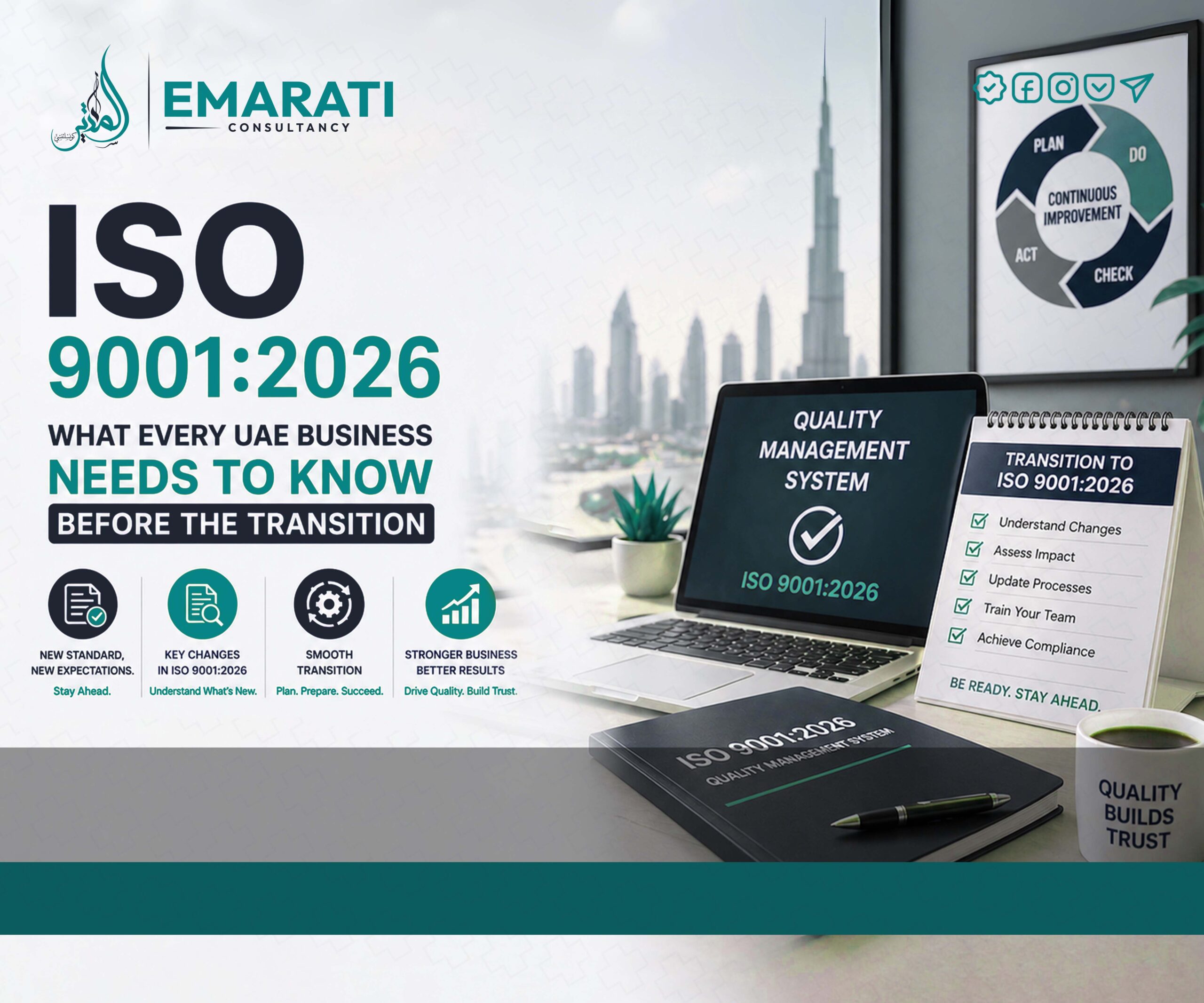
ISO 9001:2026 is expected to be published in late 2026. When it is published all currently ISO 9001:2015 certified organisations enter a transition period — expected to run until approximately 2029. UAE businesses whose recertification audit falls within this transition period will need to upgrade to ISO 9001:2026 as part of their recertification process. Emarati Consultancy prepares all clients for the 2026 transition — ensuring recertification upgrades are planned, budgeted and executed without disruption to certification status or tender eligibility. Similarly ISO 14001:2026 has already been published — organisations currently certified to ISO 14001:2015 should plan their transition as part of their next recertification cycle.

H3 How much does a surveillance audit cost in UAE?
Annual surveillance audit fees for maintaining ISO certification in UAE typically range from AED 3,000 to AED 8,000 per year per standard depending on organisation size and certification body. HACCP Certification Here is a realistic breakdown of annual surveillance audit costs by standard for UAE businesses in 2026:
| ISO Standard | Small Business | Medium Business | Large Business |
|---|---|---|---|
| ISO 9001 | AED 3,000 — 5,000 | AED 5,000 — 8,000 | AED 8,000+ |
| ISO 14001 | AED 3,000 — 5,000 | AED 5,000 — 8,000 | AED 8,000+ |
| ISO 45001 | AED 3,000 — 5,000 | AED 5,000 — 8,000 | AED 8,000+ |
| QHSE IMS | AED 5,000 — 8,000 | AED 8,000 — 12,000 | AED 12,000+ |
| ISO 27001 | AED 5,000 — 10,000 | AED 10,000 — 18,000 | AED 18,000+ |
| HACCP | AED 2,500 — 4,000 | AED 4,000 — 7,000 | AED 7,000+ |
| ISO 22000 | AED 3,500 — 6,000 | AED 6,000 — 10,000 | AED 10,000+ |
These figures cover certification body surveillance audit fees. Consultancy support for surveillance audit preparation — internal audit facilitation, management review support, corrective action management and pre-audit readiness review — is additional and depends on how well your management system has been maintained throughout the year.
ISO recertification audit cost is typically 60 to 80 percent of your initial certification cost — because your management system is already established and the audit assesses ongoing compliance rather than building a system from scratch. Here are realistic 2026 recertification cost ranges covering both consultancy preparation support and certification body recertification audit fees:
| ISO Standard | Small Business | Medium Business | Large Business |
|---|---|---|---|
| ISO 9001 | AED 4,000 — 7,000 | AED 7,000 — 12,000 | AED 12,000+ |
| ISO 14001 | AED 4,000 — 7,000 | AED 7,000 — 12,000 | AED 12,000+ |
| ISO 45001 | AED 4,000 — 7,000 | AED 7,000 — 12,000 | AED 12,000+ |
| QHSE IMS | AED 8,000 — 12,000 | AED 12,000 — 20,000 | AED 20,000+ |
| ISO 27001 | AED 8,000 — 14,000 | AED 14,000 — 22,000 | AED 22,000+ |
| HACCP | AED 3,000 — 5,000 | AED 5,000 — 9,000 | AED 9,000+ |
| ISO 22000 | AED 5,000 — 8,000 | AED 8,000 — 14,000 | AED 14,000+ |
Organisations that maintain their management system well throughout the three-year cycle consistently pay less for recertification than those who leave everything to the last three months. Plan for approximately 40 to 50 percent of the initial consulting investment per year for ongoing maintenance — covering surveillance audit fees, internal audit programme, management review support and continual improvement activities. Enactia
One of the most compelling ongoing advantages of QHSE IMS over three separate certifications is the annual surveillance audit cost saving. Three separate ISO certifications require three separate annual surveillance audits — costing AED 9,000 to AED 24,000 per year for a medium UAE business. A single QHSE IMS surveillance audit covering all three standards costs AED 8,000 to AED 12,000 for the same organisation — a consistent annual saving of AED 1,000 to AED 12,000 every year throughout the certification cycle. Over a three-year cycle the total QHSE IMS maintenance saving — compared to three separate certifications — typically reaches AED 15,000 to AED 30,000 on top of the initial implementation saving.
Most UAE businesses budget for certification body audit fees but consistently underestimate the total cost of ISO renewal. Here are the additional costs that catch businesses off guard:
If your team has not been conducting proper internal audits throughout the certification cycle you will need to invest in catching up before the renewal audit. Skipped or inadequate internal audits are the most common major non-conformity at surveillance and recertification audits in the UAE. Rushing to complete missed internal audits in the weeks before an audit consistently produces lower quality audit findings and less credible corrective action evidence than a properly maintained annual internal audit programme.
Business operations change constantly — new services, new processes, new sites, new staff, new equipment, new clients, new regulatory requirements. Every operational change that is not reflected in your management system documentation creates a non-conformity risk at your next audit. Maintaining documentation currency throughout the three-year cycle is significantly less costly than a pre-audit documentation overhaul that attempts to update three years of accumulated operational changes in six weeks.
ISO standards are periodically updated — ISO 9001:2026 and ISO 14001:2026 are the most immediately relevant for UAE businesses in 2026. When a new standard version is published organisations must transition within the transition period — which typically aligns with the next recertification audit. Businesses that plan for this transition as part of their renewal budget manage it smoothly and cost-effectively. Businesses that discover the requirement three months before their recertification audit face rushed and more expensive transitions.
Non-conformities from previous audits that were never properly closed with documented root cause analysis and effectiveness verification consistently create additional audit time — and sometimes prevent recertification until corrections are verified. Maintaining a live corrective action tracker throughout the certification cycle eliminates this cost entirely.
ISO 9001 renewal requires demonstrating that your quality management system has genuinely driven quality improvement across the three-year cycle — not just maintained compliance. Auditors review objective achievement trends, customer satisfaction data, non-conformity patterns and corrective action effectiveness over the full three-year period. Businesses that use ISO 9001 as an operational tool rather than a compliance exercise consistently achieve smoother and less costly recertification.
ISO 14001 renewal in 2026 carries an additional consideration — the mandatory climate change amendment published in February 2024. All ISO 14001 renewal audits now include assessment of whether your organisation has formally considered climate change as a relevant issue in your environmental management system context and planning. Organisations that have not yet incorporated this requirement face non-conformity risk at their next surveillance or recertification audit. Emarati Consultancy incorporates the climate change amendment into all ISO 14001 renewal preparations as standard.
ISO 45001 renewal requires demonstrating that your occupational health and safety management system has actively reduced workplace incident rates, improved hazard identification practices and evolved worker participation mechanisms over the three-year cycle. Auditors assess leading safety indicators — near miss reporting rates, hazard observation frequency, safety training completion — alongside lagging indicators like incident rates and lost time injuries. A genuine safety management culture is what successful ISO 45001 renewal demonstrates.
ISO 27001 renewal is the most technically demanding of all standard renewals because the cybersecurity threat landscape evolves continuously. Recertification auditors assess whether your risk assessment has been updated to reflect new threats, whether new controls have been implemented in response to emerging vulnerabilities and whether your Statement of Applicability remains current and accurately reflects your implemented controls. Organisations that treat their ISMS as a living security governance system pass recertification significantly more efficiently than those maintaining static documentation.
HACCP and ISO 22000 renewal audits assess whether your food safety management system has kept pace with menu changes, new ingredients, new suppliers, new processes and new regulatory requirements — including any changes to Dubai Municipality Food Watch requirements or ADAFSA food safety inspection standards. Food safety management systems require particularly active maintenance because food operations change frequently — new menu items, seasonal ingredients, new kitchen equipment and staff turnover all create food safety system update requirements.
Many UAE businesses approach renewal as an opportunity to evaluate whether their current ISO consultant is delivering value. This is a sensible commercial decision and one Emarati Consultancy welcomes — because we are confident that our renewal support quality speaks for itself.
Switching ISO consultants at renewal is straightforward. Your management system documentation, internal audit records and certification body relationship transfer with you — they belong to your organisation, not your previous consultant. Emarati Consultancy conducts a free review of your existing management system documentation and certification history before proposing any renewal engagement — giving you a clear picture of your system’s current state before committing to anything.
The most important factor when evaluating ISO renewal consultants in UAE is not price. It is the quality of pre-audit preparation. The difference between passing and failing a surveillance or recertification audit is almost always the quality of internal audit execution, corrective action management and management review facilitation in the months before the external audit — not the last-minute document review that many consultancies treat as renewal preparation.
Emarati Consultancy provides ISO certification renewal support — surveillance audit preparation, recertification management and ongoing management system maintenance — across all seven UAE emirates.
Dubai: Renewal support for businesses across mainland Dubai, DMCC, JAFZA, DIFC, Dubai Silicon Oasis and all Dubai free zones and commercial districts. ISO certification in Dubai
Abu Dhabi: Renewal support for ADNOC vendors, Abu Dhabi government contractors, ADGM businesses and organisations across KEZAD and Khalifa Industrial Zone. ISO certification in Abu Dhabi
Sharjah: Renewal support for manufacturers across Sharjah’s 18 industrial areas, Hamriyah Free Zone businesses, SAIF Zone companies and all Sharjah commercial operations. ISO certification in Sharjah
Ras Al Khaimah, Ajman, Fujairah and Al Ain: Renewal support across all remaining UAE emirates with both in-person and remote consultation available.
The best ISO renewal outcomes come from organisations that maintain their management system actively throughout the three-year cycle — not those that scramble to update documentation in the six weeks before their audit. Emarati Consultancy designs ongoing maintenance programmes that keep UAE businesses audit-ready throughout their certification cycle — eliminating the costly and stressful pre-audit emergency that poorly maintained systems create.
Our renewal preparation process begins 90 days before your surveillance or recertification audit date — providing sufficient time for a thorough gap review, internal audit completion, management review facilitation, corrective action implementation, documentation update and certification body audit logistics coordination. This timeline consistently produces cleaner audits with fewer non-conformities than last-minute preparation approaches.
ISO 9001:2026 and ISO 14001:2026 transitions will affect every currently certified UAE organisation during the coming renewal cycles. Emarati Consultancy integrates standard transition work into renewal engagements seamlessly — ensuring your organisation upgrades to the current standard version as part of your recertification without requiring a separate transition project or additional implementation budget.
If you are currently certified with another consultancy and want to switch to Emarati Consultancy for renewal — whether because of service quality concerns, pricing issues or simply wanting a fresh perspective on your management system — we make the transition straightforward. Free initial review of your existing system. Transparent fixed-scope renewal proposal. No disruption to your certification body relationship or audit schedule.
Whether you need renewal support for ISO 9001, ISO 14001, ISO 45001, QHSE IMS, ISO 27001, HACCP, ISO 22000, FSSC 22000 or any of our other standards — Emarati Consultancy manages every renewal under one roof. One team, one relationship, every standard your UAE business holds.
Every ISO certificate issued by an accredited certification body is valid for three years — subject to successful annual surveillance audits in years one and two. If annual surveillance audits are not conducted on schedule or if significant non-conformities are not resolved the certificate can be suspended before the three-year period ends. A full recertification audit at the end of year three renews the certificate for another three-year cycle.
A surveillance audit is an annual partial assessment — conducted in years one and two of your certification cycle — that verifies continued compliance across a sample of your management system. A recertification audit is a comprehensive full-system assessment conducted every three years that formally renews your ISO certificate. Surveillance audits cover approximately 30 to 40 percent of your management system. Recertification audits assess the entire system — equivalent in depth to your original certification audit.
Missing a surveillance audit without arranging an alternative date with your certification body typically results in certificate suspension. A suspended ISO certificate is not valid for UAE government tender submissions, ADNOC vendor registration or international supply chain qualification. Reinstatement after suspension may require a full recertification audit rather than a simple surveillance — at initial certification cost rather than the lower renewal rate. Never allow a surveillance audit date to pass without rescheduling it proactively.
Annual surveillance audit costs range from AED 2,500 for HACCP for small businesses to AED 18,000 for ISO 27001 for medium organisations — covering certification body fees only. Recertification audit costs at year three range from AED 3,000 to AED 22,000 depending on the standard and organisation size — covering both consultancy preparation support and certification body recertification fees. Organisations that maintain their management system well throughout the cycle consistently pay at the lower end of these ranges.
Expert recommendation is to begin ISO recertification preparation six months before your certificate expiry date. This provides sufficient time for gap analysis, internal audit, management review, corrective action implementation, documentation updates and certification body audit scheduling. Given that UAE certification bodies are often booked four to eight weeks in advance, leaving less than three months creates real risk of certificate lapsing before the audit can be completed.
Yes — significantly. ISO recertification audit cost is typically 60 to 80 percent of initial certification cost because your management system is already established. Consultancy support requirements are also lower for well-maintained systems. The exception is organisations that have not maintained their system throughout the three-year cycle — where catch-up internal audits, documentation updates and corrective action management can bring renewal costs close to initial certification costs.
Yes. Your management system documentation, internal audit records and certification body relationship all belong to your organisation — not your previous consultant. Emarati Consultancy conducts a free review of your existing system before proposing any renewal engagement. Switching consultants at renewal is a straightforward process that creates no disruption to your certification body relationship or audit schedule.
ISO 9001:2026 is expected to be published in late 2026 — replacing ISO 9001:2015 and triggering a transition period expected to run until approximately 2029. UAE businesses whose recertification audit falls within this transition period will need to upgrade to ISO 9001:2026 as part of their recertification. Emarati Consultancy integrates the 2026 transition into renewal engagements for all affected clients — ensuring the upgrade is completed as part of recertification without requiring a separate implementation project or additional investment beyond the planned renewal scope.
If your ISO certificate has already expired you need to act immediately. An expired certificate disqualifies your business from UAE government tenders, ADNOC procurement and international supply chain participation that require current certification. Restoration of a lapsed certificate typically requires a new initial certification audit — at full initial certification cost — rather than a renewal audit at the lower recertification rate. Contact Emarati Consultancy immediately for an urgent assessment of your reinstatement options and timeline.
Yes. Emarati Consultancy provides ongoing management system maintenance support for UAE businesses throughout their certification cycle — covering quarterly internal audit facilitation, management review support, document control maintenance, corrective action management and regulatory update monitoring. Ongoing maintenance support consistently produces the best audit outcomes at the lowest renewal cost — because management systems that are actively maintained between audits require minimal preparation when the certification body arrives.
Your ISO certificate is one of the most commercially valuable assets your UAE business holds. It qualifies you for government tenders worth billions of dirhams annually, maintains your ADNOC vendor status, satisfies international supply chain qualification requirements and demonstrates to every client and partner that your organisation is managed to internationally recognised standards.
Protecting that asset through active, expert renewal support is not a cost — it is the most commercially intelligent investment in your certification portfolio. Whether your surveillance audit is approaching in the next 90 days, your recertification is due within the next six months or you are looking to switch consultants and restore a neglected management system to full audit readiness — Emarati Consultancy has the renewal expertise, UAE regulatory knowledge and practical management system experience to keep your certificate current, your tender eligibility intact and your commercial opportunities open.
Phone: +971 52 856 0299 Email: info@emaraticonsultancy.ae Office: City Bay Business Centre, Office 303, Near Abu Bakr Metro Station, Dubai, UAE
Looking for reliable ISO renewal services in the UAE? Our specialists in Dubai, Abu Dhabi, and Sharjah help you align your OHSMS with updated ISO 45001 requirements, ensuring continuous compliance and smooth recertification.
The great explorer of the truth, the master-builder of human happiness no one rejects dislikes avoids pleasure itself because it is pleasure but because know who do not those how to pursue pleasures rationally encounter consequences that are extremely painful desires to obtain.
Read More