8:00AM - 6:00PM
Monday to Saturday
Monday to Saturday
+971 52 856 0299
Hor Al Anz


By Emarati Consultancy | ISO Certification Consultant Experts in UAE | Updated 2026
If you have searched for ISO certification cost UAE you already know the problem. Every consultancy website either says “it depends” or gives you a vague range so wide it tells you nothing. AED 3,000 to AED 50,000 is not a price guide — it is an evasion.
This guide is different. Emarati Consultancy publishes real AED prices for every major ISO standard in the UAE in 2026 — covering both consultancy fees and certification body audit fees combined. No hidden costs. No vague estimates. No pressure to call before we tell you what things cost.
By the time you finish reading this you will know exactly what ISO 9001, ISO 14001, ISO 45001, QHSE IMS, ISO 27001, HACCP, ISO 22000, FSSC 22000 and ISO 42001 cost in the UAE — broken down by organisation size, with the real factors that affect what you pay, the biggest cost mistakes UAE businesses make and the single most important cost insight most businesses discover too late.
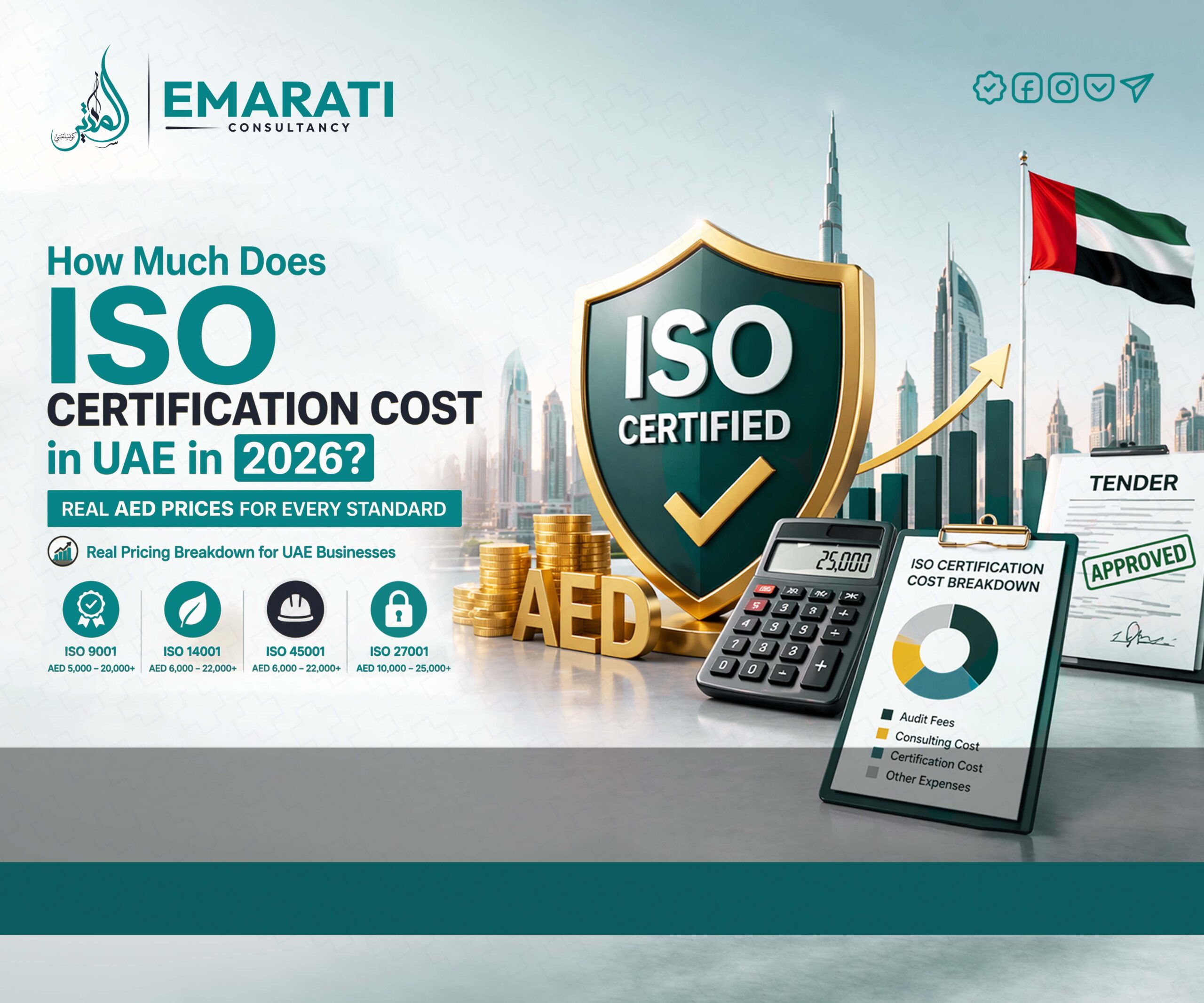
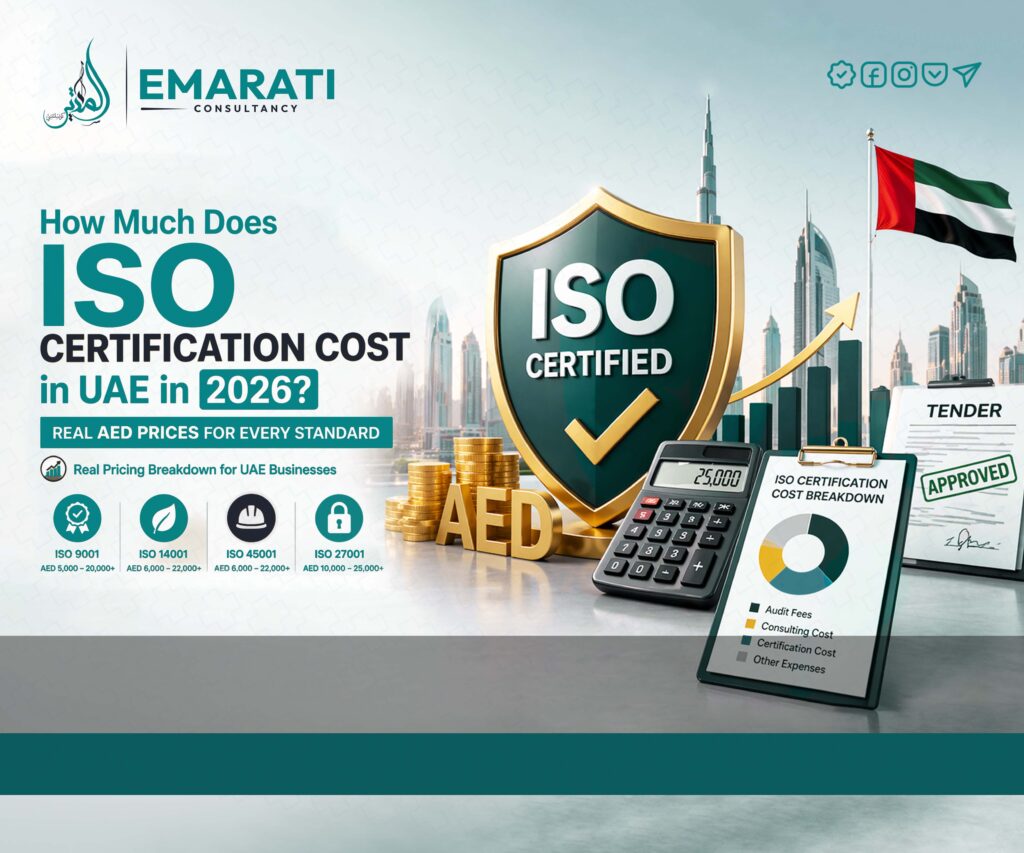
For UAE business owners who need the numbers immediately — here is the complete pricing table. All figures cover both Emarati Consultancy fees and certification body audit fees combined. These are the real numbers for 2026
| ISO Standard | Small Business | Medium Business | Large Business |
|---|---|---|---|
| ISO 9001 | AED 5,000 — 8,000 | AED 8,000 — 15,000 | AED 15,000+ |
| ISO 14001 | AED 5,000 — 8,000 | AED 8,000 — 15,000 | AED 15,000+ |
| ISO 45001 | AED 5,000 — 8,000 | AED 8,000 — 15,000 | AED 15,000+ |
| QHSE IMS | AED 10,000 — 15,000 | AED 15,000 — 25,000 | AED 25,000+ |
| ISO 27001 | AED 10,000 — 15,000 | AED 15,000 — 25,000 | AED 25,000+ |
| HACCP | AED 4,000 — 7,000 | AED 7,000 — 12,000 | AED 12,000+ |
| ISO 22000 | AED 6,000 — 10,000 | AED 10,000 — 18,000 | AED 18,000+ |
| FSSC 22000 | AED 10,000 — 16,000 | AED 16,000 — 25,000 | AED 25,000+ |
| ISO 22301 | AED 8,000 — 12,000 | AED 12,000 — 20,000 | AED 20,000+ |
| ISO 37001 | AED 7,000 — 12,000 | AED 12,000 — 18,000 | AED 18,000+ |
| ISO 42001 | AED 8,000 — 14,000 | AED 14,000 — 25,000 | AED 25,000+ |
| ISO 13485 | AED 8,000 — 14,000 | AED 14,000 — 22,000 | AED 22,000+ |
| ISO 50001 | AED 6,000 — 10,000 | AED 10,000 — 16,000 | AED 16,000+ |
| ISO 21001 | AED 5,000 — 9,000 | AED 9,000 — 15,000 | AED 15,000+ |
Small business = up to 30 employees. Medium business = 30 to 150 employees. Large business = 150+ employees or multiple sites.
Keep reading — the rest of this guide explains exactly why these figures vary, what genuinely drives your cost up or down, and how to make sure you are not overpaying or — worse — underpaying for a certificate that turns out to be worthless.
Before comparing prices between consultancies, you need to understand what you are paying for. ISO certification cost in the UAE has three components — and most UAE businesses only budget for one of them.
This is what you pay your ISO consultant. It covers gap analysis, documentation development, implementation support, staff training, internal audit, management review facilitation and audit preparation support. This is the largest component for most organisations and the most variable. A good ISO consultant costs more than a template-seller — but saves significantly more through faster certification and fewer non-conformities. Emarati Consultancy’s fees are included in the AED figures in the table above.
This is what you pay the accredited certification body to conduct Stage 1 and Stage 2 audits. Certification body fees are calculated using IAF mandatory rules based on your employee count, number of sites and scope complexity. For a small business with up to 30 employees, Stage 1 and Stage 2 audit fees typically range from AED 3,000 to AED 6,000. For medium organisations of 30 to 150 employees, expect AED 6,000 to AED 10,000. These fees are included in the combined figures in the table above.
This is the cost most UAE businesses underestimate or miss entirely. Internal costs include the time your management representative and department heads spend on the implementation project — typically 10 to 15 percent of their working time during the implementation period. For a medium-sized organisation this represents a real operational cost even though it does not appear on any invoice. Budget for it. Plan around it. Organisations that assign a dedicated internal lead consistently achieve certification faster and at lower total cost than those that leave implementation entirely to the external consultant.
Understanding why each standard costs what it costs helps you budget accurately and compare quotes intelligently.
ISO 9001 Certification is the most widely pursued ISO standard in the UAE and the most straightforward to implement for most organisations. The management system framework is well-established, the auditor pool is large and the certification body market is competitive — all of which keeps costs relatively accessible. For small UAE businesses ISO 9001 certification costs from AED 5,000 covering both consultancy and certification body fees. The primary driver of cost variation at this level is the maturity of your existing processes — businesses with informal but functional quality systems consistently achieve certification faster and at lower cost than those starting from scratch.
For medium businesses in construction, logistics and professional services ISO 9001 certification typically falls in the AED 8,000 to AED 15,000 range. For large organisations or those with multiple sites or complex scopes the cost rises from AED 15,000 upward depending on employee count and scope breadth.
ISO 14001 Certification Environmental Management System certification costs are driven significantly by the environmental complexity of your operations. A logistics company with vehicle fleet emissions and fuel consumption as its primary environmental aspects is simpler and less costly than a manufacturing business managing chemical waste, water discharge, air emissions and land contamination risk simultaneously. Cost ranges are comparable to ISO 9001 for equivalent organisation sizes — AED 5,000 to AED 8,000 for small businesses, AED 8,000 to AED 15,000 for medium organisations. UAE Federal Climate Law Federal Decree-Law No. 11 of 2024 requires environmental compliance from every UAE business by 30 May 2026 — making ISO 14001 both a commercial requirement and a legal obligation for 2026.
ISO 45001 Certification Occupational Health and Safety Management System certification cost is driven primarily by the risk profile of your operations. A professional services office environment has fewer hazards to identify and control than a construction site, oil and gas facility or manufacturing plant. For small businesses in lower-risk environments ISO 45001 costs from AED 5,000. For construction, oil and gas and industrial companies where hazard identification and risk assessment require significantly more depth, costs at the medium business level typically run AED 12,000 to AED 15,000.
This is where the most important cost insight in this entire guide appears. Most UAE construction, oil and gas, manufacturing and industrial companies need ISO 9001, ISO 14001 and ISO 45001 simultaneously for government tenders and ADNOC vendor registration. Implementing them as three separate certifications costs AED 15,000 to AED 45,000 for a medium organisation — paying consultancy fees and certification body audit fees three separate times. Implementing them as a single QHSE Integrated Management System costs AED 15,000 to AED 25,000 for the same organisation — saving 25 to 40 percent. Three certificates. One implementation. One audit. One ongoing maintenance cycle. For any UAE business that needs all three standards the QHSE IMS is always the more commercially intelligent approach.
ISO 27001 Certification Information Security Management System certification is consistently the most technically complex and therefore the most expensive standard for equivalent organisation sizes. The information security risk assessment, asset inventory and Annex A control implementation require specialist expertise and significantly more implementation depth than quality, environmental or safety standards. For small UAE technology companies or professional services firms with limited IT complexity, ISO 27001 costs from AED 10,000. For medium organisations with complex technology environments, multiple systems and significant personal data processing, expect AED 15,000 to AED 25,000. Organisations with DIFC or ADGM regulatory obligations, UAE Central Bank information security requirements or significant personal data obligations under UAE PDPL should budget for the higher end of these ranges.
HACCP Certificate is the most affordable food safety certification available to UAE food businesses — reflecting its more focused scope compared to full management system standards. For small food businesses — restaurants, cafes, small catering operations — HACCP costs from AED 4,000. Dubai Municipality’s Food Watch programme and ADAFSA food safety inspection requirements make HACCP effectively mandatory for all UAE food businesses regardless of size. At this price point there is no commercial justification for operating a UAE food business without current HACCP certification.
ISO 22000 Food Safety Management System certification costs more than HACCP because it incorporates a comprehensive management system framework alongside HACCP principles. For small UAE food manufacturers and caterers, ISO 22000 costs from AED 6,000. FSSC 22000 — the GFSI recognised food safety scheme required by major international retailers — costs more due to the additional food fraud prevention, food defense and allergen management requirements. For UAE food businesses already holding ISO 22000, transitioning to FSSC 22000 costs from AED 6,000 because the ISO 22000 foundation is already in place.
ISO 42001 is the world’s first AI management system standard and one of the fastest growing certifications globally. For UAE technology companies with limited AI use cases, ISO 42001 costs from AED 8,000. For organisations with complex AI portfolios the cost rises to AED 14,000 to AED 25,000 for medium organisations. Organisations already holding ISO 27001 achieve ISO 42001 at lower cost because the shared management system structure reduces documentation duplication significantly.
Understanding these six factors allows you to estimate where your organisation sits within the price ranges above — and to give any UAE ISO consultant the information they need to quote accurately.
Certification bodies calculate required audit days using IAF mandatory rules based on your employee count. More employees means more audit days. More audit days means higher certification body fees. This is the most consistent cost driver across all ISO standards and cannot be negotiated away — it is determined by internationally mandated audit duration rules.
Every additional operational site within the certification scope requires additional audit time and travel — increasing both certification body fees and consultancy implementation costs. UAE businesses with Mainland and Free Zone licences covering separate operational sites often face increased audit durations to address the distinct regulatory frameworks at each location.
A construction company managing hazardous materials across multiple active sites is more complex to certify than a trading company in a single office. Environmental aspects, safety hazards and quality processes all become more numerous and more technically demanding as operational complexity increases — driving up both the implementation depth required and the certification body audit time needed to assess it.
Organisations that already have documented processes, defined responsibilities and some management system infrastructure in place consistently achieve certification faster and at lower cost. A UAE construction contractor that has been operating informally to quality standards for years has a much smaller gap to close than a startup with no documented processes at all. A thorough gap analysis at the beginning of your certification journey tells you exactly where you stand.
Businesses approaching ISO certification with urgent tender deadlines or imminent ADNOC registration requirements consistently pay more — both in consultancy fees for compressed implementation timelines and in certification body fees for expedited audit scheduling. Starting your ISO certification process three to six months before you need the certificate gives you the most competitive pricing and the most manageable implementation pace. Urgency always costs money.
Certification body fees vary between accredited bodies for equivalent audit scopes. Bodies with highly recognised international accreditations — UKAS, DAkkS, EIAC, DAC, ENAS — typically charge more than lesser-known bodies. However choosing a cheaper certification body that is not recognised by your target procurement systems defeats the entire purpose of certification. Always verify that your chosen certification body is specifically recognised by Dubai Municipality, ADNOC, UAE government procurement systems or whichever procurement authority your certification needs to satisfy. Emarati Consultancy advises every client on the right certification body for their specific commercial objectives.
This section could save you more money than the entire rest of this guide.
The biggest cost mistake UAE businesses make is pursuing ISO 9001, ISO 14001 and ISO 45001 as three separate certifications when they need all three simultaneously. This mistake is so common — and so consistently expensive — that it deserves its own dedicated section.
Here is what three separate certifications looks like financially for a medium UAE construction company. ISO 9001 alone: AED 10,000. ISO 14001 alone: AED 10,000. ISO 45001 alone: AED 10,000. Total: AED 30,000 across three separate implementations, three separate gap analyses, three separate documentation sets, three separate training programmes, three separate internal audits and three separate certification body audits.
Here is what QHSE IMS — the integrated approach — looks like for the same company. One integrated implementation. One documentation framework. One training programme. One internal audit. One combined certification body audit. Three certificates issued. Total: AED 15,000 to AED 20,000. Saving: AED 10,000 to AED 15,000 on the initial certification alone — plus ongoing annual surveillance audit savings throughout the three-year certification cycle.
For any UAE business that needs ISO 9001, ISO 14001 and ISO 45001 simultaneously — which includes virtually every construction company, oil and gas contractor, manufacturing business and industrial operator in the UAE — the QHSE IMS is not just the smarter approach. It is the only financially justifiable approach. EIAC accreditation verification
No honest guide to ISO certification cost in UAE can avoid addressing this topic. Fake ISO certificates — issued by unaccredited or fraudulent certification bodies — are a documented problem in the UAE market.
The price of a fake ISO certificate can be as low as AED 1,000 to AED 2,000. The cost of a fake ISO certificate is far higher. A fake ISO certificate will not pass Dubai Municipality verification during a Food Watch inspection. It will not satisfy ADNOC vendor registration requirements. It will not pass UAE government procurement portal verification. It will not be accepted by international supply chain partners who verify supplier certification status through IAF CertSearch. It will disqualify your tender submission and potentially result in blacklisting from future government procurement processes.
Legitimate Stage 2 certification audits for a 50-person organisation take a minimum of three to four days under IAF mandatory audit duration rules. Any certification being offered for AED 1,000 to AED 2,000 with a one-day or zero-day audit is not a genuine accredited ISO certification — it is a worthless document that could cause more commercial damage than having no certification at all.
How to verify a certification body before engaging them. Check that they hold current accreditation from EIAC, DAkkS, UKAS, DAC, ENAS or another recognised IAF member accreditation body. Verify their accreditation status on the EIAC website or through the IAF accreditation body member list. Ask them specifically which UAE government procurement systems and which procurement authorities accept their accreditation. Emarati Consultancy works exclusively with internationally accredited certification bodies — every certificate we help clients achieve is genuine, verifiable and accepted across all UAE procurement systems.
This is one of the most common questions UAE business owners ask — and the honest answer is nuanced.
Consultancy fees are generally consistent across UAE emirates for equivalent organisation sizes and scope complexity. Whether your business is in Dubai, Abu Dhabi, Sharjah or Ras Al Khaimah, you should expect similar consultancy fees from a reputable UAE-based ISO consultant.
Certification body audit fees may vary slightly depending on travel logistics for on-site audit days — businesses in remote locations or those requiring multiple site visits across different emirates may see marginally higher certification body fees due to auditor travel costs.
The more significant emirate-specific cost factor is scope complexity driven by regulatory requirements. Abu Dhabi businesses pursuing ADNOC vendor registration need ISO certifications that satisfy ADNOC’s specific documentation and scope requirements — which can increase implementation depth and therefore consultancy cost compared to a similarly-sized business without ADNOC requirements. Dubai businesses facing DIFC regulatory obligations for ISO 27001 implementation may similarly see higher consultancy costs due to the additional regulatory mapping work required.
UAE free zone businesses frequently ask whether their free zone status affects ISO certification cost. The answer is that dual licensing — maintaining both mainland and free zone licences covering separate operational sites — can increase certification body audit costs. Organisations with both a mainland DED licence and a JAFZA or DMCC free zone licence often face additional audit days to cover the distinct regulatory frameworks at each location — typically adding two to three extra certification body audit days to the scope.
For businesses operating from a single free zone location without mainland operations the cost impact is minimal. Certification body fees are based primarily on employee count and operational scope — not on whether the business holds a free zone or mainland licence.
Every ISO certification quote from a reputable UAE consultancy should be based on a free initial consultation that covers the following information. Without this information any quote you receive is a guess — not an accurate proposal.
Your employee count and how many people are within the certification scope. Your number of operational sites and locations. Your industry and the specific nature of your operations. Your current management system maturity — what documentation and processes are already in place. The ISO standard or standards you need — and whether they are required separately or as an integrated system. Your timeline — when you need the certificate and whether there are specific tender or registration deadlines driving your schedule. Your target certification body preferences — particularly if you have specific procurement systems or clients whose accreditation requirements you need to satisfy.
Emarati Consultancy provides a free initial consultation and a detailed fixed-scope proposal covering all of these factors — with no hidden costs and no pressure to commit before you have complete clarity on what the process involves.
Every UAE business owner considering ISO certification eventually asks this question. The honest answer — based on the UAE commercial environment in 2026 — is that for most businesses ISO certification is not a cost at all. It is an investment with a measurable commercial return.
Consider the commercial reality. ISO 9001 certification is a mandatory qualification requirement for UAE government tenders. ADNOC vendor registration requires ISO 9001, ISO 14001 and ISO 45001. Dubai Municipality requires HACCP from every food business. A Dubai-based logistics company delayed ISO 9001 certification for eighteen months to avoid the investment. During that period they were disqualified from seven government-linked tenders where certification was a mandatory qualification criterion. The revenue lost from those seven missed tenders significantly exceeded the total cost of certification.
The question for most UAE businesses is not whether ISO certification is worth the cost. It is whether you can afford to keep operating without it while your certified competitors win the contracts you should be winning.
ISO 9001 certification for small UAE businesses costs from AED 5,000 covering both consultancy and certification body audit fees. Medium businesses typically pay AED 8,000 to AED 15,000. Large organisations from AED 15,000 upward depending on employee count, number of sites and scope complexity. Contact Emarati Consultancy for a transparent fixed-scope quote based on your specific situation.
HACCP certification for small food businesses in Dubai — restaurants, cafes, small catering operations — costs from AED 4,000 covering both consultancy and certification body fees. Medium food operations such as catering companies and small food manufacturers typically pay AED 7,000 to AED 12,000. Large or multi-site food operations from AED 12,000 upward.
ISO 27001 Information Security Management System certification costs from AED 10,000 for small UAE technology companies and professional services firms with limited IT complexity. Medium organisations with complex technology environments pay AED 15,000 to AED 25,000. Large organisations or those with DIFC, ADGM or UAE Central Bank regulatory obligations budget from AED 25,000 upward.
Yes — significantly. QHSE IMS implementing all three standards together consistently costs 25 to 40 percent less than three separate certifications for equivalent organisation sizes. For a medium UAE construction or industrial company, the saving is typically AED 8,000 to AED 15,000 on initial certification alone — plus ongoing annual surveillance audit savings throughout the three-year certification cycle.
Certificates available at AED 1,000 to AED 2,000 are issued by unaccredited or fraudulent certification bodies that conduct no genuine audit. They are worthless documents — not accepted by Dubai Municipality, ADNOC, UAE government procurement systems or international supply chain partners. Using them in tender submissions can result in disqualification and blacklisting. Always verify that your certification body holds current accreditation from EIAC, DAkkS, UKAS, DAC or ENAS before engaging.
Consultancy fees are generally consistent across UAE emirates for equivalent organisation sizes and scope complexity. Certification body fees may vary marginally based on travel logistics for multi-site organisations. Abu Dhabi businesses with ADNOC vendor registration objectives and Dubai businesses with DIFC regulatory requirements may see higher consultancy costs due to the additional regulatory mapping and documentation depth required for those specific procurement environments.
ISO certification renewal — the recertification audit at the end of your three-year cycle — typically costs 60 to 80 percent of the initial certification cost because your management system is already established and requires assessment rather than implementation. ISO 9001 renewal for small businesses typically costs AED 3,500 to AED 6,000. Annual surveillance audits cost less than the full recertification audit — typically AED 2,500 to AED 5,000 for small businesses depending on the standard.
To a degree — yes. Urgency in the UAE ISO certification market consistently increases cost. Compressed implementation timelines require more intensive consultancy support across fewer weeks — increasing consultancy fees per week. Expedited certification body audit scheduling may carry premium charges from some certification bodies. For businesses with urgent ADNOC registration deadlines or imminent UAE government tender submissions, Emarati Consultancy can assess what is achievable within your timeline and what the associated cost implications are.
Emarati Consultancy provides a free initial consultation and a detailed fixed-scope proposal for every UAE business considering ISO certification — covering the exact standards you need, realistic timelines, total cost including both consultancy and certification body fees and the commercial outcomes you can expect.
No vague estimates. No pressure to commit before you have complete clarity. No hidden costs at any stage of the process.
Whether you are a construction company in Dubai pursuing QHSE IMS for government tenders, an oil and gas contractor in Abu Dhabi preparing for ADNOC vendor registration, a food business in Sharjah needing HACCP or ISO 22000, or a technology company anywhere across the UAE pursuing ISO 27001 or ISO 42001 — Emarati Consultancy has the expertise, UAE regulatory knowledge and transparent pricing approach to guide you through certification efficiently and successfully.
Phone: +971 52 856 0299 Email: info@emaraticonsultancy.ae Office: City Bay Business Centre, Office 303, Near Abu Bakr Metro Station, Dubai, UAE
Looking for reliable ISO renewal services in the UAE? Our specialists in Dubai, Abu Dhabi, and Sharjah help you align your OHSMS with updated ISO 45001 requirements, ensuring continuous compliance and smooth recertification.
The great explorer of the truth, the master-builder of human happiness no one rejects dislikes avoids pleasure itself because it is pleasure but because know who do not those how to pursue pleasures rationally encounter consequences that are extremely painful desires to obtain.
Read More